







Don Don Donki removes helium voice-changer canisters in Singapore after safety concerns
The Japanese retail chain withdrew the novelty product after CNA raised questions about medical risks and regulatory compliance.
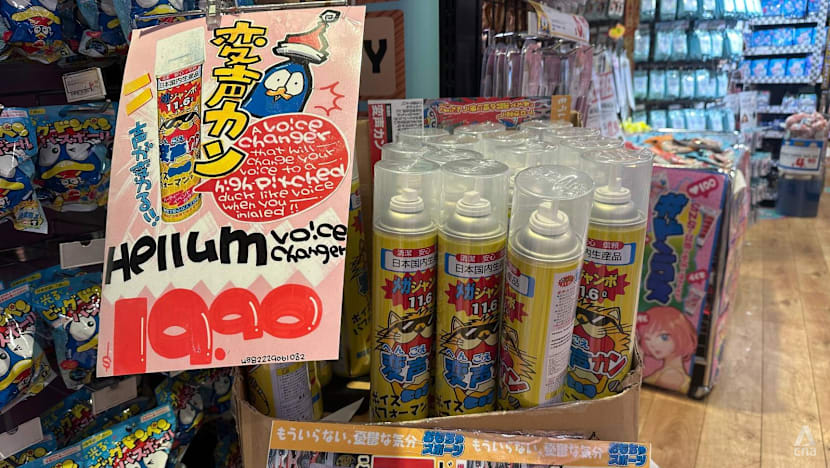
The helium canisters marketed as "voice changers" on display at the Don Don Donki outlet in Orchard Central on Dec 5, 2025. (Photo: CNA/Fabian Koh)

This audio is generated by an AI tool.


SINGAPORE: Japanese retail chain Don Don Donki has removed helium canisters marketed as “voice changers” from its Singapore stores after CNA raised questions about the product's health risks and safety certification.
The bright yellow canisters, which sold for S$19.90 (US$15.40) each, claimed to make users' voices higher-pitched when inhaled.
Each contained 11.6 litres of gas – 80 per cent helium and 20 per cent oxygen – and came with Japanese instructions directing users to take a deep breath and exhale, before pinching their noses and inhaling from the canister.
Medical experts interviewed by CNA expressed serious concerns about the product's safety, and highlighted the risks of recreational helium inhalation, even when mixed with oxygen.





CNA first contacted Don Don Donki and the Competition and Consumer Commission of Singapore (CCS) on Dec 10 regarding the safety of the product.
The consumer watchdog responded on Thursday (Dec 18), noting that such products fall under the purview of the Consumer Product Safety Office (CPSO).
“CPSO is in touch with Don Don Donki Singapore operations,” said CCS. “They have temporarily removed the product from its shelves while they review the product’s compliance with applicable safety standards.”
Don Don Donki has not responded to CNA's queries.
CCS clarified that while pre-market approval is not required for general consumer goods in Singapore, suppliers must ensure products meet at least one applicable safety standard from organisations including the International Organisation for Standardization, International Electro-Technical Commission, European Committee for Standardisation or ASTM International.
“Suppliers must ensure their products carry sufficient warnings about potential hazards as required in applicable safety standards,” added CCS. “Consumers are strongly advised to read and strictly follow the manufacturer's instructions and safety warnings on the packaging.”
It also urged consumers to use products only as intended by manufacturers. If they encounter a product they suspect is unsafe or lacks clear warnings, they can report it to the CPSO.
MULTIPLE HAZARDS
The made-in-Japan canisters included English-language warnings recommending use only for those over 16 and to keep the product out of children's reach.
The labels cautioned against use near flames, during illness or pregnancy, or after heavy physical activity. They also warned users not to inhale the gas rapidly, and that misuse could lead to serious injury, asphyxiation or death.
Despite these warnings, the product's advertising positioned it as entertainment, suggesting customers use it when apologising "for guaranteed laughter" and promoting its popularity among repeat buyers.
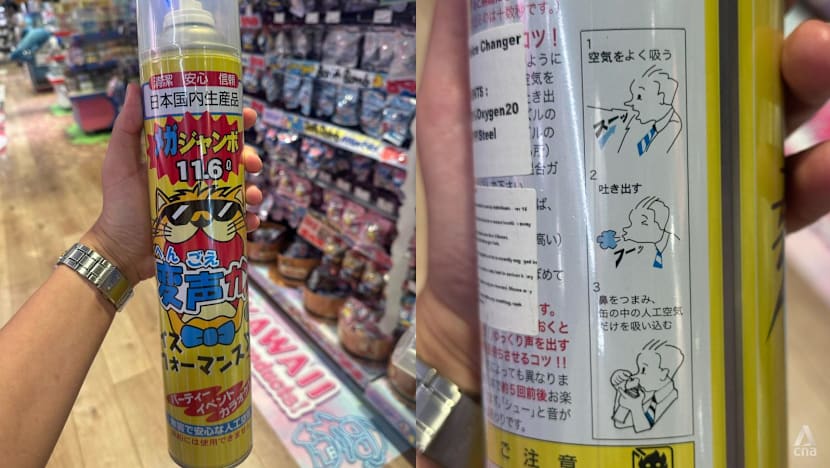
Healthcare professionals identified multiple hazards associated with the helium canisters.
Dr Adrian Chan, a respiratory expert from the O2 Lung Centre, said that while helium-oxygen mixtures – known as heliox – have legitimate therapeutic applications, they are typically used under strict medical supervision for specific conditions.
“The risks in inhaling helium are also present for helium-oxygen mixtures,” he warned. “If inhaled repeatedly or in large amounts, it might lead to oxygen deprivation in the lungs and then vital organs.”
Airway or lung injuries are also possible from the pressurised jet created during inhalation, he said.
Veteran nurse and healthcare content strategist Penny Pratt noted that while the oxygen content reduces immediate asphyxiation risk compared to pure helium, there remains no safe threshold for recreational use.
Even a brief inhalation can deprive the brain of oxygen and cause serious harm, she said.
She warned that the compressed gas, when released, becomes extremely cold and can cause frostbite or cryogenic burns on contact with skin. Eyes are particularly vulnerable and may suffer permanent damage.
Dr Phoon Chee Wee, a senior lecturer in applied chemistry at Nanyang Polytechnic, highlighted an additional danger: helium's odourless, tasteless nature means users cannot detect how much they have inhaled.
“Excessive inhalation of helium can potentially cause difficulty in breathing, dizziness, nausea or asphyxiation which could lead to loss of consciousness and even death,” he said.
Dr Chan said that while social media and celebrity videos have normalised helium voice-changing as harmless fun, ordinary users may unknowingly consume dangerous amounts.
"The worry is that ordinary users might unknowingly consume large amounts and potentially endanger their health," he said. "There is unfortunately no safe limit as helium is not a gas that our bodies can utilise."




