







Driverless vehicles may become mainstay of public transport here
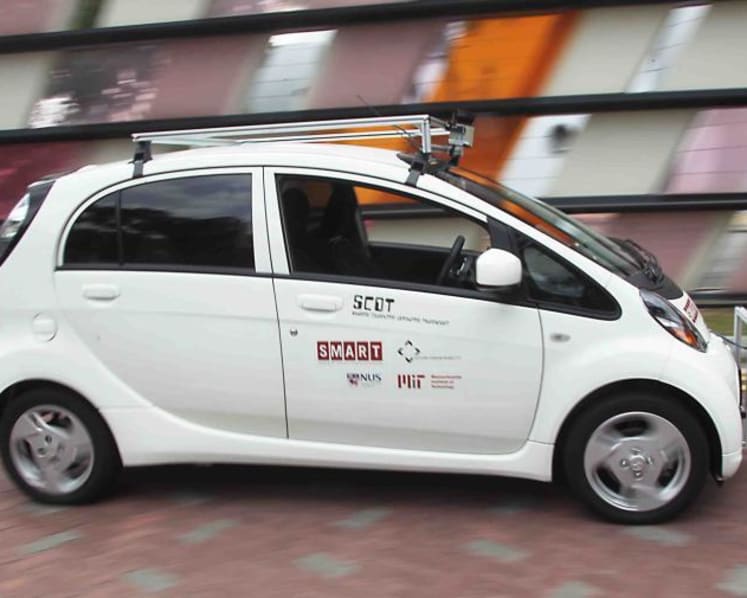
A locally developed driverless car designed for use on public roads by the Singapore-MIT Alliance for Research and Technology (SMART), Jan 28, 2014. TODAY file photo
SINGAPORE — In three years, operational trials for driverless buses and shared autonomous vehicles (AVs) may take off and if all goes well, commuters may be hopping onto these vehicles in a pilot scheme slated to start as early as 2020.
Driverless technology may then become the mainstay of Singapore’s public transport network, should the Land Transport Authority’s (LTA) vision come to fruition.
Today (June 5), it called a Request for Information (RFI) to gather proposals on how AV technology could be explored in mass public transport.
Imagine autonomous buses picking up passengers along fixed routes at pre-set schedules, or demand-responsive bus services that operate from bus interchanges and depots.





“Buses can be parked in an optimised and compact manner within bus interchanges and depot compounds, and could be mobilised to arrive at passenger pick-up points,” stated the LTA’s RFI document, published on the Government’s e-procurement site GeBIZ.
The LTA will also study the feasibility of an on-demand service, provided by shared vehicles whizzing “seamlessly” within or between towns, under a “light traffic environment”. Commuters may even book these using a smartphone app.
“AVs have the potential to optimise road capacity by moving in a compact, systematic manner. They can also provide greater connectivity for first- and last-mile travel, and facilitate the efficient sharing of vehicles,” said LTA chief executive Chew Men Leong.
Interested parties have to submit supporting documents or evidence to prove they have tested and determined that an AV can run safely in conditions similar to Singapore’s public roads, among other things.
Submissions close on Aug 28 and the outcome will be released at the end of the year, after which the authorities may issue a Request for Proposal.
Transport analysts noted that implementing AV technologies within the public transport network has its advantages, namely, fewer accidents and less manpower.
Having driverless buses may also result in cost savings, especially as drivers’ wages increase in the future, said Dr Paul Barter, who teaches transport policy at the Lee Kuan Yew School of Public Policy.
The timeline set for the LTA’s pilot scheme is feasible, given that overseas AV trials on roads — such as Google’s self-driving fleet — have been successful, said the analysts.
However, they questioned whether full-scale deployment could be realised in the near future. “There are some optimists saying 2020, but many people are saying there are a lot of obstacles to overcome.
There’s a debate on how soon it’ll be, ranging from five years (onwards),” said Dr Barter.
Nanyang Technological University economist Walter Theseira said legal liability and ethical dilemmas are some major considerations the authorities would have to tackle first.
“For example, if a driverless car comes across a situation where it would have to choose between different alternatives — both of which would hurt some people — what would the option be?” he pointed out.
The Singapore-MIT Alliance for Research and Technology, which is conducting AV demonstrations in one-north, will be looking at developing algorithms to incorporate road rules and scenarios requiring decision-making.
Separately, the LTA has received proposals from the alliance and Institute for Infocomm Research to conduct Proof-of-Concept trials. When contacted by TODAY, both institutions expressed interest in responding to the latest RFI.
National University of Singapore transport analyst Lee Der-Horng, however, questioned the need for AV technology. “What are we trying to get the driverless cars to do? Are we trying ... to solve day-to-day traffic problems or ... have something we’ve never had?”
He added that existing driverless technologies such as those in the MRT and LRT networks would suffice.




