







Early closures for North-East Line from January to March 2019 to step up maintenance
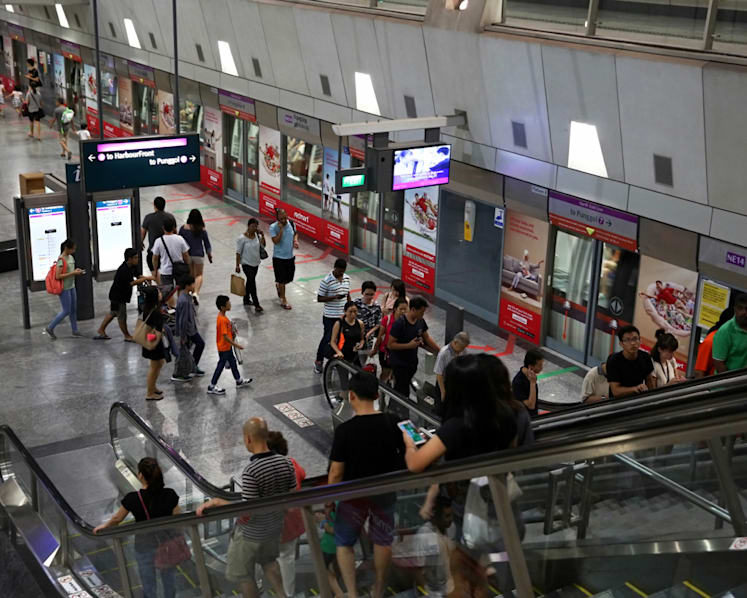


SINGAPORE — Early closures will be extended beyond Singapore’s two oldest rail lines to the 15-year-old North-East Line (NEL) on selected Fridays and Saturdays in the first three months of next year, to escalate maintenance works.
Transport Minister Khaw Boon Wan announced this on Monday (Dec 17), saying that Singapore should glean from the past mistakes of rail operator SMRT, which “under-invested” and “did the minimum” in the upgrading and maintenance of the North South Line and East West Line.
Speaking at a signing ceremony for a S$117 million contract to upgrade 25 of the NEL’s oldest trains, which had reached “midlife”, he said: “The cumulative effects of their decisions in those years were only corrected in recent years, at great inconvenience to commuters.
“We have learnt this hard lesson. We are determined not to have it repeated.”





Noting that the NEL’s three to four hours nightly maintenance window now “will no longer be sufficient” as the line ages, Mr Khaw said that the extended engineering hours of about 12 hours per month are “much needed” to renew parts of the line's power and signalling systems and to replace rail crossings and tracks.
As such, stations between Kovan and Punggol will be closed by about 11pm on Jan 4, 5, 11 and 12, Feb 22 and 23, and March 1 and 2, while stations between Harbourfront and Dhoby Ghaut will be closed earlier on subsequent Fridays and Saturdays between March 8 and 30.
To facilitate early closures between Jan 4 and March 2, the last train will be departing from Harbourfront for Punggol more than an hour earlier at 10.39pm.
On the same dates, the last train will leave Punggol for Harbourfront about 30 minutes earlier than the timing now, at 11.01pm.
Commuters riding only between Harbourfront and Serangoon will be largely unaffected, as the last train from Harbourfront to Serangoon will depart at 11.56pm, and the last train from Serangoon towards Harbourfront will leave at 12.09am — similar to timings now. However, train services between these stations will operate with longer intervals of about nine minutes during the early closures.
Early closure timings for the March 8 to 30 period will be announced at a later date.
The 16-station NEL is Singapore’s third rail line, but it was the first in the network to use fully automated and driverless trains when introduced in 2003. Some 600,000 commuters take the line daily.
The S$117 million contract that was inked on Monday was awarded to Chinese railway rolling stock manufacturer CRRC Nanjing Puzhen.
Besides replacing the ageing fleet’s electrical components and mechanical systems, and giving the trains’ interior a facelift, it will also install condition monitoring systems on them to help in the early detection of equipment deterioration.
Each of the 25 trains will be upgraded one at a time to minimise disruptions, so works are expected to stretch till September 2024, although they are slated to begin by March next year.
A ‘RELATIVELY SUCCESSFUL’ YEAR IN TRANSPORT
On Monday, Mr Khaw also gave a round-up of the achievements by the Ministry of Transport (MOT) this year. Compared to the first two years when he had taken on the portfolio, 2018 was a “relatively successful one”, which saw a marked improvement in rail reliability, he said.
Service on Singapore’s oldest line, the North South Line (NSL), for instance, improved almost 10 times if the metric of mean kilometres between failures (MKBF) was to be considered.
In the past 11 months, it had recorded 824,000 train-km, compared to 2017’s 89,000 train-km, he said, adding that the line had crossed its 200th disruption-free day earlier this month.
“I think we have turned the corner on rail reliability,” Mr Khaw said, pointing out that the older rail networks should be able to achieve his original MKBF target of one million train-km by 2020.
It was on this note that Mr Khaw told reporters he had asked the two fourth-generation leaders under him at MOT — Senior Ministers of State Lam Pin Min and Janil Puthucheary — to take charge of next year’s Budget debate as part of an ongoing leadership transition.
“I will play a supportive role and this stretching of the two (Senior Ministers of State) will be good for them, for their political career development,” he said, noting that Dr Puthucheary is already taking “full charge” of the public consultation for a 2040 land transport master plan.
“The young ministers need to be able to reach out to their own young generation of Singaporeans, work together and share each other’s aspirations for Singapore for the future.”
Asked how new SMRT chief executive officer Neo Kian Hong had performed in his first few months in office, Mr Khaw said that he is part of the reason the NSL turned around.
“You will see from this example that leadership matters. If you have a good leader, you can turn things around,” he said.




