







Economy to expand at modest pace for rest of 2015, 2016, says MAS
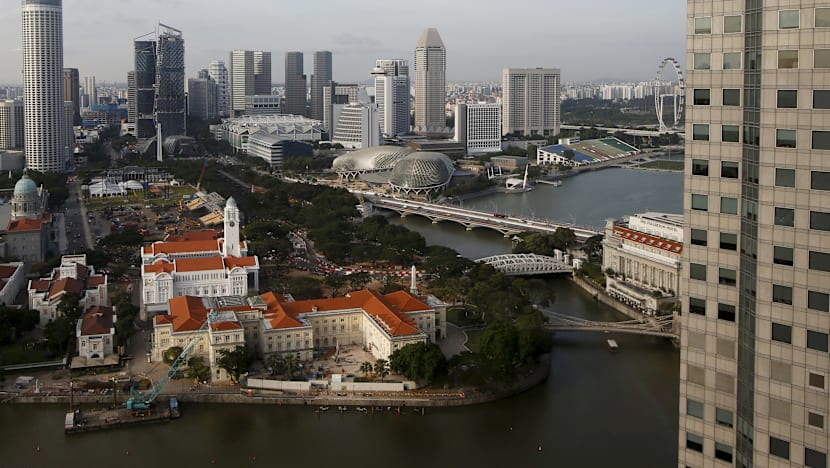
Marina Bay and the Singapore River are seen along with the Fullerton Hotel (bottom right). Photo: Reuters

SINGAPORE — Singapore’s economy is projected to “expand at a modest pace” for the rest of 2015 and 2016 as it navigates through a challenging external environment, and it is imperative that growth — as the Republic enters the next phase of economic restructuring — be driven by productivity gains that are underpinned by knowledge and skill upgrades, the Monetary Authority of Singapore (MAS) said today (Oct 27).
The new economic frontier, as the central bank outlined in its twice-yearly Macroeconomic Review, will see technology and innovation-intensive activities play an increasingly important role. This assessment by the MAS came as Asia looks set to house the production base for high-tech products.
“This trend will likely increase, with some Asian exporters gradually specialising in areas such as niche pharmaceutical drugs, industrial robots and satellite equipment … The shifts by regional producers into higher-value-added goods should pave the way for further deepening in intra-Asian trade flows, as greater opportunities for specialisation enlarge the scope for gains in trade,” the central bank said.
Singapore stands to benefit from the increased trade in high-tech goods and services. Exporters here have started scaling the value chain by exporting more complex items, gaining global share in niche products such as military-related equipment, biomedical products and specialty chemicals.





As these shifts in economic activity continue, the workforce will have to possess a mix of technical, innovative and soft skills required to do these jobs.
Economists TODAY spoke to agreed that gaining greater traction in higher-value added economic activities is the way to go to shore up growth over the long term. MAS said this year’s growth is expected to come in at 2-2.5 per cent, with risks tilted to the downside. Next year will also likely see similar growth outcome.
Standard Chartered economist Jeff Ng said: “Singapore can’t really compete on the low-value add manufacturing anymore because it doesn’t have cost advantages, so turning our attention to technology and innovation as the world becomes more focused on higher technology is positive for us.”
“(Improving) productivity has been challenging. I think a part of it has got to do with the weak global outlook which played a part in limiting upside in productivity gains for now,” he added.
The central bank said in the report that overall outlook for the global economy has softened since the last Macroeconomic Review six months ago. That deterioration in the external environment has led to the sluggish performance of the Singapore economy.
Recovery in the US is underway but growth has largely been driven by consumption which is mainly met by domestic supply. This means that Singapore may not see much positive spillover effects. At the same time, regional headwinds led by China’s slowdown have also intensified and will likely persist.
However, the growing importance of Cambodia, Laos, Myanmar and Vietnam (CLMV) should benefit exporters and wholesalers here, MAS said. The four economies have been the “main source of support” for Singapore’s flagging exports this year. Vietnam is a particularly bright spot having bucked the trend to increase its export market share to the G3 economies between 2006 and 2013.
“Vietnam’s growing role as an electronics assembly hub does not pose a direct competitive threat to Singapore’s IT manufacturers at present… While Singapore’s electronics export basket largely comprises semiconductors, Vietnam’s comparative advantage lies in the manufacturing and assembly of mobile communication devices and office equipment,” the central bank said.
Economists said Singapore is set to benefit further from the rise of the CLMV bloc as the ASEAN Economic Community initiative will eliminate tariff barriers among member states. They also singled out Vietnam, being a member of the Trans-Pacific Partnership agreement, as having the most potential among the four.
“When tariffs are being eradicated almost or all of it, we will have advantage of trading with these countries and we will surely see volume increase – more corporates may be looking at locating their plants there. Among the four, I will give more weight to Vietnam as it’s the only country that’s part of the TPP,” said UOB economist Francis Tan.
“However, it’s going to be quite hard to replace our larger trading partners like the US, Europe and China,” Mr Tan said, adding that better demand from these markets are needed to lift Singapore’s exports out of the doldrums.
Economists also said that other pockets of opportunities within the oil-related industries as well as steady growth in domestic-oriented sectors will also provide some support to Singapore.




