







Eradicating the source key to fighting dengue, Zika in long run: Masagos
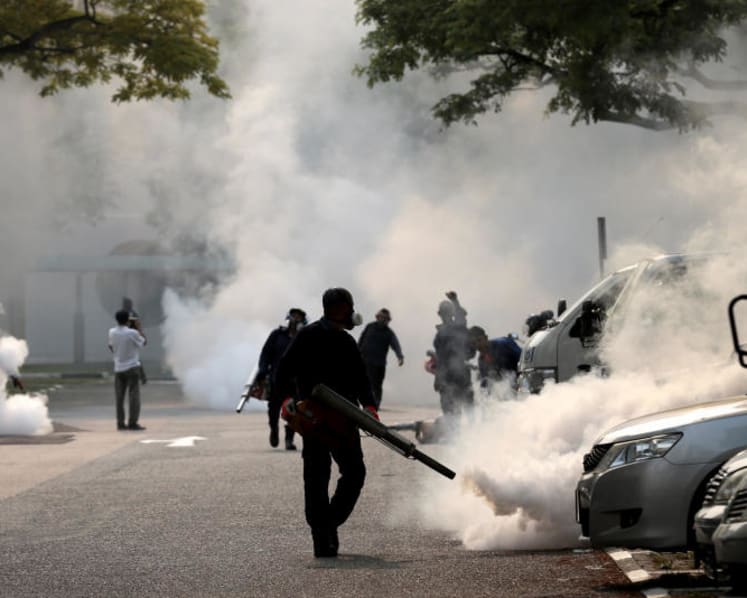
Workers fogging around Aljunied Crescent on Aug 28, 2016. The overuse use of chemical treatment can cause resistance to build up in the local mosquito population. TODAY file photo


SINGAPORE — Routine, indiscriminate fogging is not a sustainable measure in the battle against the Zika virus, Environment and Water Resources Minister Masagos Zulkifli said on Tuesday (Sept 13), in response to calls for more fogging to be done at various housing estates.
Fogging is effective only if the chemical has direct contact with the Aedes aegypti mosquito, which spreads the infection, and this has to be repeated frequently using the right chemical and a sufficient number of fogging guns, he said, stressing that the overuse of chemical treatment can cause resistance to build up in the local mosquito population.
Instead, the “key strategy” must be in eliminating the sources, such as detecting and removing breeding habitats and larvae, to suppress the mosquito population in the long run.
In his ministerial statement in Parliament on his ministry’s vector control operations to tackle the spread of Zika, Mr Masagos said: “Fogging should be used (only) when there are Zika or dengue clusters, or when the adult population is observed to be high so that we can mitigate the situation which, again, I qualify, is effective only together with source eradication.”
The National Environment Agency’s current fogging protocol in the Zika clusters — spraying insecticide indoors and fogging or misting outdoors — is directed towards areas with infected adult mosquitoes, which must be destroyed before they bite and infect more people.





Mr Masagos said: “Everyone likes fogging because … everyone can see (it), and everyone feels better. But it does not solve the problem. It must be done together with source eradication, whether in construction sites or in our homes.”
For various reasons, Singapore remains vulnerable to dengue and other mosquito-borne diseases even with the authorities’ and community’s efforts.
First, the number of dengue cases has been increasing globally. Second, Singapore is in a dengue-endemic region with four different strains circulating. The region’s constantly warm climate and high humidity also facilitate mosquito breeding throughout the year.
The success in mosquito control over the past decades has “paradoxically lowered our herd immunity” as well, Mr Masagos said, referring to how a large proportion of people here lacks immunity to these diseases.
He added that the Aedes mosquito has adapted “particularly well” to the urban environment because it “loves human beings … and likes to breed, mate and feed near human dwellings”.
Other efforts to better control the mosquito population include the use of more Gravitraps to trap large populations of female Aedes mosquitoes. From October, male Aedes mosquitoes carrying the Wolbachia bacterium will also be released in three housing estates over six months to mate with female ones in the wild, as part of a field study. Should a male carrier of the Wolbachia bacterium mate with an uninfected female mosquito, the resulting eggs will not hatch.
Member of Parliament Foo Mee Har suggested having more stringent control measures at construction sites, such as getting all building contractors to engage pest controllers.
However, Mr Masagos said the Control of Vectors and Pesticides Act has sufficient punitive measures: “We should not go overboard by implementing more measures and adding more cost when we can do things well currently.”




