







Experts flag potential harm of indiscriminate cancer screening
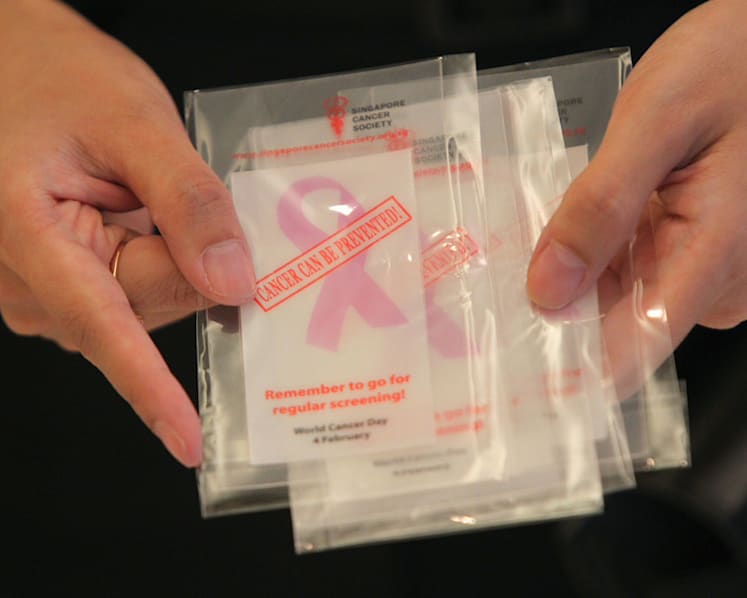
Bookmarks with a reminder message to attend regular checkups distributed at the Colorectal Cancer Awarness Month Press Conference at SIngapore General Hospital. TODAY file photo


SINGAPORE — As health screening packages offering to detect tumour markers become increasingly common, experts have warned of the potential harm caused by indiscriminate cancer screening, with a public-sector oncologist calling for service providers to rethink cancer screening that is not evidence-based.
Screening is undesirable if it merely finds a cancer earlier or finds more cancers, without helping to prolong survival and reduce long-term relapse, wrote Dr Raymond Ng of the National Cancer Centre Singapore in an article titled “Too Much Medicine: Time to Stop Indiscriminate Cancer Screening” last month.
The health authorities currently recommend routine screening for breast, cervical and colorectal cancers in those with average risk who belong in certain age groups; the guidelines do not include serum tumour markers.
In his article, which was published by the Academy of Medicine, Singapore (AMS), Dr Ng expressed concern over service providers indiscriminately offering health screening packages that include tests for serum tumour markers. These packages often bear attractive names like “premium” and “deluxe”. Packages that include serum tumour markers can cost over S$1,000, two to three times more than “basic” packages, according to an online check of several screening providers by TODAY.





“Many of these health screening endeavours are not truly individualised according to personal risk factors despite their claims as such. In fact, the only personalised aspect of the screening appears to be based primarily on consumer request and how much he or she is willing to spend,” wrote Dr Ng.
“Just as troubling, is that these practices appeared to have also filtered across to many primary health practitioners as well as government hospitals in Singapore. Furthermore, third-party health screening industries now also frequently contact business and educational institutions to sell health screening packages to their staff personnel.”
Overdiagnosis occurs when a cancer that either never progresses or regresses is diagnosed, or if a cancer is diagnosed that progresses so slowly that a patient dies of other causes before he shows symptoms of the cancer.
Highlighting the potentially detrimental effects of screening for a serum tumour marker called cancer antigen 125 (CA125) – associated with ovarian cancer – Dr Ng noted that an overseas study of close to 80,000 women aged 55 to 74 found no difference in the number of ovarian cancers detected, or the stages at which the cancer was detected, between the group that underwent CA125 and ultrasound screening and the group that did not.
In the group that screened, 10 per cent were also told that they had cancer when they did not. “Yet every day in Singapore right now, serum CA125 blood tests are being offered and performed in women as part of cancer screening despite clear evidence confirming these very detrimental harms,” he wrote.
In another example, Dr Ng noted that thyroid cancer rates in South Korea have drastically spiked with ultrasonography screening, but mortality from thyroid cancer has remained virtually unchanged. This suggests that the excess cases are overdiagnosed and clinically irrelevant cancers.
Cancer experts told TODAY that non-evidence based screening can lead to anxiety and unnecessary investigation. “There are tests like the Pap smear and faecal occult blood testing which can be applied on a large scale, population-wide, because they have the evidence behind them, but otherwise, screening needs to be applied with much more care, in order to balance the potential benefits with the possible harms for each individual,” said Associate Professor Adeline Seow of the Saw Swee Hock School of Public Health, National University of Singapore.
“When people undergo cancer screening tests that are non-evidence based and not in line with recommendations or national guidelines, this could result in non-effectiveness, false assurances and more testing that does not lead to higher rates of cancer detection,” said Dr Lim Siew Eng of the National University Cancer Institute, Singapore. “But there are also groups of cancer patients who present late or in advanced stages that could have benefited from earlier detection and cancer screening. This is the paradox of cancer screening.”
Data in Singapore shows that up to half of colon cancer cases and one-third of breast and cervical cancer cases still present late, at Stage 3 or 4. Dr Lim encouraged everyone to participate in national cancer screening programmes.
Aside from guidelines for breast, cervical and colorectal cancers, the MOH also recommends screening for additional cancers based on elevated risks such as family history.
Asked if the MOH is looking to regulate cancer screening, a ministry spokesperson said doctors have the professional obligation not to offer screening that is not evidence-based. Non-evidence based screening incurs unnecessary cost and is ineffective in detecting diseases, he said.
The public may visit the Health Promotion Board’s website, www.screenforlife.sg, for “person-centric recommendations” of available screening packages, as well as healthcare financial assistance schemes available, the spokesperson said.
The Singapore Cancer Society follows national screening guidelines and offers free Pap smear screening to female citizens and Permanent Residents above age 25, said its chief operating officer David Fong. It provides free faecal immunochemical test kits to those aged 50 and above, and recently introduced free mammogram screening at its Bishan multi-service centre for Community Health Assist Scheme recipients who are aged 50 and above.




