







Experts mixed on whether fake-news laws can protect society from ‘threat of our times’
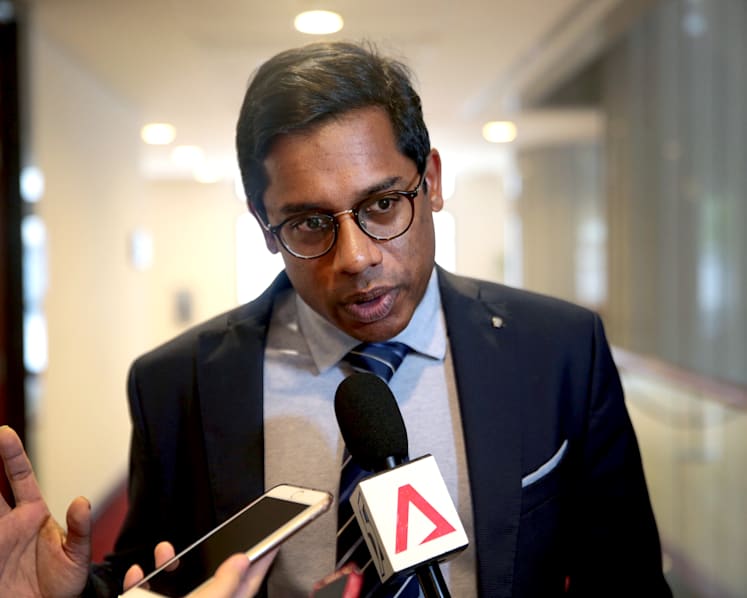
Dr Shashi Jayakumar, Head, Centre of Excellence for National Security and Executive Coordinator, Future Issues and Technology, S. Rajaratnam School of International Studies, Nanyang Technological University, gives an interview after presenting at the public hearings of the Select Committee on Deliberate Online Falsehoods. Photo: Jason Quah/TODAY


SINGAPORE — Given racial and religious fault lines as well as its high Internet penetration rate, Singapore could become a “sandbox for subversion” preyed upon by groups looking to test their methods, warned national security expert Shashi Jayakumar on Thursday (March 15).
Testifying on the second day of the public hearing held by the Select Committee studying online falsehoods, Dr Jayakumar also pointed to the presence of “hired guns” and fake news mills in Singapore’s immediate neighbours, Malaysia and Indonesia.
“Let’s say, touch wood, in a worst-case scenario where we have a serious mishap in relations with one of our near neighbours. It will be a mistake to assume the means employed against us will be merely kinetic,” said Dr Jayakumar, who heads the Centre of Excellence for National Security at the S Rajaratnam School of International Studies.
He cited how Saracen, a notorious fake news factory in Indonesia, was involved in bringing down former Jakarta governor Basuki Tjahaja Purnama — popularly known by his Hakka name Ahok — such as by attacking his Chinese ancestry and Christian faith. Similar techniques have also been used to launch character assassinations against other high-level politicians.





Dr Jayakumar warned: “So far, that (has been) limited to Indonesian domestic political machinations, but the planning could be turned with a tweak against Singapore in the event of a serious mishap or falling out.”
Political parties in Malaysia have also reportedly used big data analytics and disinformation to appeal to the electorate ahead of the upcoming general election.
Dr Jayakumar said: “The means and tools are actually there…I don’t want to cast allegations, or smears, or be a fear monger, but in my view, it would be amazing to assume this is not already happening in Singapore. These are advanced persistent threats.”
The most advanced and persistent forms of cyber threats are deployed “long in advance” and “reside in your system long before you detect it”, he said.
“You don’t realise you’re being boiled…And when you detect it, that means the communal resilience or the body politic has already started to fray,” he added.
With the aid of social media, many forms of intolerance in the region, including non-Islam extremists, could seep into Singapore.
“So Singapore can be a sandbox for subversion and these issues and they should be looked into. We shouldn’t isolate one particular type of strain or intolerance at all,” said Dr Jayakumar.
It does not take a large team with deep pockets to launch a disinformation campaign, Dr Jayakumar cautioned. Some of the attackers are co-opted from within the target country, with little or no reimbursement, he said.
In his written submission, Dr Jayakumar cited how a group of about 10 people with “pronounced right-wing sympathies” living in Moscow had “strong ideological impetus” to spread falsehoods in their home country, which he did not name, in Western Europe.
“They felt that their country had gone down the wrong path when it came to multiculturalism, and in terms of its immigration and refugee policy, and felt that they and the fake social media accounts they had created will aid in the ‘legitimate’ resistance that would bring their country to the ‘correct’ path again,” he wrote.
Mr Ruslan Deynychenko, co-founder of Ukrainian fact-checking outfit StopFake.org, also stressed that Singapore must not be complacent, despite not having been a target of such campaigns in recent times.
Speaking to reporters after giving oral evidence on Thursday, Mr Deynychenko drew insights from the Russian invasion of Ukraine from 2014, often cited as the bloodiest war in European history since the early 1990s.
He cautioned: “It is possible that someone would send weapons to your country, to some radical groups, either religious or nationalistic groups… Our example demonstrates that it is possible. No one believed that (Ukraine) could ever have military conflict with Russia, because we were persuaded that we are brothers. We speak the same language, and half of the population are Russians.”
“We thought we had nothing to fight for, then suddenly it happened because someone in Russia decided that they need this trophy,” he said, referring to Russia’s annexation of Crimea in early 2014.
TO LEGISLATE OR NOT?
Experts who presented on Thursday were divided on whether legislation should form a crucial piece of the Republic’s arsenal against falsehoods.
Dr Jayakumar, for instance, felt legal recourse would be helpful in calling to account agencies and individuals who have “actively seeded subversion”.
Government and legislative intervention must be complemented with other measures, such as education, he said. For instance, the social studies curriculum in secondary schools could be revamped to include topics that raise awareness of falsehoods and disinformation, which Dr Jayakumar called “the threat of our times”.
However, information warfare analyst Ben Nimmo, who presented his evidence via video-conferencing from the United Kingdom, felt that legislation should be “the very last resort”.
A more effective and prompt approach is to work directly with the tech platforms to take out misinformation, he suggested.
Countering Mr Nimmo’s suggestion, Law and Home Affairs Minister K Shanmugam said that the platforms may not be keen to engage with Singapore.
The minister said: “When you’re in the United States, I suppose you can talk to (large Internet platforms)… What if they say no to you, to a country like Singapore? What do we do?”
While acknowledging that legislation is a recourse when platforms are reluctant to engage, Mr Nimmo, who is a fellow at the Atlantic Council’s Digital Forensic Research Lab, maintained that laws have limitations in terms of flexibility and speed.
“It’s much quicker to be able to have… a dedicated contact system whereby in severe cases, you can reach directly to (the platforms)… If they don’t appear to respond, then you (can use laws), but it’s much better not to,” he said.
There are many “grey areas”, he added, such as how some pieces of misinformation may not be entirely false.
“How will you define the problem? There are so many grey areas here. Just the preamble to your legislation is going to be the size of the Oxford Dictionary,” he said.
The debate went on for about 10 minutes before Mr Shanmugam concluded: “It’s a matter of values, but I think it is entirely justified for the state to intervene and say, ‘This is not allowed’…Legislation may not necessarily just be one solution, there might have to be different solutions for slightly differentiated outcomes.”




