







Explainer: What to look out for on US Election Day and beyond as Trump and Biden face off
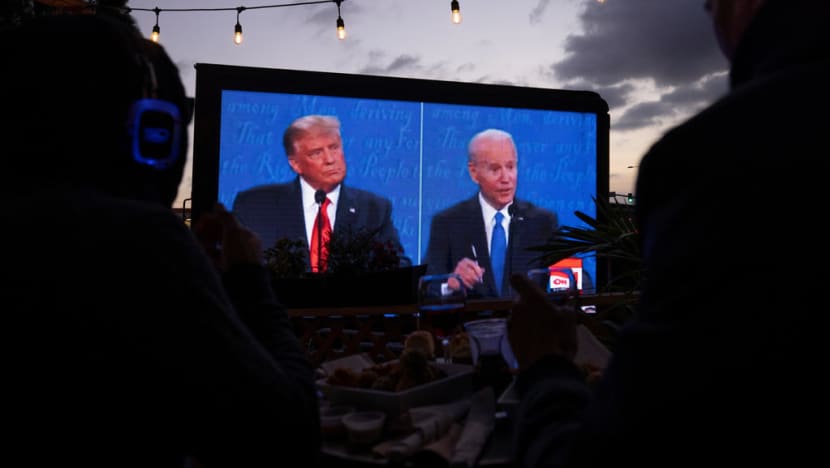
The final results of the presidential election between President Donald Trump (left) and former vice-president Joe Biden (right) could take days, even weeks, pundits said.


- The highly charged US presidential poll culminates on Election Day on Nov 3 (Nov 4 Singapore time)
- The final results will likely be known after days or weeks
- Key states to watch are: Florida, Ohio, North Carolina, Texas, Arizona, Michigan and Pennsylvania
- Three key battleground states have emerged that could decide the election: Florida, Arizona and Pennsylvania
- Possible recounts, legal battles and disputes over absentee ballots could delay results
SINGAPORE — After a final blitz of rallies across key states, the months of campaigning by Republican nominee, President Donald Trump, and Democrat challenger, former vice-president Joe Biden, are drawing to a close. And a bitterly divided United States is heading to polling booths across the country on Election Day.
As the final round of voting takes place over the course of Election Day on Nov 3 (Nov 4 Singapore time), the process to determine the next occupant of the White House begins, although it is shaping up to be a chaotic affair.





Armies of lawyers on both sides are preparing to challenge close results, state governments are readying their National Guard in fear of election violence, and more than 230 unresolved election-related lawsuits loom beyond Election Day, several American media outlets reported over the past week.
Some cases could finish up in the Supreme Court, where cases will be heard by all nine judges, including Mr Trump’s most recent pick, Justice Amy Cohen Barrett.
Holding the election during a pandemic has spurred around 100 million Americans to vote early, to avoid the risk of catching the coronavirus in crowds, and this has shattered early voting records.
The herculean task of counting the ballots will fall on the states, though some pundits said that there could be early clues on the election outcome depending on how decisive the vote is one way or another.
Dr Meena Bose of Hofstra University in New York said: “It could be a long evening, depending on when the polls close and which states are able to return results.”
TIMELINE ON ELECTION DAY
There is no central authority that counts the votes — US elections are carried out at the state level, which results in a patchwork of regulations on Election Day.
And for the first time in US history, more votes are likely to be cast early than on Election Day itself, Dr Bose said. She is the director of the Peter S Kalikow Centre for the Study of the American Presidency.
An estimated 50 to 70 per cent of the total early votes are absentee ballots, which complicates the ballot tallying process since mailed-in votes take longer to count than ballots cast at polling places, including those dropped off early.
Some states start tallying votes, including early votes, after polls close, so key states such as Pennsylvania that do this may take a long time to give a clear indication of a result.
Certain initial returns may also be misleading depending on whether states release the counts for mailed or in-person ballots first — the former are more often cast by Democrat voters, studies have shown.
Poll analytics site FiveThirtyEight found that 16 states are most likely to report nearly all votes at the end of Election Day, including Florida, Nebraska and New Hampshire.
Another 24 states will give only an indication of who has the most votes, because these states count absentee votes that arrive later. These states include important battleground states such as Arizona, Michigan, Wisconsin, North Carolina, Ohio, Iowa and Georgia.
Ten states as well as Washington DC could take the longest time to count, due to regulatory differences that slow down the process.
There could also be recounts if the result is close, such as in Florida during the 2000 US presidential election between George W Bush and Al Gore. It was the sunshine state that ultimately sealed Mr Bush’s victory.
The recount delayed that election result by more than a month, with the case eventually heard by the US Supreme Court, which stopped further recounting and effectively awarding the election to then President-elect Bush.
STATES TO WATCH
Giving a cheat sheet on Election Day, Dr Bose said that the key states to watch are: Florida, Ohio, North Carolina, Texas, Arizona, Michigan and Pennsylvania, in the order of how early polling closes in those states and their speed of counting.
Based on consensus polls, most pundits said that Mr Biden’s chances of securing the White House are higher this time round, especially in Wisconsin and Michigan — which Mr Trump was able to flip in 2016.
As a result, three key battleground states have emerged that could decide the election: Florida, Arizona, and Pennsylvania.
For Mr Trump to be re-elected, he would almost certainly need to secure the 29-elector state of Florida, a state that every successful Republican candidate since 1924 had won.
Dr Bose said that Florida will be able to give an early projection of how the vote may go on Election Day, because the state started counting the vote two weeks ago and has said that it could declare a result early.
The first batch of results, comprising early votes and pre-counted mail ballots, is likely to be reported within 30 minutes after its polls close at around 8am Singapore time on Wednesday.
“Florida is a critical race. It is not decisive, but it is, I would say, highly predictive. If Joe Biden wins Florida, then President Trump's path to re-election is very narrow,” she said.
Arizona, which ends voting at 9am Singapore time and has 11 electors, is another key battleground that could be a decider.
Pennsylvania, which Mr Trump flipped in 2016 and ultimately cost the Democrats the presidency, has 20 electors that Mr Trump also sorely needs to bolster his re-election chances.
FiveThirtyEight gives Mr Trump a six in 10 chance of winning the election if he secures Pennsylvania, and Mr Biden a nearly guaranteed victory if he does the same.
ELECTORAL COLLEGE
In the US, voters do not cast a ballot directly for their president. Instead, they choose the party for their state, the party then picks the electors to sit in the 538-strong Electoral College, and the electors pick the president and the vice-president.
The mathematics of the race to the presidency is simple: In 2016, Democratic nominee Hillary Clinton won 232 Electoral College electors out of the 270 electors needed to win. This time, Mr Biden needs to win the same contests and secure another 38 more, although theoretically, he could compile the 270 electors by winning different states.
US congressional law has established Dec 8 as a “safe harbour” deadline for all states to complete vote counting and select their electors, who will then travel to their respective state capitals on Dec 14 to cast their presidential ballot based on what the voters in their state picked.
The result of the Electoral College vote is to be announced in Congress on Jan 6, 2021.
However, if several election results are contested, there could be lawsuits over ballot counting and certification, which have already started. In Houston last week, a US district court threw out a Republican suit that challenged the legality of around 127,000 votes cast at drive-through voting sites in Texas state.
So far, President Trump has refused to commit to a peaceful transfer of power to Mr Biden should he win, and has continued to sow doubt over the legitimacy of absentee balloting, which is expected to favour his rival. Both sides are reportedly preparing for a protracted legal battle over the validity of the election results.
When TODAY asked what happens if the continued conflict after Election Day leads to states not being able to meet the safe harbour deadline, Dr Bose said that things “will get very complicated”.
During the 2000 Bush-versus-Gore case over the Florida recount, it was the safe harbour deadline that was a factor in the Supreme Court’s conclusion. However, if multiple states cannot certify by Dec 8, it could give rise to unprecedented questions about a contested election and whether the 270-electoral threshold still applies.
In August, Republican Senator Marco Rubio introduced a bill to extend the safe harbour deadline due to the pandemic, warning of “election chaos” if the deadline is exceeded. The bill has not been passed.
Dr Bose said: “I have to tell you I don't have fixed answers. Clearly, both campaigns have their legal teams ready to go and I would have to say that those decisions will probably end up in the courts.”




