







Exports fall raises odds of technical recession
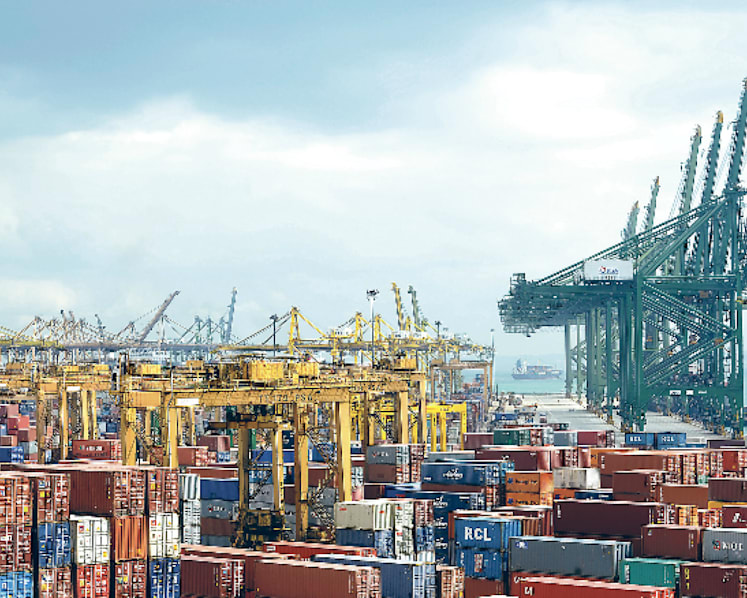
TODAY file photo


SINGAPORE — Exports from the Republic fell the most in six months in August, raising expectations that the central bank may ease monetary policy at its meeting next month to stabilise an economy that is teetering on the edge of a technical recession.
Non-oil domestic exports (NODX) last month plunged 8.4 per cent compared to a year ago, deepening the 0.7 per cent contraction in July, as shipments of both electronics and non-electronic products fell, trade agency IE Singapore said today (Sept 17). Economists in a Reuters poll had expected a 3 per cent contraction.
“The poor export performance in August has pushed the economy closer to a technical recession … The ugliest part of the data set is the sequential month-on-month 4.6 per cent decline in NODX. Not only does this wipe out the modest 0.2 per cent gain from the previous month, it essentially has tipped the economy even closer to a technical recession,” said DBS economist Irvin Seah.
A technical recession is defined by two consecutive quarter-on-quarter contractions. On a quarter-on-quarter seasonally-adjusted annualised basis, the economy contracted by 4 per cent in the three months through June, a reversal from the 4.1 per cent growth in the previous quarter, the Ministry of Trade and Industry said last month.





The decline was led by the manufacturing sector, which has contracted for three consecutive quarters in year-on-year terms and for three out of the past five quarters on a sequential basis.
However, other segments in the economy, such as services and finance, could provide a boost and potentially help Singapore avoid a technical recession.
“Singapore could avoid a technical recession if the domestic segment remains vibrant (enough) to generate sufficient demand for services, which forms the bulk of GDP,” said Dr Tan Khay Boon, Senior Lecturer, SIM Global Education.
“We should see some support to third-quarter GDP growth from financial services output, given stronger FX turnover numbers in the quarter,” said Mr Michael Wan, economist at Credit Suisse.
Today’s export data comes ahead of the Monetary Authority Singapore’s semi-annual policy meeting in October. In January, the MAS reduced the slope of its policy band for the Singapore dollar in a surprise off-cycle move, but then left monetary policy unchanged April.
“Our base case is still for the MAS to remain on hold come the October meeting, although (we) note that the risk of policy easing (eg. flat slope) has been a risk with the slew of weak data. A much weaker-than-expected industrial production print next Friday, and softer MAS core inflation could tip the balance towards the central bank easing its exchange rate policy in October,” said Mr Wan.
Shipments of electronic products fell 2.7 per cent last month, reversing from a 2.5 per cent expansion in July mainly due to declines in the export of personal computer parts, integrated circuit parts and disk drives.
Exports of non-electronic goods contracted by 10.6 per cent, after slipping 2 per cent in July. The decline was led mainly by a fall in exports of petrochemicals, pharmaceuticals and structures of ships and boats.
NODX to all of the Republic’s top 10 export markets declined except Thailand, the United States and Hong Kong. They fell the most in Taiwan, South Korea and China.
Shipments to China, Singapore’s top destination for exports, faced its largest fall since February 2013 as it contracted 8.2 per cent, extending from a 1.6 per cent fall in July due to declines in exports of petrochemicals, integrated circuit parts and trailers.
If the US Federal Reserve does decide to raise interest rates, it could provide a fillip for Singapore’s exports.
“A Fed revision of interest rates would be better for local exports to the US. With the SGD weakening against the USD, importers in the US may increase the units of goods due to a higher conversion rate. Also, exporters in the Republic who sell in USD would also experience higher conversion earnings,” said UOB economist Francis Tan.
“The US Fed rate hike would also be a bright light for China, providing a boost to their economy and allowing a slight recovery, which will also in turn help Singapore in exports growth.”




