







Faces on the Subway: Growing up between two lands, with her heart in both
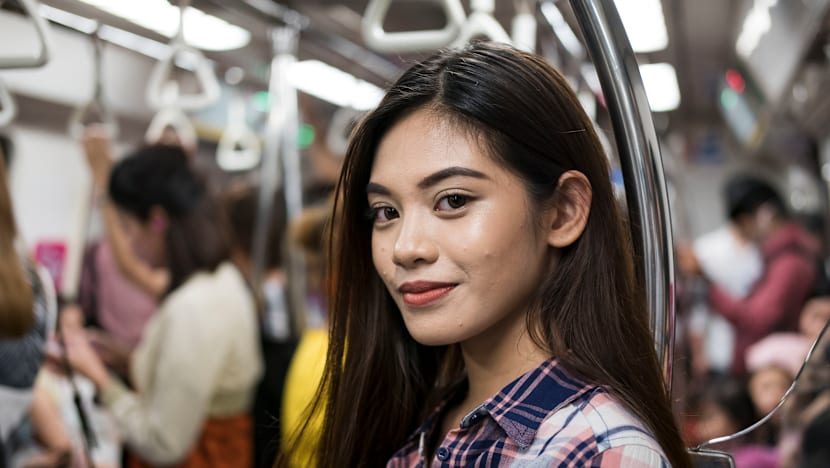
Danielle Sugpatan, 21, has been mistaken for a Malay or Chinese Singaporean because she can speak Singlish, but she is a Filipina who is fluent in Tagalog. Photo: Nuria Ling/TODAY


Every day, hundreds of thousands of passengers take the MRT, traversing across the island for work, school and leisure. The spate of disruptions and incidents, which the operators and authorities are looking to resolve, and the inconvenience caused to commuters, have brought into focus how the rail network has become a big part of our lives. So, too, are the countless faces we meet on the subway, some growing familiar over time and each with a story to tell.
In our Faces on the Subway weekly series, we speak to commuters who start their day while it is still dark, or call it a night when others are already fast asleep — people on the first or last train.





SINGAPORE — Danielle Sugpatan, 21, has been mistaken for a Malay or Chinese Singaporean because she can speak Singlish, but she is a Filipina who is fluent in Tagalog. Then, when she visits her relatives back home in Manila, they find her Tagalog accent “weird”.
The Temasek Polytechnic graduate, who holds a diploma in law and management, is trying to find her place and feels like an outsider at times, both in Singapore as well as the Philippines.
She moved here with her family in 2006 when she was nine because of her engineer father’s work. Now a permanent resident and dating a Singaporean Eurasian, she said that there are still moments when she would feel “quite lonely”.
“Sometimes I feel like I’m not really sure where my home is… because I was born in and grew up in the Philippines when I was younger, but I’ve also spent half my life in Singapore… so there’s this confusion... Where do I belong?”
When she heads home every year or two to catch up with her large extended family, she discovers new places as friends take her around her hometown of Ayala Alabang, on the outskirts of Manila. It came as a “shock” to realise how things have changed, for instance. “I didn’t know we had three schools, or a country club in the village… I wasn’t aware of that,” she said, bemused.
There are also certain Tagalog words that she might not understand or use wrongly. “Over here, I have a (bit of a) Filipino accent, but when I go back home, they have a different accent… They also find it weird… So in both countries, I kind of speak weirdly,” she said with a laugh.
Asked how she feels about people here who are not welcoming towards foreigners or poke fun at the way she speaks, she admitted that it “can get quite offensive”, but she is used to it and will “laugh it off” should her friends make a joke of it.
She has also embraced the “kiasu” (competitive, afraid to lose out) trait associated with Singaporeans and loves her fair share of chicken rice and laksa.
However, she did experience some culture shock when she was first trying to settle here as a child, and the language barrier was the biggest hurdle to overcome. Not used to speaking English, she struggled to communicate with her peers at Kranji Primary School.
STRESS LEVELS WENT UP
At one point, she even bought a book on Singlish from Popular bookstore to familiarise herself with colloquial terms such as “kiasu” and “kaypoh” (busybody).
The stress levels in school shot up as she had to attend tuition classes and adjust to a more competitive environment, although “everyone was always nice, friendly and accepting”, she said.
She also quickly befriended a small group of students who had also emigrated from the Philippines to Singapore. The close-knit group, who lived just five minutes away from each other, would do homework together as most of them were exempted from taking Mother Tongue classes in school, or they would head to the neighbourhood playground or one other’s homes to hang out.
“It helped a lot… Even though I was in a different country... this place could still be my home,” she said. The group of them have since taken different paths, but still make time to meet up twice yearly.
TODAY caught Ms Sugpatan on the last train on the Downtown Line earlier this week, as she was returning home after visiting a friend. When she was still studying in the polytechnic and spent late nights on campus, taking the last train between Tampines West to Bukit Panjang stations was a common ritual.
Having applied to enrol in a few universities here, she is now waiting for the outcome. The plan is to continue studying law and eventually practising it as some of her relatives do, to “make a difference to other people’s lives”.
Ms Sugpatan looks up to her father, 51, as one of her role models because he is a hard worker and has been the breadwinner for the family — her mum is 54 and a housewife, and her brother is turning 18 and still studying as well. When they were in the Philippines, her father was often sent to work in far-flung places such as Brazil, Canada, Russia, Libya, Saudi Arabia and the United States. There were also postings to Brunei, China, Malaysia and Singapore.
Thinking that Singapore was a good place to settle down, the family made their move, but in Ms Sugpatan’s memory, it was a somewhat abrupt departure and she did not have time to “say a proper goodbye” to her childhood friends. These were people who, along with her cousins, had spent time with her flying kites on the rooftop of her home, playing in the rain, and cycling around the neighbourhood.
STAYING CLOSE TO HER ROOTS
However, thanks to smartphones and social media, she keeps in touch with her cousins these days through WhatsApp, Instagram and Twitter, so “we’re still connected”, she said.
There are eight aunts from her mothers’ side of the family that they catch up with when they return to Manila. “My family and relatives would always tell me, ‘No matter how far you are, how long you haven’t been in the Philippines... you’ll always be welcome here’.”
In Singapore, efforts are made to keep family ties tight as it is over there. They have meals and watch Tagalog movies together.
Ms Sugpatan enjoys her mother’s homecooked Filipino dishes such as adobo (a stew of assorted cuts of meat marinated in a base of vinegar, soy sauce and garlic) and tinola (a ginger- and onion-based soup with chicken).
Other times, her parents make their way to Lucky Plaza on Orchard Road for some traditional Filipino fare, and at least once a month, they have fried chicken from Jollibee there.
Other traditions they keep up include celebrating Christmas together, and the family would attend mass at the Church of Saint Mary of the Angels in Bukit Batok. During get-togethers with the Filipino community, such as friends from church, their condominium at Yew Tee and her fathers’ workplace, they would do potluck meals or have barbecues. At a recent family outing, they went to the ongoing Prudential Marina Bay Carnival, which featured amusement park rides.
Ms Sugpatan sees herself staying put in Singapore for good, to “build a family here”. “I want to have a happy family like the one I have now… I want to have that on my own (in future).”




