The faces of Sungei Road market, and the stories they tell
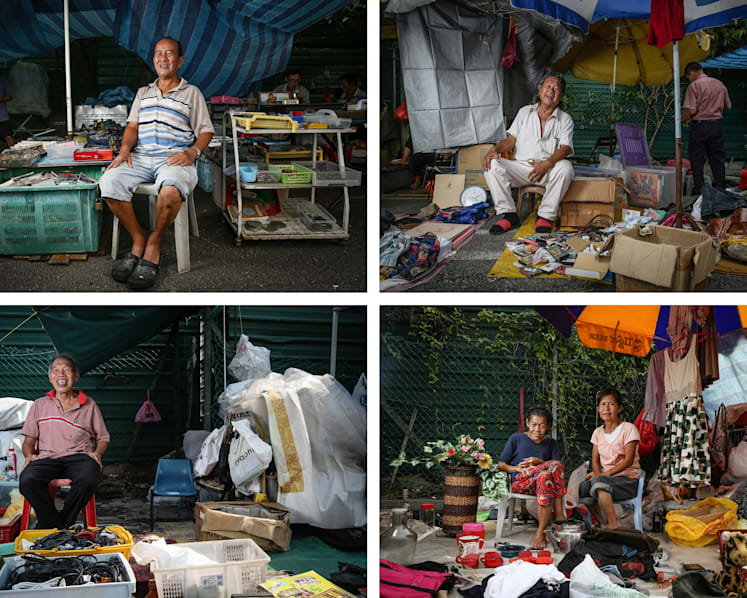
Portrait of the hawkers- Clockwise: Lee Yew Tee, 69, who gas been hawking at the Thieves' Market for the last 20 hears, sells antiques, old coins and notes; Josh tang, 64, who has been hawking at the Thieves; Market for 16 years, sells vinyl records and cassette tapes, among other things; Teng Soon Heng, 79, and younger sister Chan Ah Ling, 69, sell clothes. Teng has been at the Thieves' Market for the last 40 years. Ng Seng Khong, 73, has been hawking at the Thieves' Market since the 1960s. He is one of the 11 permit holders. Photo: Koh Mui Fong/TODAY
SINGAPORE — Before Sungei Road Thieves’ Market opens at 1pm, many of the hawkers there have already started their day by looking for goods to peddle. They forage in dumpsters or hunt down bargains with wholesale and retail stores. Others retrieve their wares — comprising unsold items from previous days — from a storage area close to the market, which they pay S$150 a month to use.
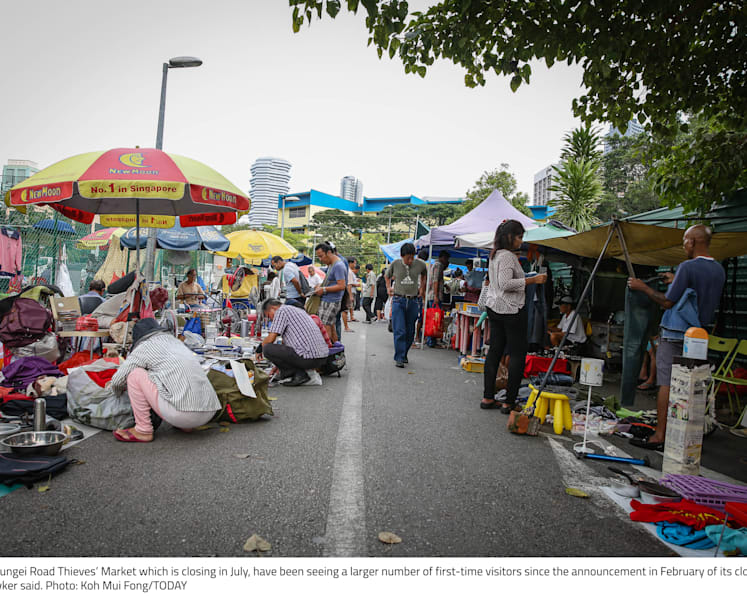
Wheeling their luggage bags and trolleys to the outdoor market at about noon, the sellers arm themselves with up to five water-bottles to beat the heat. They then take their time to set up shop at the site located between Jalan Besar and Rochor Canal Road. For many, this is the time to chat and joke with one another before business begins.
In a matter of minutes, umbrellas, poles and canvas sheets are transformed into makeshift shelters and a colourful array of wares are displayed.
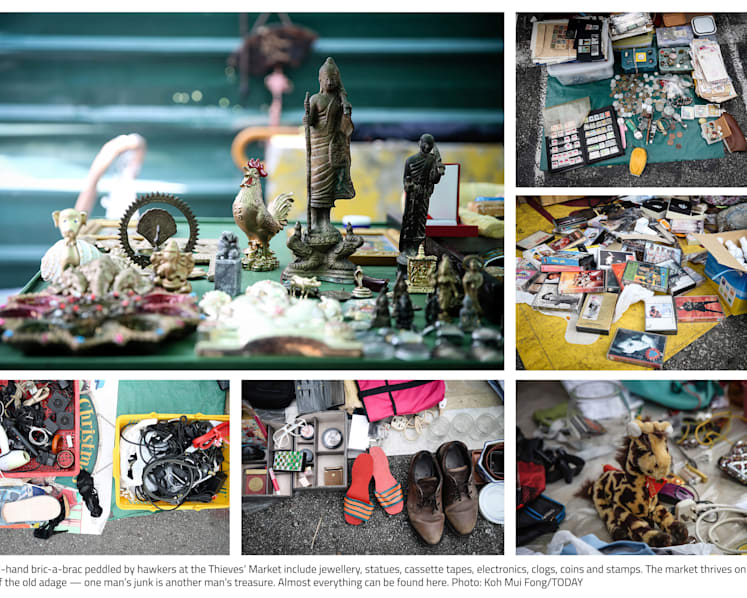
As each hawker is allotted a 1m-by-1m space, some of them end up hidden behind the heaps of old clothing that they are selling. Others showcase their prized possessions in display cases, including jewellery that has been slightly tarnished, vintage watches and old coins.





On the green fencing behind them hang plastic bags and boxes of half-eaten lunch.
Regular patrons start showing up, and on weekends, families and foreign workers, too. Some of the regulars even have their own wares to sell or give away to the hawkers.
The crowd usually peaks towards the evening (the market closes at 7pm) or on weekends. Undergraduates looking to it as a research topic of interest poke their noses in, tourists go to browse, and the so-called hipsters of the day are there to snap Instagram-worthy photos to publish on their carefully curated accounts.
Stop to chat, and you will find that what makes this market so enduring and endearing are the colourful hawkers there. Take Mr Josh Tang, a former sailor.
The 64-year-old with windswept hair has been hawking there for 16 years. He makes several hundred dollars in a couple of hours selling old clothes, music cassette tapes, vinyl records, and other knick-knacks. And he freely gives away goods that remain unsold at the end of the day — all except for two boxes containing vinyl records which, he told TODAY, are his “bestselling products”.
“I like setting up shop here because it’s very easy to convert things to cash,” he said. “You can sell anything here. Visitors who (come here) are interesting… That makes it quite comfortable to do business.”
He scours for new goods each day, but was coy when asked for his preferred sources. “Those are secrets. If I tell you, then I don’t have to do the business anymore,” he said with a laugh.
While Mr Tang has obviously found a niche for himself, not many hawkers enjoy brisk business like his or adopt his trading style.
Mr Ng Seng Khong, one of the original 11 hawkers who still hold permits to trade at the market, said that he takes home a modest two-digit sum on good days. On days when it pours, his wares are thoroughly soaked and the 73-year-old goes home with nothing.
Pointing to books and DVDs still wet from the previous day’s downpour, Mr Ng said: “I don’t expect to get much from these things, but there is nothing else I can do because I no longer have much strength to do most other forms of work.”
He revealed that he suffers from Parkinson’s disease, and he sets his goods aside by the road at the end of the day, even though he lives just across the road. “Some things go missing, but I cannot manage (if I take) them all home.”
Having been in the market for more than 50 years, Mr Ng knows the names and faces of hawkers there, and is able to assist National Environment Agency officers who come by for checks each evening.
Spotted among the older vendors is a younger face: Ms Kuek Lian See, who is in her 40s and selling jewellery and statues with religious motifs. She told TODAY that she takes home about S$50 a day, which is enough for her family of six to get by. Ms Kuek became the sole breadwinner after her husband stopped working while recovering from depression. They have five children aged 10 to 25, including a daughter who already has a family of her own.
“I like to work here because it is flexible, I can take time off when my children fall ill,” Ms Kuek said.
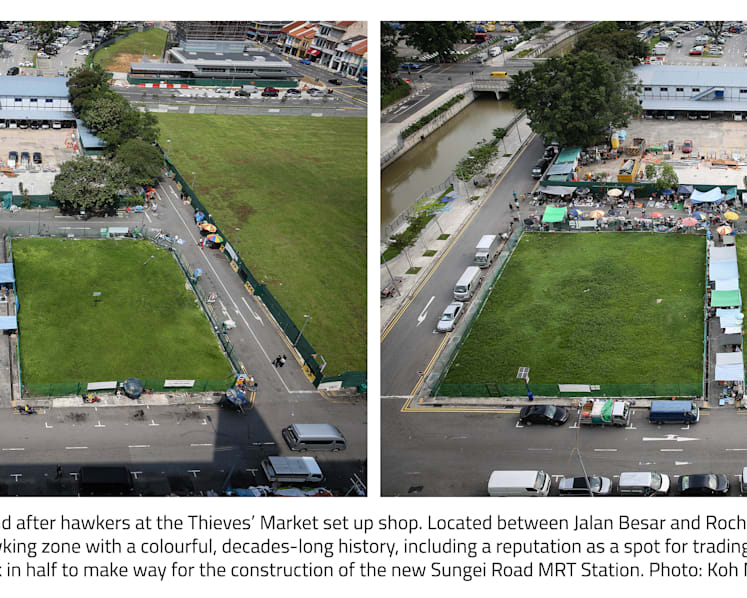
Started in the 1930s, Thieves’ Market used to be the oldest and largest flea market in Singapore. It has had a colourful history since it made its mark as a place to trade stolen, smuggled or illegal goods, thereby earning it its name.
In 2011 though, it was reduced to half its size to make way for the construction of the new Jalan Besar MRT Station.
This last “free hawking zone” in the country has also become a sight for sore eyes to those living in the organised space around it, even though regulators have moved in through the years to give it a dusting here, a sorting there. Its organic nature remains, with opportunists sometimes taking advantage of the rent-free space to hawk prohibited goods such as pornographic materials, for instance.
News that the market will be shut for good have drawn mixed reactions, with heritage enthusiasts lamenting the loss of a precious piece of the nation’s cultural landscape.
A week after the market’s impending closure was announced, a petition was launched online calling for it to be retained, describing the market as an “indispensable means of livelihood” for the many dozens of older vendors who have “few or no practicable alternatives”.
The market’s long and rich history also contributes to a “sense of community, continuity and shared memory” in the grassroots, the petitioners said.
However, for some residents in the area, it is a relief. One of them, who gave his name only as Mr Yeo and who has lived in Jalan Besar for a long time, is hoping to have a cleaner and more hygienic living environment. The businessman and grassroots leader said: “Most of the hawkers are there because they don’t have to pay rent, but they end up hoarding their goods in a public space, drawing pests.”
Mr Yeo recalled that fellow grassroots workers had to help put out fires caused by flammable items left unattended.
Many of the hawkers acknowledge that the Government’s decision is final and it is time to move on.
Mr Tang said: “I have to thank the Government (that I did not have to pay rent) for 16 years… I will probably move on to other flea markets.”
Ms Lai Ya Fen, 70, who peddles household goods, was not so sentimental as well: “It is just a matter of time (that the market will be closed)… There is not much to miss or grieve over.”
In an update in Parliament early this month, Mr Masagos Zulkifli, Minister for the Environment and Water Resources, said that five of the 11 permit-holders at the market have shown interest in relocating to hawker centres in the city area.
In the first year, rental for these vendors would be waived, and a 50-per-cent rebate off the subsidised rent would be given for the second year on a “goodwill basis”, should they take up the offer.
Officers from five government agencies have reached out to about 200 hawkers early this month, and in a joint statement, said that a “sizable number” of the hawkers have indicated interest either in taking up lock-up stalls at hawker centres, continuing their trade at temporary flea markets, or applying for jobs or financial aid if they cannot continue their trade.
The agencies added: “Over time, the nature of (Sungei Road Thieves’ Market) has changed as reflected in the profile of vendors, buyers and type of goods sold. Such street trades should only be allowed to continue in designated venues such as temporary flea markets, rather than on a permanent basis, to minimise disamenities to the public.”
For some hawkers, it is the relationships that they will miss the most.
Mr Lee Yew Tee, for instance, said that he has befriended visitors from all over the world and even picked up bartering and negotiation skills from fellow hawkers.
The 69-year-old said: “I wasn’t very good in the past, so this place helped me brush up my skills.” He first started selling his wares such as antiques and old coins at the market on weekends, but made it his full-time work about 10 years ago.
For a pair of sisters, Ms Teng Soon Heng, 79, and Ms Chan Ah Ling, 69, they said that their fondest memories of the market are the friendships formed with fellow vendors and customers. Ms Teng has been selling clothes there since the 1970s.
“We like this place because everyone is very relaxed, we laugh and joke with one another. We feel at home with fellow Singaporeans,” she said.
Not all is always warm and rosy in the community, of course. Mr Tang said matter-of-factly: “You make lots of friends, but you make enemies, too. This is just the way life is.”
And like life, things have to “come to an end”, he said.