







False taxi claims, bookings an issue for third-party apps
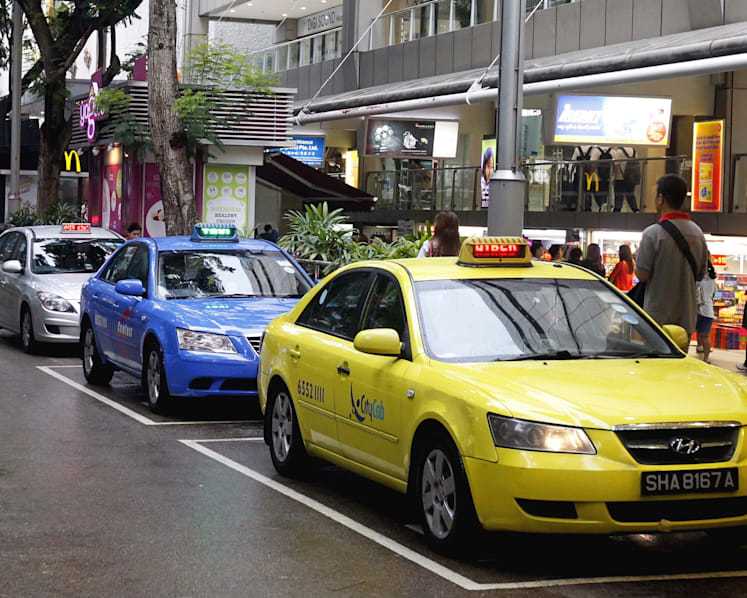
TODAY file photo
SINGAPORE — The use of third-party taxi booking applications is showing its darker side — to the detriment of the app providers.
Lucrative incentives are being offered by the providers of the apps — touted as one way of alleviating Singapore’s taxi availability woes — to cabbies as they jostle to eke out dominance, but some cab drivers are said to be exploiting the system and cheating the companies of payments, despite safeguards to prevent this from happening.
Easy Taxi has referred four drivers to the police for repeatedly making fraudulent claims for rides, while two other app providers — GrabTaxi and Hailo Singapore — attributed such behaviour to a few black sheep, but did not comment on its prevalence.
Cabbies TODAY spoke to said they have heard of cases where drivers would ask friends or relatives to make bookings for non-existent commutes, for instance.





Mr George Lim, 41, who has been driving a taxi for five years, said some drivers make fake bookings from multiple phone lines.
Another example is drivers who take advantage of promotions such as free rides of up to S$20 for commuters on specific days. When claiming the fare from the companies, some drivers would claim S$20, even though the fare amounted to less.
Such drivers, they said, may do this three to five times a week.
Incentives offered by the taxi app providers vary and can change from time to time. Easy Taxi, for example, at one point gave monetary incentives to drivers accepting rides via their app. The more rides they accept through the app each week, the larger the sum paid out. They have also previously promised a S$1,000 bonus for cabbies who manage to reach 100 rides within a week.
Mr Li Jianggan, managing director of Easy Taxi Singapore, said the company’s system flags “abnormal” rides based on the ride histories that are fed back to them after each trip.
Rides that are unusually short and bookings from a particular number being accepted by a particular driver are deemed suspicious and investigated.
“In rare cases where a driver has not been paid, this is mostly due to pending investigations on suspected fraudulent rides. In this instance, we speak with the driver(s) involved and clarify each ride, verifying data with our back-end system,” he said.
“Any fraudulent drivers who undermine the trust in and fairness of the platform will be suspended. While we always speak with the drivers to understand their side of the story, we do not hesitate to refer repeated offenders to the police, as we have done so with four individuals in the past.”
Meanwhile, Uber Singapore and Hailo Singapore track their drivers via the Global Positioning System. Mr Wong Yu Hsiang, general manager of Hailo Singapore, said the company is able to determine where drivers are, the distance they travel and the routes taken.
Errant cabbies, depending on the severity of the case, can receive a stern warning or be barred from using the app. A GrabTaxi spokesperson said: “When joining GrabTaxi, each driver is made aware of the consequences should he or she choose to engage in any such activity.”
Instances of drivers claiming for nonexistent rides, while isolated, run counter to the authorities’ ongoing attempts to increase taxi availability here.
They also come as the Land Transport Authority (LTA) moves to protect commuters who use these apps. From the second quarter of this year, all third-party taxi booking services will be required to register with the LTA to operate locally.
They must also provide commuters with payment details, including flag-down fare, distance and time rates, the booking fee charged by the service provider and applicable surcharges, among other rules.
Transport analysts have said that because such cases are few, the impact on taxi supply is negligible.
Dr Alexander Erath, transport researcher from the Singapore-ETH Centre for Global Environmental Sustainability, said: “If it’s just a handful of taxi drivers exploiting the system … this does not significantly influence the problems that exist in the (taxi)-booking system.”
However, he added it was in the interest of app providers to come up with smarter incentive schemes to plug any loopholes.




