







Fewer S'poreans unemployed as overall jobless rate dips slightly in Q3: MOM
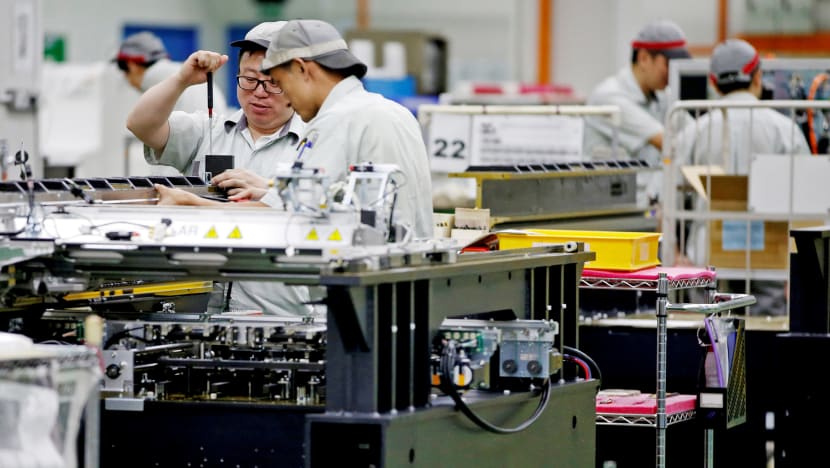
Employees at a printed circuit board assembly factory in Singapore. Reuters file photo


SINGAPORE — Fewer Singaporeans were unemployed in the three months from June to September as the Republic’s overall unemployment rate in the same period dipped slightly, preliminary estimates from the Ministry of Manpower (MOM) showed on Friday (Oct 27).
Some 62,600 Singaporeans were unemployed in September compared to 63,800 in June, with the unemployment rate for citizens dipping to 3.2 per cent in the third quarter, from 3.3 per cent in the previous quarter.
However, the number of residents here who became unemployed rose from 70,800 in June to 71,900 in September.
The ministry cautioned that the resident unemployment rate — which held steady for residents at 3.1 per cent in the third quarter — could remain “elevated in the medium term” due to on-going economic restructuring, shift in composition of the resident labour force, and job-skills mismatch, said the MOM.





Overall, total employment continues to fall. But the decline is easing, the latest figures showed.
Total employment, excluding foreign domestic workers, shrank by 2,500 in the third quarter, compared with 7,900 in the second and 9,400 in the first.
The recent decline was mainly due to a reduction in work permit holders in the marine and construction sectors, as a result of low oil prices and “continued weakness” in construction activities, said the MOM.
However, the decline was partly offset by a pickup in employment in the service sector, including professional services, information and communications, administrative and support services, finance and insurance, as well as accommodation.
The number of layoffs remained unchanged over the quarter at 3,600, about 14.7 per cent lower than a year ago. Compared to the previous quarter, retrenchments went down in the manufacturing sector but remained similar in the construction and services sectors.
Member of Parliament Patrick Tay, who is also the Assistant Secretary-General of the National Trades Union Congress, said in a Facebook post that the Republic will expect to see pockets of layoffs in the last quarter due to restructuring and re-organisation by firms faced with “disruption, digitalisation and changing demand patterns, including the oil prices”.
But he added that he expected fewer layoffs this year compared to 2016.
MOM said labour demand is expected to pick up in the final quarter this year, in line with “seasonal hiring” observed in previous years.
The ministry highlighted sectors like information, communications and media, finance and insurance, healthcare, professional services, and wholesale trade among those where job opportunities will be available. However, employers in the construction and marine sectors remain cautious about hiring, it said.
MOM added that it will continue to work with tripartite partners to support job seekers and those at risk of being displaced to re-skill and seek new employment opportunities. It also urged companies undergoing restructuring to prepare workers for new roles in the firm, so as to reduce the need for retrenchments.
While acknowledging that the figures are encouraging, economists interviewed by TODAY cautioned that structural unemployment is still a key challenge confronting the labour market.
“While unemployment has fallen overall, the trend does not cut across all sectors… Whether the market will experience a rebound remains to be seen, especially with all the structural changes taking place,” said CIMB Private Bank economist Song Seng Wun.
The job market will continue to improve on the back of a strengthening economy, but the pace of recovery will likely be slow, said Dr Chua Hak Bin from Maybank Kim Eng Group.
Dr Chua expects employment growth to turn positive in the fourth quarter, as the services and domestic-oriented sectors see more growth.
Labour economist Randolph Tan of the Singapore University of Social Sciences said he does not expect a return to “strong growth” in employment. “We still have to be on the lookout for unemployment to rise…Significant effort still is being expended by MOM and its agencies, as well as in concert with its tripartite partners, in overcoming the problem of (job-skill) mismatches,” he said.
Some were optimistic that the construction sector is headed for a turnaround, boosted by the recent en bloc boom. “The surprising optimism surrounding en bloc sales throughout the year may change the state of the construction sector,” said UOB economist Francis Tan.
Job prospects in sectors like retail, media and hospitality could also be damped, due to “disruptive competition” from e-commerce and the sharing economy, said Dr Chua.
The marine and offshore sector will likely remain weak next year, he added, as restructuring and more stringent foreign worker policies reduce competitiveness for such sectors, which depend heavily on foreign labour.




