







GE15 result apparent well before polling day: Survey
SINGAPORE – The People’s Action Party’s (PAP) landslide victory in last year’s General Election (GE) may have surprised many, including Prime Minister Lee Hsien Loong. But if the findings of regular surveys conducted before and after the GE by a research company are anything to go by, the PAP’s resounding win was every bit expected.
Data collected by Blackbox Research, which was shared yesterday at a lunch-time talk held at the Lee Kuan Yew School of Public Policy, found consistently high satisfaction with the PAP Government in the months leading up to the polls last September.
The company also found that despite the strong mandate for the PAP in the recent GE, two-thirds of respondents in a December survey last year indicated that a change in government was possible in the next five decades.
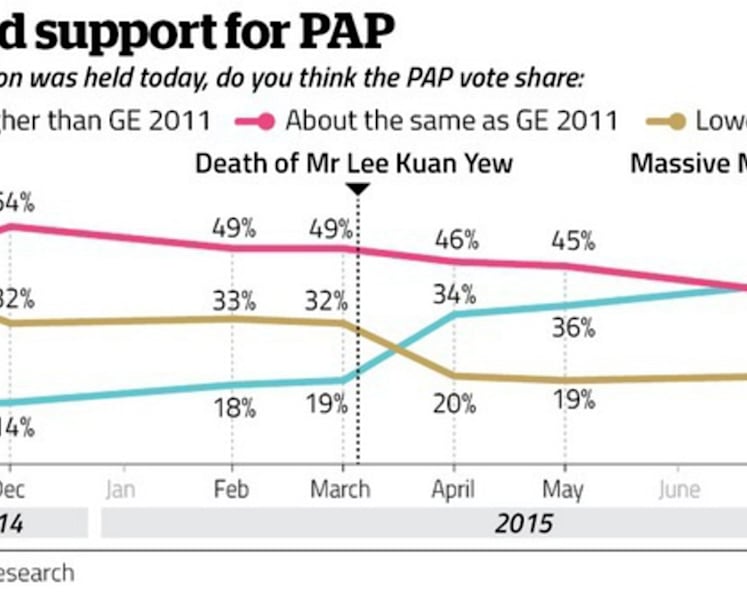
Between January 2014 and November last year, the company carried out face-to-face surveys with 1,000 respondents each month and found that events that occurred before the GE had influenced public sentiment and “locked in” PAP’s vote share even before voters went to the ballot box. In particular, the death of Singapore’s first Prime Minister Lee Kuan Yew was found to have a significant “multiplier effect”, said Blackbox Research managing director David Black.





Analysing the data from the public opinion polls, Mr Black said that following the PAP’s less-than-stellar performance in GE 2011, public support for the ruling party was still affected by train breakdowns and the Population White Paper, among other issues. But the “seeds of recovery”, in Mr Black’s words, were planted with the 2014 Budget, which was headlined by the Pioneer Generation Package.
“It was a significant change in responsiveness that really emerged from the Government. Certainly when we were doing qualitative work, you would start to hear words like ‘generosity’, words you’ve never heard before. People were reacting that somehow things were a little different,” said Mr Black.
Policies such as MediShield Life and SkillsFuture were subsequently rolled out over the past year. Mr Black said that Blackbox’s Government Satisfaction Index hovered around the 75 per cent mark from January 2014 to March last year before Mr Lee died.
Following his death, there was a surge in national pride and support for the PAP, Blackbox associate research director Johannes Loh said. “In effect, the younger generation was reminded of Singapore’s achievements, and this is not to be underestimated … When (Mr Lee) passed away, the entire 50 years of achievements ... were brought back to the surface, which to no surprise, boosted public satisfaction (with the Government) on many metrics we were measuring,” he said.
In November 2014, when respondents were asked how the PAP would fare compared with 2011 if elections were to be held, almost six in 10 said the PAP would maintain or improve on its vote share of 60.1 per cent received in GE 2011. In April last year, that proportion rose to eight in 10 as the Government Satisfaction Index reached 80 per cent — the spike on both counts was due to what Mr Black called “the LKY effect”.
Surveys conducted by Blackbox after GE 2015 also found that the SG50 “feel good” factor and Mr Lee’s death were the two most-cited answers from respondents who were asked why they thought more people voted for the PAP compared with GE 2011.
“(Mr Lee’s death) had a multiplier effect. There was never really any doubt the PAP was going to get maybe the same (vote share) or above what they had the last time, but it was the kind of super-boost (or) adrenaline that was added that got them that much further,” said Mr Black.
He added that the PAP’s campaign during the hustings had little impact on the results. “Our feeling is that the 70 per cent vote that was achieved by the PAP was pretty much locked in before the election campaign, and that was a result of the work the Government had done in the two previous years,” said Mr Black. “I would argue (that) they didn’t land any really solid punches on the opposition during the campaign.” Laura Philomin




