







Singapore’s global investment talent push faces bigger test: Can it propel locals into top roles?
Singapore hopes anchoring top overseas talent here will deepen the local asset management industry and strengthen the pipeline of homegrown professionals.
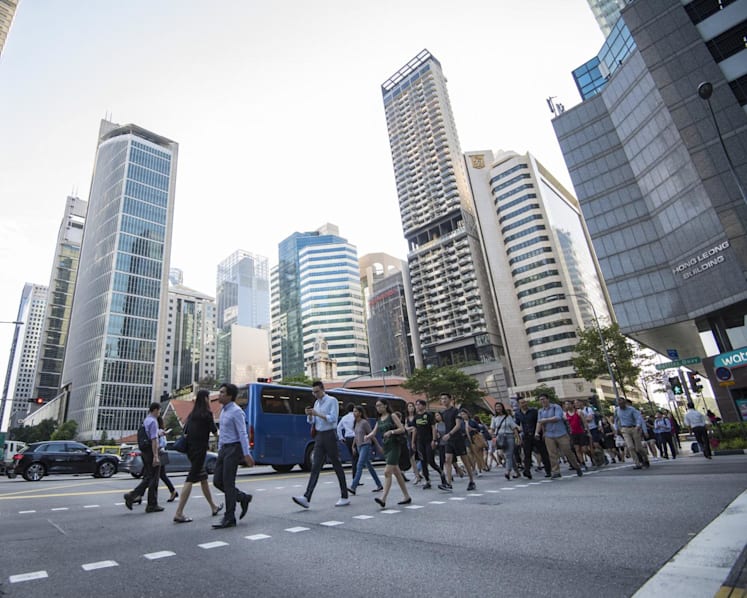
Office workers walking on the streets of the Central Business District in Singapore. (File photo: iStock)

This audio is generated by an AI tool.




SINGAPORE: The success of Singapore’s push to attract top global investment professionals may ultimately hinge on more than the jobs they create, observers say.
Industry watchers believe the bigger test is whether their expertise helps Singaporeans move into more senior roles.
Singapore hopes anchoring top overseas talent here will deepen the local asset management industry and strengthen the pipeline of homegrown professionals.
TALENT BEYOND THE TOP
Mr Kher Sheng Lee, co-head for Asia Pacific at the Alternative Investment Management Association, likened senior investment professionals such as portfolio managers to “race car drivers”. But a much larger team sits behind each driver.
“The jobs are in the garage, the corporate offices, the research labs,” he said.
These include analysts, traders, risk and compliance professionals, as well as operations and technology teams. A broader ecosystem of fund administrators, prime brokers, lawyers and auditors also supports their work.
Singapore’s asset management industry employs close to 25,000 people, about 80 per cent of whom are locals.
Observers say the issue is not a general shortage of finance professionals, but a scarcity of talent at the very top – people with specialised expertise and long investment track records.
Financial centres around the world are competing for the same small pool.
“The talent we're looking at is very scarce. Scarcity at the very top of the game is a global challenge,” said Mr Lee, adding that financial centres such as New York and London face the same challenge.
Investing requires not only technical skill but also the temperament to make difficult calls under pressure, he said. “You're making judgment calls with other people's savings, their investments. That's a very important heavy obligation.”
Such qualities can take years – and several market cycles – to develop, he added. “That's why these people are highly sought after.”
Singapore’s strategy is to bring some of these experienced professionals here, then build teams and investment activities around them.
Professor Lawrence Loh of the Department of Strategy and Policy at the National University of Singapore (NUS) Business School described the approach as “anchor first and then multiply after”.
“We are not looking at just them as persons. In fact, we are looking at the whole sector, the whole value chain or pipeline,” he said.
TURNING EXPOSURE INTO ADVANCEMENT
But analysts say the payoff for Singapore workers should not be measured by job numbers alone.
A key test is whether locals working alongside these global professionals gain the experience and exposure needed to advance in their own careers.
Mr Khairil Baharudin, a senior professional at the Institute for Human Resource Professionals, said this type of learning can be difficult to replicate through formal training.
“You learn from sitting alongside someone who has managed through several market cycles,” he said.
“You see how they assess risk, how they make decisions when markets are volatile, and how they exercise judgment when there isn't an obvious answer. So this is quite different from simply sending someone for another training programme.”
While training remains important, exposure, mobility, progression and succession are stronger indicators of whether genuine capability transfer is taking place, said Mr Khairil.
This could mean Singaporeans gaining greater exposure to investment decisions, taking on increasingly complex portfolios and eventually moving into regional, global or leadership roles.




