







Government working to house IT systems in commercial cloud: PM Lee
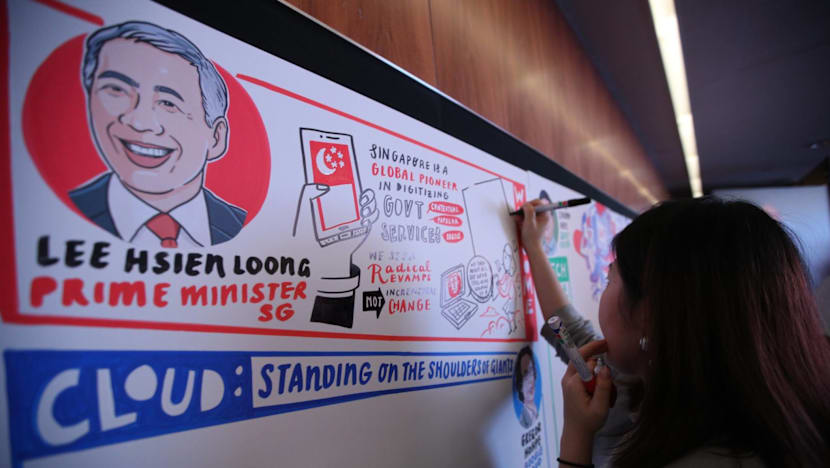
In a Facebook post, Prime Minister Lee Hsien Loong said that his speech at the conference organised by the Government Technology Agency of Singapore was brought to life by the "creative hands at Idea Ink".
SINGAPORE — Over the next few years, the Government will begin moving some of its IT systems to a commercial cloud system, Prime Minister Lee Hsien Loong said.
Speaking on Tuesday (Oct 2) at a conference organised by the Government Technology Agency of Singapore (GovTech), Mr Lee said that a preliminary study done by the Government showed that many of its systems can — in principle — exist in the commercial cloud.
He stressed that there are still “major considerations” of security and data protection even as the Government begins embracing cloud technology.
He pointed to the recent SingHealth cyber attack, where 1.5 million patients’ personal information and 160,000 medical records — including his own — were stolen by hackers in a “sophisticated, well-resourced” attack.





“The latest SingHealth incident only drives us to redouble our efforts. We must be alert to detect intrusions, respond decisively, and recover quickly,” Mr Lee said, adding that cyber security is a “long and unending journey”.
On the need to “re-engineer the Government”, where IT systems are housed on the premises of its various offices, Mr Lee said that one of the ways was to “fully exploit the potential of new technology”, particularly to take “maximum advantage of cloud technology”.
The use of cloud technology could lead to advantages such as a reduction in operating and maintenance costs, and the ability to run systems around the clock without having to provide for expensive dedicated backups and standbys, he said.
The question now is not whether the Government should use cloud, but “to what extent we can use the cloud, and how we can overcome the problems and minimise the risks”, Mr Lee said.
“We have to decide which government system can use commercial cloud services, and which cannot,” he added. “We must continually strike the right balance between security and usability, but there are many things we can do to tighten processes and fix weaknesses without affecting the user experience.”
A cyber-security expert contacted by TODAY said that there was scope for some — but not all — of the Government’s systems to be moved to a commercial cloud.
Dr Steven Wong, president of the Association of Information Security Professionals, said that systems that do not deal with personal information or critical data can be moved to the commercial cloud.
Still, he stressed that in shifting to a cloud system, the Government needs to remember to encrypt the data, and follow “security by design principles”. This means taking into consideration security concerns when designing the integration of front-end and back-end systems in the cloud, Dr Wong said.
REDUCING BUREAUCRACY
On Tuesday, Mr Lee also spoke of the need to use technology to “reduce bureaucracy, and simplify our processes significantly”.
While the technology need not be complex, the re-engineering and redesigning of processes require a lot more work and “a deep understanding of the end-user’s perspective and psychology, as well as organisational dynamics and change”.
“We need to know, from the user’s point of view, what problems are we solving, what he wants to do, what his pain points are, how he prefers to perform his transaction, and what sort of difficulties he is likely to run into,” Mr Lee said.
The aim of using IT to deliver value to citizens is not only to save them time from running between and dealing with multiple government agencies, but also to “reduce worry and stress”.
To achieve this, the Government will have to develop strong engineering capabilities, and to invest in and build up its human resources.
Mr Lee called on all ministries and agencies to develop their IT capabilities, not just in central agencies such as GovTech and the Cyber Security Agency of Singapore.
“IT can no longer be an afterthought or add-on that is grafted onto the organisation. It must be intrinsically part of what the organisations do, even if their main mission is something different but has to use IT to succeed,” he said.
Sign up for TODAY's WhatsApp service. Click here:




