







Hire-and-fire strategy in the financial services sector will ‘no longer work’: MAS chief

Financial institutions should continually train, upskill and transform the existing workforce in order to deal with business transformation, said MAS chief Ravi Menon.


SINGAPORE — The hire-and-fire strategy traditionally used by financial institutions to deal with business transformation will “no longer work”, said Mr Ravi Menon, managing director of the Monetary Authority of Singapore (MAS).
Instead, the “superior” strategy is to “continually train, upskill and transform the existing workforce”, added Mr Menon. He noted that financial institutions often hire people with the necessary skills to perform new emerging jobs and fire those whose jobs have become less relevant.
The central bank chief was on Tuesday (April 23) commenting on the findings from a study commissioned by the Institute of Banking and Finance Singapore and the MAS, on how the finance sector would be impacted by technological changes.
The key findings from the study were released at the launch of the Technology in Finance Immersion Programme at the MAS Building.





Speaking at the launch event, Manpower Minister Josephine Teo said that financial institutions that rely on the dominant strategy of hiring at “top dollar" will soon “hit roadblocks" as demand for tech skills in the sector will grow much faster than supply.
She called on the chief human resources officers and other C-suite executives — or top senior employees — in these companies to invest in workforce planning.
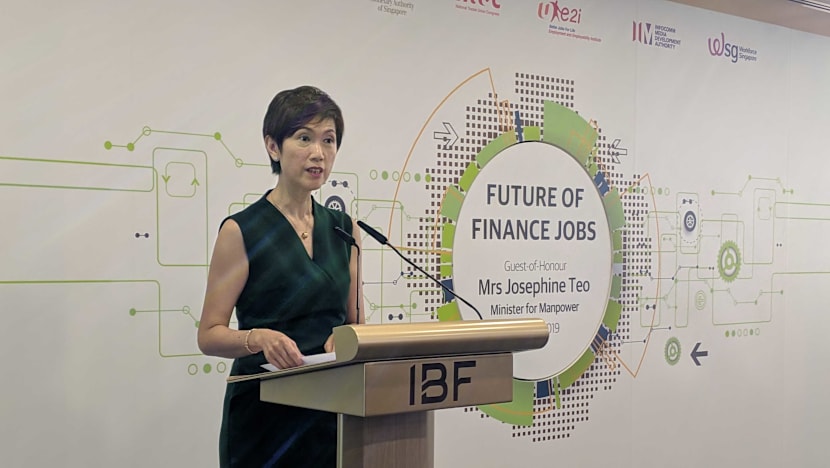
Firms that plan for workforce transformation would be better able to edge out their competitors, said Mrs Teo.
“Especially for HR (human resources), you plan to help the company succeed, I suggest you build (tech talent) and not just buy,” she added.
“Do some serious workforce planning, know your gaps, build systematically and buy selectively. You are more likely to win the race this way.”
BANK TELLERS, TRADERS HIGHLY IMPACTED
Conducted by professional services firm Ernst & Young, the study looked at how the sector would be impacted by data analytics and automation in the next three to five years. A third of the 121 job roles analysed would be transformed, as technology would be used for a significant proportion of job tasks, particularly those that are repetitive.
Bank tellers, traders and policy servicing officers are some current jobs that are assessed to be “highly impacted” by technological disruption, said the study.
It also found that more job roles are increasingly moving away from their silo functions and that workers from different departments re collaborating more often.
While some job roles would be displaced, the study found that human expertise remains critical.
“Despite automation, there will be a need for oversight, results interpretation and exception management/processing, which still require human intervention,” the study said.
Mr Menon said that the main effect of technology is to transform jobs, rather than create or destroy them.
“Technology affects tasks within jobs rather than entire jobs. Many of the jobs we have been doing all these years have not disappeared, but the tasks we do within jobs have changed substantially because of technology,” he added.
The Technology in Finance Immersion Programme was launched on Tuesday to train mid-career professionals in new and emerging roles identified in the study, such as data scientists and cloud specialists. The programme is seeking those with a background in science, technology engineering and mathematics (Stem) who are looking to switch to a career in the financial services sector.
Successful applicants will undergo classroom and on-the-job training with the seven participating financial institutions for up to two years and may be offered full-time positions there.
The seven firms are: DBS Bank, Deutsche Bank, Oversea-Chinese Banking Corporation (OCBC), Singapore Exchange, Schroder Investment Management, the Hongkong and Shanghai Banking Corporation, and United Overseas Bank.
Mr Ng Nam Sin, chief executive officer of the Institute of Banking and Finance Singapore, said that the banks have provided feedback that they are keen to develop four growth areas: Cyber security, cloud computing, data analytics and full stack development, which refers to the development of front- and back-end portions of an application.




