







Demand for home hospice services rising faster than manpower, say providers
The Singapore Hospice Council warns the sector needs at least 20 to 30 per cent more home hospice staff as the population ages.

A nurse taking 86-year-old Paul Wong's blood pressure. He was diagnosed with terminal stomach cancer and chose palliative care at home.

This audio is generated by an AI tool.


SINGAPORE: When 86-year-old Paul Wong was diagnosed with terminal stomach cancer in January, he chose to spend the rest of his days in the comfort of his home.
A year ago, his wife passed away from colorectal cancer at home with the support of Assisi Hospice’s hospice home care service.
“I saw the care she received and I hope would be able to receive that too,” he told CNA.
“I’ve stayed here for over 40 years. I find the place quiet, and the neighbours are friendly. I hope to be comfortable and manage my pain.”





His daughter and grandchildren also live nearby and visit him for meals and activities.
Mr Wong is among a growing number in Singapore opting for palliative support at home. They have also gotten a boost from the government, which is looking to increase the availability of such end-of-life care.
To help more people spend their final days the way they wish to, the Ministry of Health (MOH) has put in place a National Strategy for Palliative Care.
Since its launch in 2023, home palliative care capacity has grown by 25 per cent, from 2,400 to 3,000 places. It is set to increase to 3,600 places by the end of this year.
An equipment rental scheme that was put in place, which provides patients with subsidised essentials like hospital beds, has benefited more than 1,000 Singaporeans so far.
Care providers said it is not just about infrastructure, but also having competent palliative care staff – and there is a shortage.
HIRING STRUGGLES
In fact, demand for such care is rising faster than manpower, with providers saying they need more trained staff to keep up.
HCA Hospice Care, the nation’s largest home hospice provider, said hiring is an ongoing issue.
"One of the things I struggle with is to find the right people with the right heart to do this work,” said its medical director Dr Chong Poh Heng.
“It's not a terribly glamorous (job) to work in the home, in different settings, some of which are, in my opinion, not quite habitable,” Dr Chong added.
“But the patient is comfortable there, so within those limitations (we must) find the means to deliver the same quality of care to those patients and their families."
The hospice looks after about 1,400 home patients and will soon increase capacity to take in more.
Among its ways to manage manpower issues is enlisting the help of the patients’ caregivers.
"We teach (caregivers) some of the knowledge aspects, including hands on (care), hygiene care, serving of medication, sometimes giving injections too,” said Dr Chong.
Family members also learn to prepare special food and manage appliances like oxygen concentrators or suction machines, he added.
Related:
Palliative care nurses give a peek into their work journeying with patients at the last mile
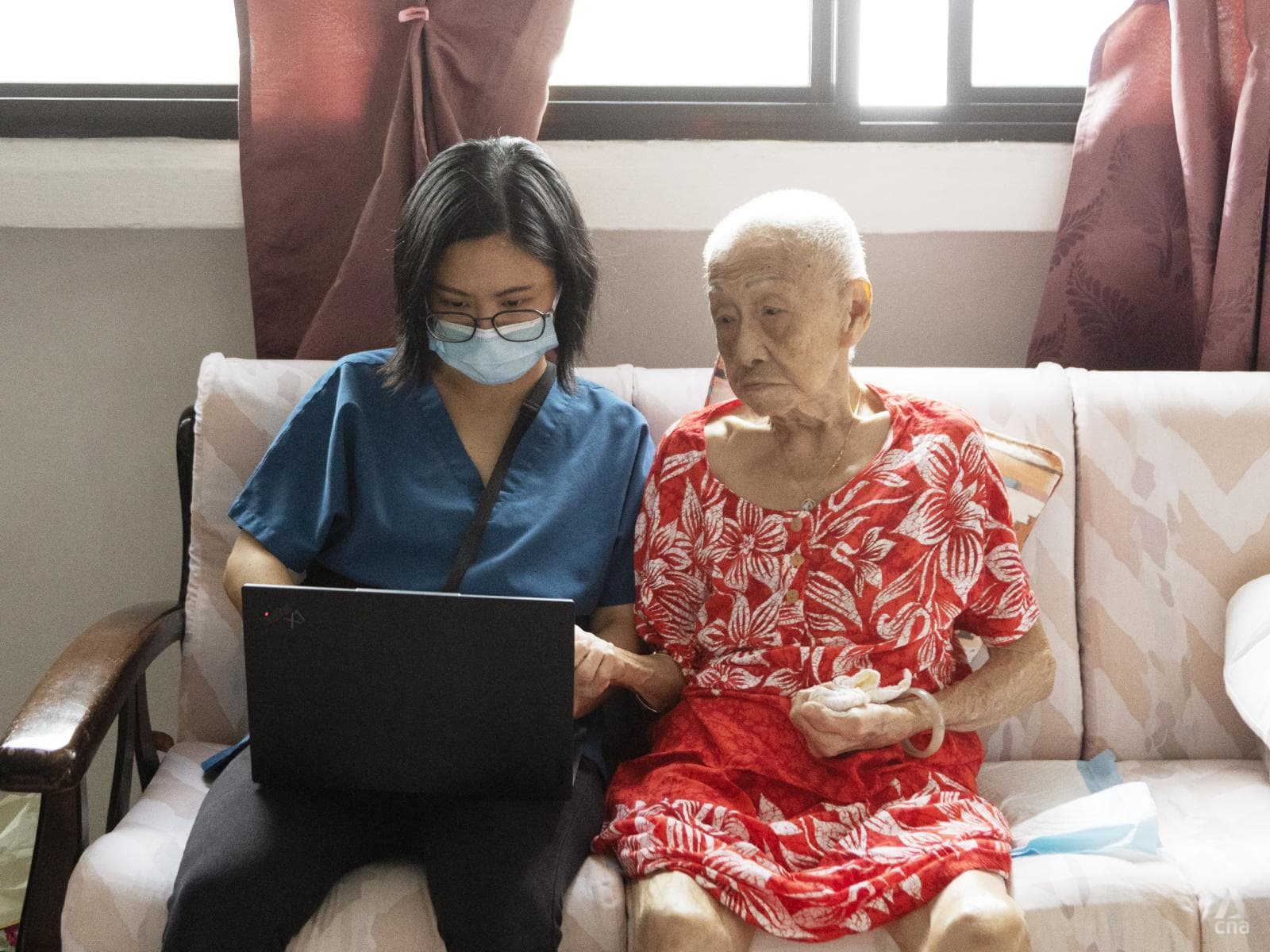
Ms Katherine Lim, a palliative home-care nurse, sitting with Madam Chua Swee Eng. (Photo: CNA/Raj Nadarajan)
The familiar melody of a Teochew opera caught the attention of 95-year-old Chua Swee Eng.
She glanced over at Ms Katherine Lim, 32, her palliative home-care nurse seated next to her, playing the song from her laptop.
The nonagenarian has advanced dementia and typically does not communicate much. Music is one way to make her feel at ease.
A simple nod or smile from Madam Chua would indicate that she is in a “good mood” that day.
In Pixels accompanied three palliative healthcare workers as they went about their task of caring for patients with life-limiting conditions.
They talked about the relationships they have built with their patients and how they support the patients' families as they navigate the difficult and painful journey of end-of-life care.
Palliative care is focused on relieving severe symptoms and it aims to provide as much comfort as possible to patients with terminal illnesses.
'A SENSE OF RELIEF'
Ms Lim has been visiting Mdm Chua one or two times a month for the last seven months.
The nurse from Dover Park Hospice checks on her vitals and the gangrene wound on her right leg.


Her visits provide much relief and reassurance to Mdm Chua’s daughter, who is her primary caregiver with assistance from a domestic worker.
The 64-year-old daughter who did not want to be identified said: “I feel a sense of relief when Katherine is here. I can reach out to her if I have questions."
Over the nine years that Ms Lim has been working in palliative care, she has built close bonds with her patients and their families.
She recalled an elderly patient who treated her 'like a granddaughter" and gave her a monetary gift in a red packet when she got married in September 2019.
She did not keep the money due to company policy, but kept the red packet envelope as a memento for the time she had spent with the patient, who died six months after she got married.
Dealing with death is an inevitable part of palliative care.
“The first death I witnessed when I first started, it was a bit scary because I was just on an outing with the same patient the day before," Ms Lim said.
“Eventually I felt that death itself could be a relief, knowing that the patient is free from suffering.”

PONDERING THE MEANING OF LIFE
Khoo Teck Puat Hospital's senior staff nurse Daniel Sii described one of his former patients Holman Liang as someone who was “stoic” and “wise”.
He was admitted to Yishun Community Hospital recently in August but died earlier this month.
The 90-year-old had gastric cancer and due to his age, the family had declined further invasive treatments and had opted for palliative care.

A railway engineer from China who moved to Singapore 30 years ago, the patient was a man of few words.
There were the occasional moments though, when he was chattier than usual, talking to Mr Sii about politics, history, his love for reading biographies or the meaning of life.
The senior staff nurse said: “When a patient shares a lot of things with me, like the meaning of life, there is definitely a bond. No one will simply blurt out things like that."
And if there was one piece of advice he took from the elderly patient, it was to never stop learning.
“I was impressed that someone his age would continue learning ... I admire that.”


It is not just the physical pains that Mr Sii has to tend to when minding the patients.
“The hardest part of my work is managing the emotions of the patients and their families. It is not uncommon for patients to say, ‘Give me a pill to die’,” Mr Sii said.
“Our role is to journey with them by offering physical and emotional support,” he added.
And sometimes, that means going out of the way to help patients be a part of important life events.
For instance, Mr Sii has helped arranged several marriage solemnisations at the hospital. Patients would otherwise not be able to leave the hospital and attend these events with their families due to their conditions.

WORDS TO A DYING MOTHER
Ms Hazeena Banu Shaik Alaudeen, 41, an assistant nurse clinician from Khoo Teck Puat Hospital, remembered caring for Mary (not her real name), a mother of three who had an advanced-stage cancer last year.
The patient was in a lot of pain and her husband was concerned about how their youngest child, a seven-year-old boy, would react after seeing his mother in such a frail state.
With the help of a social worker, Ms Hazeena encouraged the soft-spoken boy to pen down what he had said to his mother.

In the letter, the boy expressed how much he loved his mum, how he would be strong and that his aspiration is to be a policeman.
Ms Hazeena, who has three children similar in ages to Mary's children, said: “The ‘I love you’ in the note was important and I felt it was a closure for Mary."
The mother later died.
Having been in palliative care for 14 years, Ms Hazeena said that this is what she has learnt from her patients: “We don't know if we are around the next day, so we live each day and appreciate the people around us.”

TRAINING TAKES YEARS
One challenge in hiring is finding personnel with adequate skills and qualifications, as roles in the sector can take years to learn.
Assisi Hospice said its staff nurses are trained for up to three years before they are fully competent and can deliver care effectively.
It is the largest inpatient facility in Singapore, and is leveraging home care to meet growing demand. Its home caseload has grown nearly five-fold over the last decade to about 700 today. The figure is projected to reach 850 by late 2026.
Aside from medical know-how, staff also need training to understand how to manage the mental and psychosocial needs of the patients and their families.

“Palliative care patients (are) very ill, with many comorbidities, different organs may not be functioning. They have been through a lot,” said the hospice’s CEO Choo Shiu Ling.
“Their journey in the healthcare system would have been very long. They have a high complexity of needs. Their caregivers could be emotionally and financially exhausted,” she added.
“It is the nurses and the special skills of a palliative care team that can possibly address all these very complex (issues).”
She said the hospice’s priority is to train its healthcare staff well and continue to grow its home care team.
“Because we discover (that) when nurses are confident and competent, it aids retaining so they stay with us, and we actually have a very low or almost no attrition for our home care team,” noted Ms Choo.
Assisi Hospice currently has 48 staff tending to end-of-life patients at home, and plans to grow the team to 60 by the end of next year.

RISING COSTS
There are around nine providers in Singapore that specialise in home palliative care.
The sector needs at least 20 to 30 per cent more home hospice staff as the population ages, warned the Singapore Hospice Council.
Board member Mervyn Koh suggested adequate remuneration and recognition could attract more to the industry.
With funding another key concern as home hospice is fully subsidised, he said he also expects such care to be chargeable in future.
“Chargeable doesn't mean expensive. If it is MediSave deductible, that may be the way to go in future to keep healthcare costs sustainable,” said Dr Koh, who is also a senior consultant of palliative medicine at Tan Tock Seng Hospital.
“This will enable families to still (fulfil) the wishes of patients passing on at home without having to fork out cash by themselves.”
He pointed out that most home hospice care providers are charity organisations, and it may be challenging to keep up free home care due to rising costs.
"Policy makers can consider potentially opening up, say, MediShield Life to support home hospice care,” Dr Chong said.
“Currently, it can be used in the hospital, in inpatient hospice facilities, but it's not quite possible to use MediShield or insurance to pay for home care."
CNA understands that council members regularly engage with MOH on the future of the sector, including financing.




