







I’m no Tiger mum, insists Judy Murray
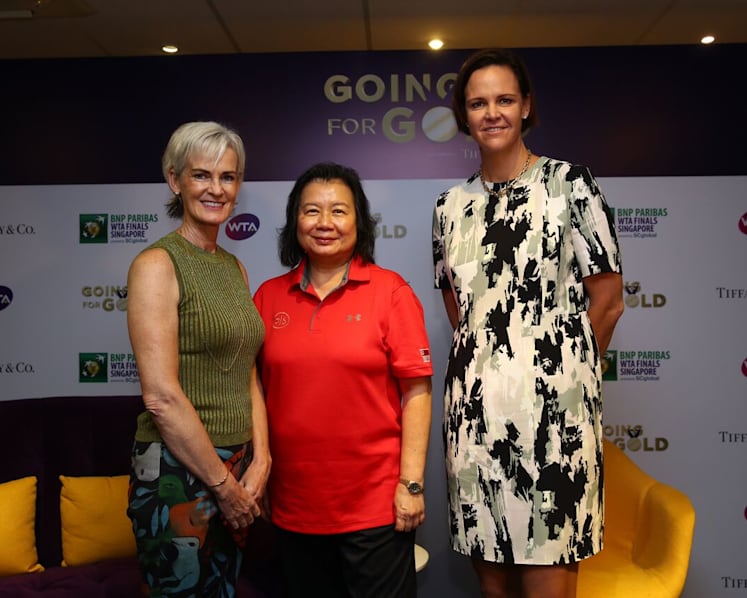
Judy Murray, May Schooling, and WTA Finals Legend Ambassador Lindsay Davenport at a lunch forum. Photo: Getty Images


SINGAPORE – She has been photographed often in roaring, fist-pumping mode in the player’s box at Grand Slams, cheering on her youngest son, three-time major champion, double Olympic medallist and former world No 1 Andy Murray.
While that has earned Judy Murray the label of “tiger mum” by the British media, the soft-spoken 57-year-old insists that she is anything but.
“It’s not every point that I have this face! Only the great ones,” said Murray, smiling as she showed off her tennis poker face on Tuesday (Oct 24) at a lunch forum alongside May Schooling, mother of Olympic swimming champion Joseph Schooling, and WTA Finals Legend ambassador Lindsay Davenport, where she touched on her role in grooming two sons –Jamie and Andy – to become successful tennis players.
It was her hands-on attitude, which ranged from taking up coaching courses and learning how to do sports massages, that allowed her sons to flourish in a sport that was not well recognised nor supported in her home country of Scotland.





Calling it a “cottage industry”, Murray recalled how she applied for the job of Scottish national coach after it was left vacant for 18 months. Her son Andy was only seven years old then, and she said: “At that time, we had only one indoor centre with four courts. It was a minority sport, a cottage industry.
But the parents played a big part and they were the perfect workforce.”
For over a decade, her work with the Lawn Tennis Association included initiating the Scottish Development School programme that eventually produced four Davis Cup players and one Fed Cup player. In 2011, she was appointed captain of the British Fed Cup Team, and has since started several tennis initiatives including Miss-Hits, a programme for girls aged five to eight.
But her biggest success was right at home, when Andy won the US Open Junior in 2004. “That was the moment in which our lives changed,” she said.
“There were photographers at the airport, and I didn’t know why they were making such a big deal out of it. But I went from learning to coach to learning the life of a professional athlete.
“I had a difficult time with the media in UK, they decided I was the parent from hell. I did a three-day public relations course, learnt how to do tax returns in three countries, how to set up a website.”
While noting that Singapore and Scotland differ in culture and climate, Murray believes small countries can do well in tennis with the right plan and people. She added: “Ultimately any success is not about systems and progress, it’s about people.
“So investing in good leader who understands tennis and sport development and create a workforce. You need to have great coaches at entry level, high school, national, and hopefully international level.
“You need at least a 10 year period to start with your seven to eight year old, you need the numbers because kids need to play with other kids. But it would be great to have a legacy from the WTA Finals here. If you get the framework right, find the right people among your own people, because your own people will care about what happens in your country much more than somebody from outside.”
While acknowledging that parents play a big part in children’s success in sports, Murray also cautioned about putting too much pressure on them. Her focus for Andy and Jamie – the two-time Grand Slam doubles winner is 15 months older than Andy – was always on allowing them to play multiple sports and having fun.
“The most important thing is the kids are enjoying it and you are there to support them, through the good times and not so good times and you understand it’s a long term development, and not results when you’re 10 or 12,” she said.
“Individual sports have much more tendency for parents to get too emotionally invested, they invest a lot of time and finances so they can get very caught up in it. I learnt a lot from parents who got it right, and those who got it wrong, but at the end of the day, you find your own way. You know your own kids better than anyone else does.”
It is a philosophy that Mrs Schooling agrees with, as she shared her story on raising her only son Joseph, who left to study and train in the United States when he was a teenager in order to achieve his Olympic dream.
“Joseph was the one who was driven, he wanted to be at the Olympics, he wanted to win, he wanted to be on the podium, that was his target,” she said.
“Some people have asked me, what’s the secret formula? There’s no secret formula, the kid has got to want it. You must give them the chance to find out what they want to do. But don’t expect your kid to be an A-star student all the time, don’t put too much pressure on your kids. Make sure they enjoy what they do.”
Former world No 1 player Davenport agreed that it is important for children to try out different sports, and to keep it fun.
The mother-of-four added: “I started playing tennis at six, and even though my parents tried to get me to play volleyball, I didn’t and I regret it. I make my sons (who play tennis) do team sports every season, doing the opposite of what I did in the hope that they become more athletic.”
Developing well-rounded individuals is important for a coach and tennis mum like Murray, who is immensely proud of her sons’ achievements. Those public relations skills picked up along the way have also come in handy, as when questioned on Andy’s dour demeanour – which the British media have labelled boring – at press conferences, Murray insisted, with a guffaw: “He’s not boring at all, sometimes the questions are boring!
“What you have to remember tennis unlike any other sport, the players have to do a press conference after every match you play. If you’re a footballer, you might do one a season.
Calling her youngest son a “bit of a geek”, she added: “To get the best out of Andy, you have to ask him questions that engage him in something he’s interested in, one of his causes or ask him about the actual tactics, momentum, the flow of the match and then he’ll come to life because he’s talking about something that he’s interested in.”




