







'Impressive Kawasaki went all out' to repair train defects
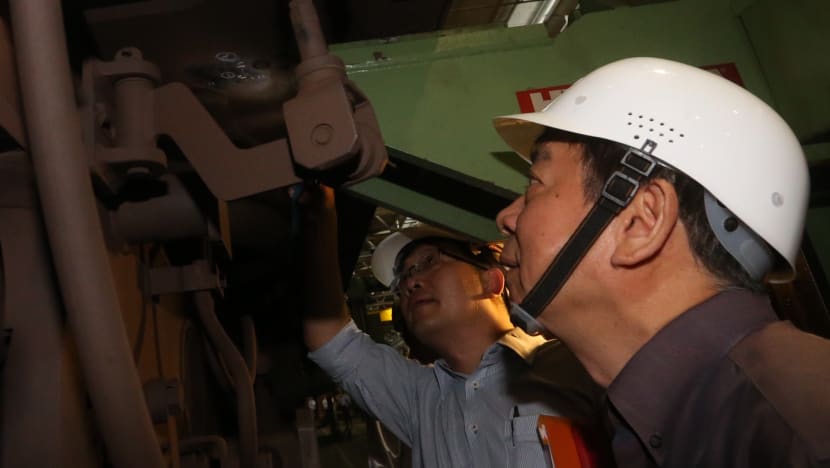
Transport Minister Khaw Boon Wan inspecting a fixed bolster on a SMRT train that has a hairline crack, at Bishan Depot on July 12, 2016. Photo: Ooi Boon Keong/TODAY


SINGAPORE — The response of Japanese manufacturer Kawasaki Heavy Industries to the hairline cracks that appeared on 26 SMRT trains has been impressive, and all organisations, including town councils, should try to emulate it, said Transport Minister Khaw Boon Wan on Tuesday (Aug 16) , alluding to the Workers’ Party’s (WP) handling of lapses found in Aljunied-Hougang-Punggol East Town Council (AHPETC).
Responding to a series of questions in Parliament on the defective trains, Mr Khaw said that Kawasaki, which partnered CSR Sifang in China for the tender of the trains, had taken ownership of the problem “at great cost to themselves”. “(They were) not in denial of the problem and went all out to protect their reputation, made certain decisions not at our request but on their own — bolsters replaced, car bodies replaced, extended warranty, clock restart ... that’s much more than one can hope for from any manufacturer,” he said.
Cracks on the trains’ bolster, a structure supporting the train car body, were discovered about 27 months into service. Most of the cracks were less than 30cm, while two bolsters were found with 40cm to 50cm cracks. Following the discovery of the problem, the manufacturer arranged for the bolster and car bodies to be replaced in Qingdao, China, although the trains remained safe for use.
A decision was made for them to be shipped back one at a time for repairs from July 2014. To date, five trains have been repaired.





“At the end of the day, when confronted with the problem, how do you deal with it? There are people who will deny, blame others, or in this case, Kawasaki immediately sent their engineers down, identified the primary cause and worked out how to move from there,” said Mr Khaw, who is also Coordinating Minister for Infrastructure.
“All organisations should try to emulate (Kawasaki), including all of us who take responsibility, let’s say, for running a town council. That should be the attitude we take when we confront problems. Take ownership, rectify (the problem) to the satisfaction of the customer,” he added.
Earlier in the Parliament sitting, Senior Minister of State for National Development Desmond Lee also expressed concern about the WP’s slow progress in rectifying lapses that the Auditor General had found in the management of AHPETC.
As he reiterated that the repairs of the 26 defective trains will not affect train service, Mr Khaw also said Kawasaki has extended the defects liability period and warranty period for the replaced bolsters and car bodies for five years.
Kawasaki also changed its bolster supplier from the China-based Longkou Conglin to Japanese firm Kobe Steel. In 2009, Kawasaki and CSR Sifang, together with Kawasaki’s Singapore subsidiary, had bagged a S$369 million contract to supply 22 six-car trains for the North-South and East-West lines. SMRT subsequently ordered another 13 trains of the same model.
Mulling over the learning points from this episode, the minister said one lesson was that it was always better to provide more information, rather than less, in public communications. This was something that he learnt during the Severe Acute Respiratory Syndrome (Sars) outbreak in 2003, where he was part of a Government-appointed team handling the crisis.
Mr Khaw said: “That time, (there was) a lot of misinformation, lack of information, lies going on. Coming out to share with the people what you know, including what you don’t know ... that is always the better strategy than to try and keep information to your chest.”




