In and out of surgery in a jiffy, thanks to robotics
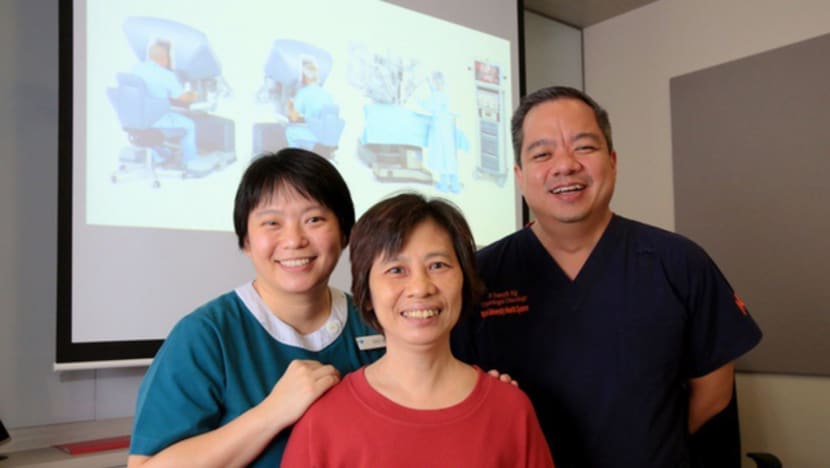
It’s smiles all round for Ms Joyce Er, advanced practice nurse, NUH (left); Mdm Goh Hui Im (centre); and Dr Joseph Ng, senior consultant, division of gynaecological oncology, department of obstetrics and gynaecology, NUH (right). PHOTO: KOH MUI FONG
SINGAPORE — When Mdm Goh Hui Im underwent a hysterectomy to remove her entire womb early this year, following an endometrial cancer diagnosis, she had expected to feel pain and weakness after the major surgery.
But the 57-year-old mother-of-two was up and about hours after her procedure in the morning. By evening, she felt well enough to be discharged from hospital.
“When I reached home, my family was surprised to see me. They could not believe I had already completed the surgery as I did not look or feel like a patient,” said Mdm Goh, who has completed her treatment and intends to work part-time.
Mdm Goh is among the first five patients to undergo an outpatient hysterectomy at the National University Hospital, which began offering the day surgery in March and is currently the only hospital in Singapore doing so.





Each year, it performs about 100 to 120 hysterectomies for endometrial cancer, which begins in the inner lining of the uterus. The standard treatment for this cancer, a hysterectomy, is usually “curative” in 90 per cent of cases when detected early, according to Dr Joseph Ng, senior consultant at NUH Women’s Centre and the National University Cancer Institute, Singapore.
Considered a major gynaecological operation, a hysterectomy was traditionally performed as an open surgery that involved large incisions in the abdomen. Patients typically required a week-long hospital stay after surgery, and may take two to three months to achieve 90 per cent recovery, said Dr Ng.
But advancements in minimally invasive surgical techniques in the last decade — using surgical robots (see box) — have improved recovery time for patients, allowing them to get back on their feet faster.
Mdm Goh’s hysterectomy was performed using a robot with ultra-flexible mechanical arms controlled by a surgeon seated at a nearby console, via tiny incisions in the abdomen.
“For a long time, a hysterectomy has been perceived to be a major surgery with a long recovery period. When we started performing robotic hysterectomies some years back, a next-day discharge was possible. Now we hope to change patients’ mindsets that a same-day discharge is as safe, and has been done in other countries such as the United States,” said Dr Ng.
With the same-day discharge service in place, about 90 per cent of eligible patients undergoing a robotic hysterectomy at the hospital will be fit enough to go home the same day, added Dr Ng.
The most common gynaecological cancer in Singapore, endometrial cancer rates have more than tripled over the past 40 years, according to figures from the National Registry of Diseases Office.
As the number of hysterectomies performed is expected to rise, a same-day discharge programme would help free up hospital beds and maximise healthcare capacity, said Dr Ng.
But not all patients welcome an early discharge. Obstetrician and gynaecologist Suresh Nair from Mount Elizabeth Novena Hospital said: “Most local and regional patients generally do not appreciate being discharged too soon as they feel a need to recuperate in the hospital post-surgery.”
Dr Lewis Liew, a urologist and kidney transplant surgeon at Farrer Park Hospital, said same-day discharge is currently not known to be the usual practice for patients undergoing major surgeries using robotic-assisted technology in Singapore.
While the technology enables more surgeons to perform a hysterectomy expeditiously, Dr Nair said it is “prudent” to observe the patient for at least one to two nights, especially in cases of extensive surgery.
“Sometimes, post-surgery issues such as bleeding, urination difficulties requiring a catheter or wound infection could occur. Even in the United States, patients who are discharged the same day are observed in a nearby motel or hotel where medical staff visit (them) daily,” he added.
NUH’s advanced practice nurse Joyce Er said nurses play an important role in patients’ post-surgery recovery. To ensure patients cope well and are assessed for potential issues, NUH nurses conduct phone follow-ups with patients after they are discharged.
According to Ms Er, it is well-documented that nursing support and counselling reduce post-surgery anxiety and the need for pain medication.
“Some patients may face psychosocial challenges during the post-surgery recovery period. Nursing support and patient education play important roles in (helping them cope) with the recovery process,” she said.