







ITE enrolment on the rise, in spite of smaller cohort
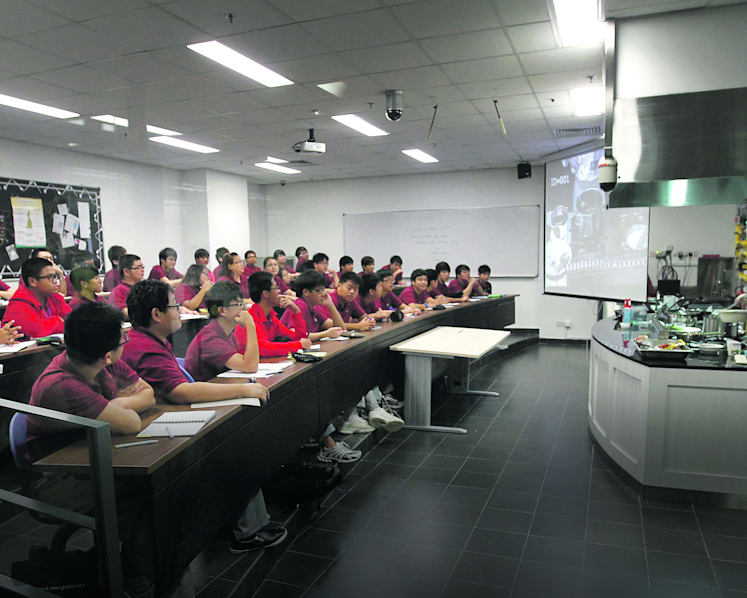
Students having a lesson at ITE College West. TODAY file photo


SINGAPORE — Fuelled by greater encouragement from schools to pursue the Institute of Technical Education (ITE) path, total enrolment at the ITE has risen over the years, even as the number of students entering post-secondary educational institutions is falling amid shrinking birth rates.
Latest available figures show that the cohort size fell by about 10 per cent from 41,500 students in 2013 to 38,200 in 2014, leading to falling intake sizes on the whole, but total ITE enrolment still increased from about 26,000 to about 28,000 over the same period, with no change in admission criteria for most ITE courses. It is also up from 21,603 in 2005, and the biggest increase — nearly 7 per cent — since the 9.4 per cent increase seen from 2005 to 2006. Figures for 2015 will only be available later this year.
Among a slew of reasons for the increase in enrolment is a “conscious effort” on the Ministry of Education’s (MOE) part to encourage Normal (Technical) stream students to enter the ITE, such as under the Enhanced Nitec Foundation Programme (eNFP) introduced in 2014, said a ministry spokesperson in response to queries from TODAY.
The eNFP allows students with one or no N-Level passes to enter ITE, but they have three years to complete Nitec courses instead of two.





The ministry has also been successful in “channelling” Secondary 4 Normal (Academic) students into ITE through the Direct-Entry-Scheme to Polytechnic Programme (DPP), where students who completed their N-Level exams can enter the ITE’s two-year Higher Nitec programmes without having to sit for their O-Levels, and are guaranteed a place in a polytechnic diploma programme so long as they meet a minimum Grade Point Average.
Teachers and students whom TODAY spoke to raised other possible reasons for the jump in enrolment. Some teachers have been advising their Normal (Academic) students to apply to ITE directly after taking their N-Levels, rather than take O-Levels the following year and risk not doing well enough to get a spot in a local polytechnic, said one ITE teacher who wished to remain anonymous.
She also noted the Government’s SkillsFuture drive, which has enhanced vocational options for students. Initiatives like the Earn and Learn programme, which matches polytechnic and ITE graduates to employers to work and train towards industry-recognised certification, could entice students to choose the ITE, she said.
A secondary school teacher, who declined to be named, concurred, adding that not all Normal (Academic) students can cope with the syllabus change from Secondary 4 to Secondary 5 and higher stakes and greater expectations. She also noted the improved image of ITE, with state-of-the-art campuses and resources “that are even better than what universities are getting”.
ITE student Balaprashanth Konasegaran, who is currently pursuing a Higher Nitec in Passenger Services, pointed out the increased variety in ITE courses, which he and his peers found attractive while considering their post-secondary education choices.
“There are more courses to choose from and some are not available in the polytechnics. For certain polytechnic courses, the cutoff is also lower, so we will go to ITE to study what we want if we cannot get into the same poly course,” the 18-year-old added.
Former ITE student Shawn Lim, 25, could have sat for the O-Levels after finishing his N-Levels. But he was part of the pioneer batch of students who had the option of entering a Higher Nitec course after graduating from secondary school if they did well enough in their N-Levels, and thus decided not to “waste a year”.
“People are starting to realise that having and gaining skills is as important as, if not, more important than a purely theory-based education… Contrary to what people say, students actually are keen to learn and the lecturers are willing to teach...the learning was enjoyable and it equipped me with the skills that I use in my job today,” the journalist added.
There are currently 98 full-time Nitec and Higher Nitec courses, and over 30 traineeship courses available to secondary school graduates.




