







Kashmir conflict: Indians, Pakistanis living in S'pore worry for family, friends back home
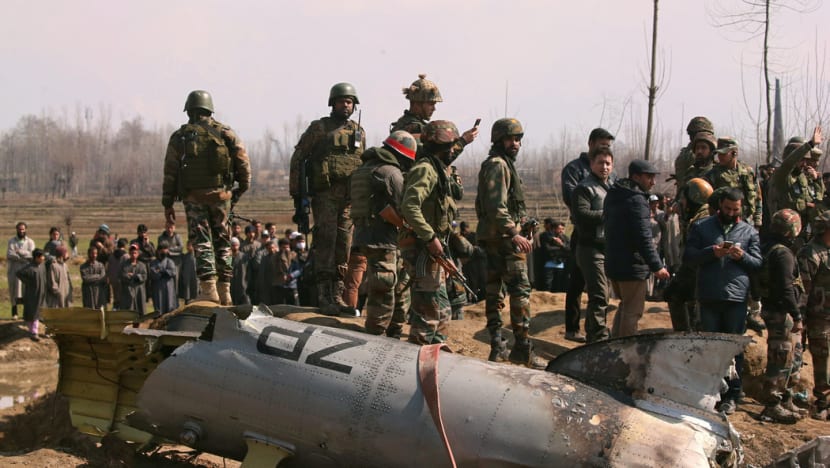
Indian soldiers near the remains of an Indian aircraft after it crashed on Wednesday.


SINGAPORE — As tensions mount due to escalating hostilities over the disputed Kashmir region, Indian and Pakistani citizens living here are keeping close tabs on the situation for fear of the safety of their family and friends in the two countries.
Pakistani national Mohammad, who declined to give his full name, told TODAY that he has been trying to keep track of the developments by requesting information from friends who live close to the action at home.
“My WhatsApp group chats have been five times as active,” said Mr Mohammad, who has lived in Singapore for more than 10 years and has family and friends in Pakistan.
“My friends (in the Pakistan military) are giving updates not yet in the news.”





Although the armed conflict has been largely contained in the disputed border region, a number of Indians and Pakistanis here are worried that hostilities could spiral beyond Jammu and Kashmir.
Mr Asif Khan, 34, moved from Pakistan to Singapore about seven years ago and his parents and brother live in Faisalabad in the eastern province of Punjab.
“My family said they’re okay as they’re not near the conflict, but I can’t help but worry if the tensions do increase,” said the mechanical engineer.
Indian national Dinesh Naidu, 40, said that his parents, who live in Jaipur, cancelled plans for a weekend trip as a safety precaution.
“They booked a really nice resort in Chandigarh with some friends, but they all decided to stay home just in case,” said the IT support manager.
Another Indian national who did not want to be named said that she is concerned for the safety of her parents, who live in Delhi.
“Although they are not directly affected by the conflict, there are always uncertainties to what may happen next,” said the 26-year-old financial analyst.
“You can never say how it is. It can spread.”
India and Pakistan have been fighting over Kashmir since the British left in 1947, with armed conflict reigniting this past month. Both countries control parts of the territory, but each claims full ownership.
On Tuesday (Feb 26), India conducted airstrikes over the disputed Kashmir border on the training camps of a Pakistan-based militant group. The group had claimed responsibility for a suicide bombing in Kashmir two weeks ago that killed at least 40 Indian paramilitary troops.
The next day, Pakistani jets entered Indian-controlled territory over the disputed border state of Jammu and Kashmir. Pakistan claimed that they shot down two jets and captured an Indian pilot, who is expected to be released on Friday.
CONCERNS OVER FLIGHT SAFETY
Following the air skirmishes, Pakistan closed its airspace and India shut down at least four airports near the border. Although most flights had resumed by Friday, those whom TODAY spoke to are still concerned about air safety and worried that airports may close again.
Mr Khan had intended to travel home to Pakistan sometime this year, but said that he is having second thoughts after the recent incidents.
“Even though the flights may continue, it seems dangerous to fly after they shot down a plane,” he said.
Ms Chandreyee Ray, 21, a Singaporean who has several extended family members living in India, also said that the airport closures are a cause for concern. Her father had initially planned to travel from Singapore to Kolkata to visit her uncle who recently suffered heart failure and was under intensive care in a hospital.
“My dad was planning to go over sometime this weekend or next week but now, we are uncertain if airports will remain open. Flight safety is also a concern,” she said.
‘PEOPLE DON’T WANT TO FIGHT, WE WANT PEACE’
As the conflict between India and Pakistan continues to simmer, the tension has strained some relationships between citizens of both countries who are living here.
“Everyone is quite charged up in their personal space,” said Mr Mohammad. Some of his Pakistani friends had gotten angry over comments from Indian colleagues that were “incendiary” in nature, but they chose not to respond, he added.
Others said that they were careful when discussing the topic, although they said that Indians and Pakistanis here have largely remained cordial with one another.
Ms Ray said she is “inclined to avoid the topic” if she were speaking to a Pakistani.
“I would be wary of discussing the conflict happening right now, or even the history of war and conflict our countries have had,” she said.
All eight individuals TODAY spoke to were hopeful that the situation would tide over.
“Harmony should be the end goal. I sincerely hope there will be a peaceful resolution for this issue,” said Mr Naidu.
Ms Naureen Sattar, who is the vice-president of the Singapore Pakistani Association — which has about 1,800 members, said its members frequently meet for dinners and gatherings. Indian nationals have also attended some of these events, she added.
“Indians are just like us too. In the end, we are all just people,” said the 58-year-old housewife, who has lived here for almost six years.
Ms Sattar said that she has many Indian friends and had just visited an Indian friend’s home for karaoke and a movie on Thursday when TODAY spoke to her.
“It’s a sad situation,” said Ms Sattar, adding that her Pakistani and Indian friends all hope for the conflict to end.
“People don’t want to fight, we want peace.”




