







Labour movement ‘must help workers transit into new jobs’
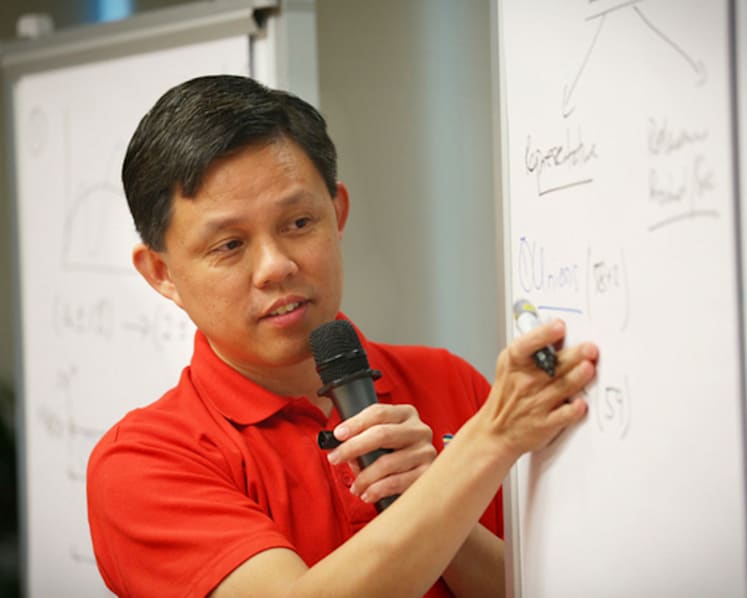
Labour chief Chan Chun Sing said beyond the existing services, health and eldercare will be vital needs that NTUC’s social enterprises must step up to meet. Photo: Nuria Ling


SINGAPORE — With technology and changing business models disrupting jobs, the labour movement wants to help workers minimise the time needed to transit into new jobs, labour chief Chan Chun Sing said yesterday.
Speaking to reporters at a briefing ahead of May Day, Mr Chan, the National Trades Union Congress’ (NTUC) secretary-general, cited preparing workers for more frequent transitions as a priority of the labour movement.
It was “not good enough” only to identify and place workers into jobs, but also to help them anticipate changes and the skills required to take on those jobs. “The question is how fast and how well we help our workers to transit,” he said.
On this front, the NTUC has in January formed the Future Jobs, Skills and Training Unit, which works with the Government and tripartite partners to forecast new skills and develop training programmes, he said.





As workers switch jobs more often — unlike in the past, when they could stick to a single job throughout their careers — the labour movement also wants to look at their long-term retirement adequacy with the increased transitions, said Mr Chan. “Will (the sum) be more or less … with these more frequent changes?” he asked.
To prepare workers for the ever-evolving jobs landscape, the NTUC has started the U Career Network to reach out to, among other groups, students to offer career guidance and counselling at 14 institutes of higher learning (IHLs).
An element of the initiative, called the Youth Career Network, will encourage youths to tap the labour movement’s suite of services on this front. Meanwhile, to promote continuing education and training, Mr Chan said the NTUC, tapping on the S$200 million NTUC-Education and Training Fund, will work with the IHLs to build new pedagogy and models of learning better suited to the needs of busy adult learners.
“People have less dedicated time to go for long courses and modules,” he said. More details will be unveiled on May Day, he added.
Like other segments of the economy, Mr Chan noted that NTUC’s “staple” social enterprises, such as NTUC FairPrice and NTUC Income, will be disrupted by technology and evolving business models.
They will have to look at how they can do better in leveraging technology to serve customers better. “We’re challenging ourselves to disrupt our own models even before people disrupt us,” he added.
Mr Chan said health and eldercare will be vital needs that its social enterprises must step up their efforts to meet. The cost of these services will increase over the course of one’s life, becoming “pressure points”, he noted. “(They’re) essential services that we want our people to … access easily and at an affordable price,” he said.
He said that, over many months, NTUC has been providing community health services through NTUC Health and its nursing homes to understand the “cost drivers”, in order for it to moderate prices and grasp how to control such critical costs.
Mr Chan said that NTUC is also looking at how its 10 social enterprises can team up to provide an “integrated suite of services”, rather than operating in silos.
For example, as part of the People’s Association’s Embracing Parenthood movement, NTUC Income and NTUC First Campus came together to offer perks to benefit young families, he said.




