







Lesser-known stories of Telok Ayer revisited this Car-Free Weekend
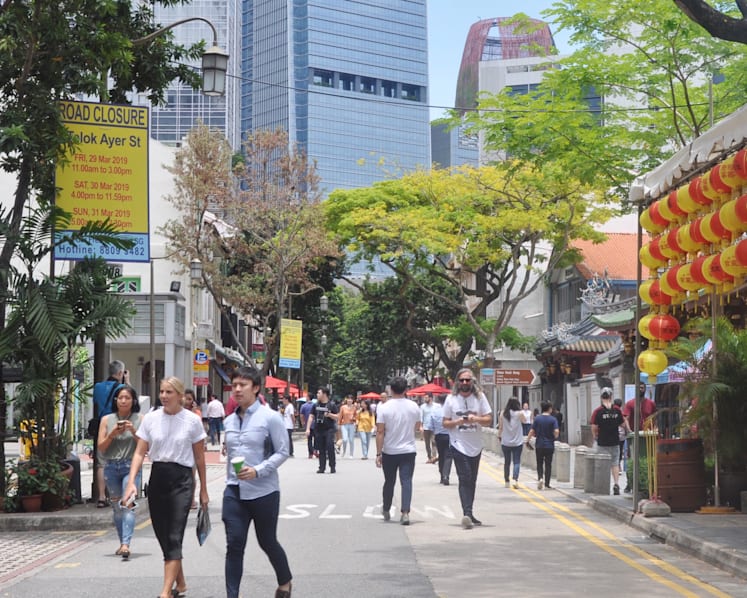
The latest edition of Car-Free Weekend features a series of exhibitions dubbed “Our Telok Ayer Stories”, an exploration of Singapore’s oldest streets.


SINGAPORE — Few might know that Telok Ayer, now a bustling hub of upscale restaurants and pubs in the city centre, used to be situated at the island’s coastline as the landing point for migrants decades ago.
This weekend, the streets in the area will be closed to all vehicles so people can learn more about the area's history through creative installations and community activities, including one which uses augmented reality (AR) to show people a flooded Cecil Street in 1948.
Happening from March 29 to 31, the latest edition of Car-Free Weekend features a series of exhibitions dubbed “Our Telok Ayer Stories”.
Curated by media publisher Our Grandfather Story, the series is an exploration of Singapore’s oldest streets inspired by the lesser-known histories of the heritage district.





Pointing out Telok Ayer’s historical significance, Our Grandfather Story co-founder Ng Kai Yuan, 25, said the area “reflects key development and sentiments in Singapore through different time periods, and that gives us breadth to reimagine its stories”.
“It’s a different experience for the visitors when they come down and see, and know of these stories through the art experiences,” added Mr Ng.
This is the publisher’s first collaboration with Car-Free Weekend, a community initiative spearheaded by the Urban Redevelopment Authority, Land Transport Authority, National Parks Board and National Arts Council, among other agencies.
TODAY went down to Telok Ayer on Friday (March 29), to check out the first day of the Car-Free Weekend activities.
Here are some highlights visitors can keep an eye out for:
EXPERIENCE HISTORY THROUGH ART
In the past, Telok Ayer Street was the shoreline of Singapore. To mirror this, an exhibition featuring photographer Lim Wei Xiang’s works documents the coastline of Singapore.
Titled “Coastline”, it explores the “relationship between Singaporeans and the sea, and how it has changed”, explained curator Chong Kai Yan, 24.
“Then you compare our current state versus the past. The first immigrants landed here and this used to be the centre of Singapore.”
Printed on fabric, the medium also symbolises the “fluidity of the relationship”, Ms Chong added.
“It is ever evolving, because of the fact that we are an island nation and how there is constant reclamation and development.”
Another interesting installation is “The Flood on Cecil Street, 1948”, an AR piece by artist Leong Man Wei. Visitors can scan it on their phones to envision what the floodwaters looked like in that era.
On Saturday, performer Polina Korobova will take to the streets dressed from head to toe in gold paint and glitter.
This “glitter queen” was inspired by how the Telok Ayer area used to have the nickname “Golden Shoe”, derived from the area’s resemblance to an upturned shoe and its value as prime land.
But with redevelopment of the area and the relocation of Golden Shoe Hawker Centre, “the name is kind of lost and no one really knows of it anymore”, pointed out Mr Ng.
“So this is a reminder that this place used to have this iconic name.”
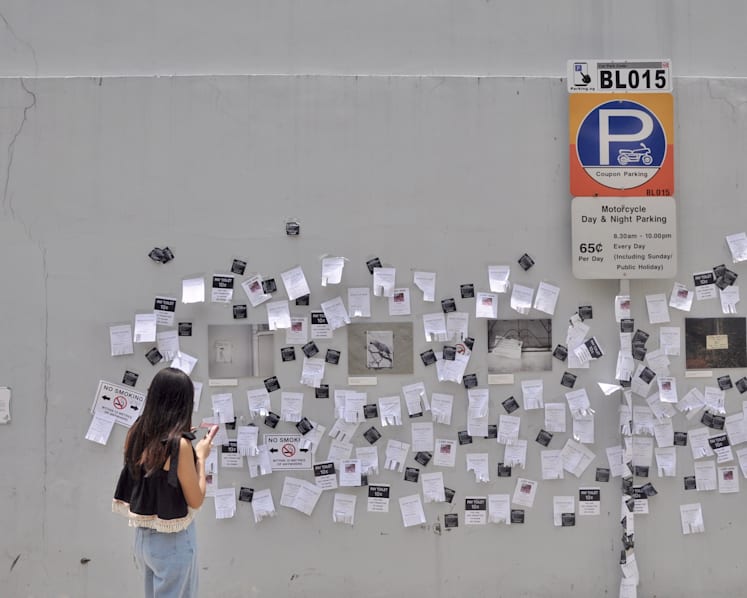
Visitors can see through the notices the 'innermost needs' of people in the past.
CULTURE ON DISPLAY
On a nondescript wall beside the car park at Amoy Street, a collection of public notices shrouds the wall, with familiar content on them such as rental information, lost pet notices or job offers.
“These public notices actually tell a lot about this city and our urban residents,” said Ms Chong.
Titled “Singapore on Public Notice”, she added that “these reflect the innermost needs of people. For instance, tuition, needing a place to stay, or if you’re willing to pay thousands to find your precious lost dog.”
Visitors can also find a locker placed in the middle of Telok Ayer Street, with yellow helmets ready for them to don and take selfies with.
With skyscrapers a common sight in Singapore, the #YellowHelmetChallenge campaign aims to foster friendships with the migrant workers who have contributed to urban development here.
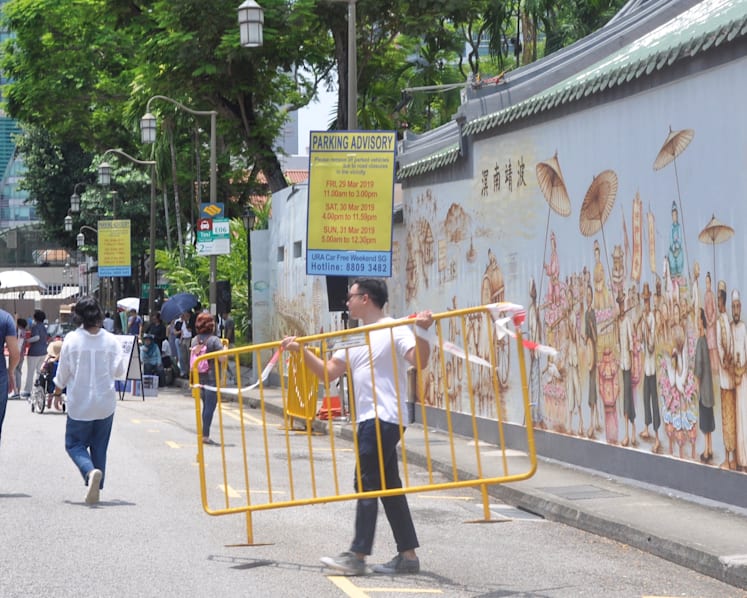
This 44-metre-long mural depicts key events of the past.
OUR GRANDFATHER ROAD
People who have passed by the area near Thian Hock Keng temple would not miss the 44-metre-long mural that graces the temple’s facade.
Inspired by the key events as depicted on the mural, a street takeover titled “Our Grandfather Road” will feature mini installations and activities for visitors to partake in, said Ms Chong.
One example would be a sampan ball pit, mirroring a “sampan imagery” inspired by how immigrants landed in Singapore via boats and ships.
While there have been previous Car-Free Weekend events, Ms Chong noted that this edition highlights more of Singapore’s heritage and community.
“This weekend, it’s more about the spirit of exploration, kind of in line with how this area used to be in the past when immigrants had to explore the area themselves when they first landed in a foreign land,” she said.
This edition of Car-Free Weekend runs from March 29 to 31, in the Telok Ayer area as well as the Civic District.
Visit the historic temples in the area, enjoy traditional puppet shows and outdoor film screenings, or hop on a trishaw ride.
For more information, visit ourtelokayerstories.com and ura.sg/carfreesundaysg




