







Liberal foreign manpower policy a quick, but wrong decision: Giam
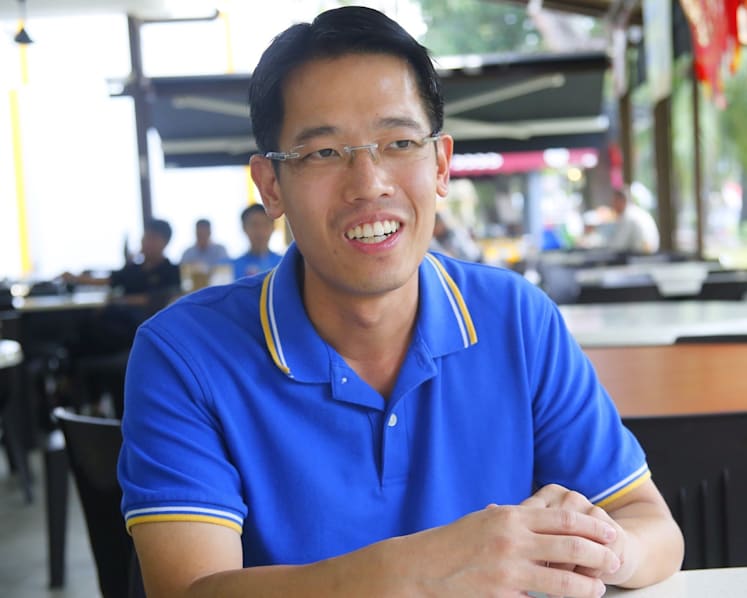
Mr Giam felt that with the 12th Parliament having a record number of opposition MPs, the Government was ‘forced to sit up and listen’. Photo: Ernest Chua


SINGAPORE — The liberal foreign manpower regime of the past was a “quick, but wrong decision” that exemplifies the need for an effective Opposition in Parliament, Mr Gerald Giam, a member of the Workers’ Party (WP) Central Executive Council, said in an interview with TODAY.
“If there had been more debate on the trade-offs of having this large population growth, I don’t think (the Government) would have embarked on such a tremendous opening of the floodgates … A lot of what we are doing right now is actually trying to reverse the effects,” said Mr Giam, who served as a Non-Constituency Member of Parliament (NCMP) in the 12th Parliament.
In an interview with TODAY last week, Manpower Minister Lim Swee Say stressed that the tightening of the Republic’s foreign manpower policy was not a reaction to past mistakes, but a reflection that realities had changed.
With Mr Giam tipped to lead a WP team to contest in East Coast GRC in the coming General Election (GE) — and go up against a People’s Action Party (PAP) team led by Mr Lim — it was perhaps unsurprising that Mr Giam spent much of the 45-minute interview with TODAY speaking about manpower issues. However, he remained tight-lipped on his plans for the GE, when asked to talk about the subject.





Mr Giam was part of the WP team who contested in East Coast GRC in the 2011 GE, garnering 45.2 per cent of the vote — a result that enabled him to be offered the NCMP post, as one of the “best losers” among the opposition candidates.
During his stint as NCMP, Mr Giam spoke mainly on healthcare and transport issues. If elected, he wants to focus on manpower and economic issues, such as investing in Singaporeans, helping them get better jobs and raising their incomes, he said.
“I would like to look more into how we can increase the workforce’s productivity, because that is really lagging behind. In the four years that I have been in Parliament, productivity has been either flat or negative,” said the 37-year-old father of two children, aged seven and five.
Mr Giam was among the more vocal Opposition members in the 12th Parliament, asking more than 150 questions and making over 50 speeches.
Earlier this month, Deputy Prime Minister Teo Chee Hean pointed out that the Constitution guarantees that there will at least be nine Opposition members in Parliament.
He added that the Opposition in Parliament had no bearing on the many policies introduced or refined by the PAP government since the 2011 GE, as the foundation for these plans had been laid out earlier — a point that was echoed by Deputy Prime Minister Tharman Shanmugaratnam at a separate event.
But Mr Giam disagrees. He felt that with the 12th Parliament having a record number of opposition Members of Parliament (MPs), the Government was “forced to sit up and listen”. There were seven elected MPs and three NCMPs in all.
Though a novice in Parliament, Mr Giam had on a few occasions had to withstand heavy artillery from the PAP’s big guns — at times, coming off second best — including during the debates on the Population White Paper in February 2013 and ministerial salaries in 2012.
Mr Giam described those experiences as “interesting”, and said he had learnt from them to “treat PAP frontbenchers as fellow human beings”, not “god-like” figures.
“It’s really a matter of seeing it as a conversation with a fellow human being, rather than someone who is more powerful,” he said.
On the WP’s performance in Parliament, Mr Giam acknowledged that there has been some criticism, but pointed out that the party seeks to be responsible and would always do its homework and avoid grandstanding. Otherwise, it would be much easier for the Government to dismiss the Opposition’s ideas, “because it will sound like a voice in the wilderness”, he said.
“If we have considered the trade-offs and presented an alternative ... that is more ‘implementable’ ... we can increase our effectiveness in Parliament,” he said. “If we had taken the other path, we will be having a different discussion about the WP right now. We will be discussing how the WP is composing nonsense in Parliament, and all its ideas are just wacko.”
Though the 2011 GE was described as a turning point in Singapore’s political landscape, Mr Giam said the coming polls will be “the real watershed election”.
“It would determine whether what has been achieved in the last election will continue … People have tasted what it’s like to be a competitive democracy, and I don’t think they will want to stop just there,” he said, arguing that there is still a long way to go before Singaporeans “really have significant bargaining power over the Government”.




