







Loan schemes, tax rebates among measures to help SMEs weather uncertainty
Photo: Koh Mui Fong
SINGAPORE — To tide firms over in the immediate future amid the uncertain economic climate, the Government is putting out wide-ranging measures, including a new loan scheme for small and medium enterprises (SMEs), adjustments to the corporate income tax rebate and more support for mom-and-pop stores.
Finance Minister Heng Swee Keat revealed in his Budget speech yesterday that the existing corporate income tax rebate will be raised from 30 per cent of tax payable to 50 per cent, with an annual cap of S$20,000 rebate for 2016 and 2017. The 50-per-cent rebate was last effected in 2001.
This raising of rebates will benefit SMEs in particular, and will cost the Government an extra S$180 million over two years, bringing the total rebates given to companies to nearly a billion dollars over the same period.
An SME working capital loan will also be introduced, capped at S$300,000 per company. Under this scheme, the Government will co-share half of the default risk of such loans with participating financial institutions. This measure, available for three years, will support “viable SMEs that may have cash-flow concerns or wish to continue growing their business”, the minister said.





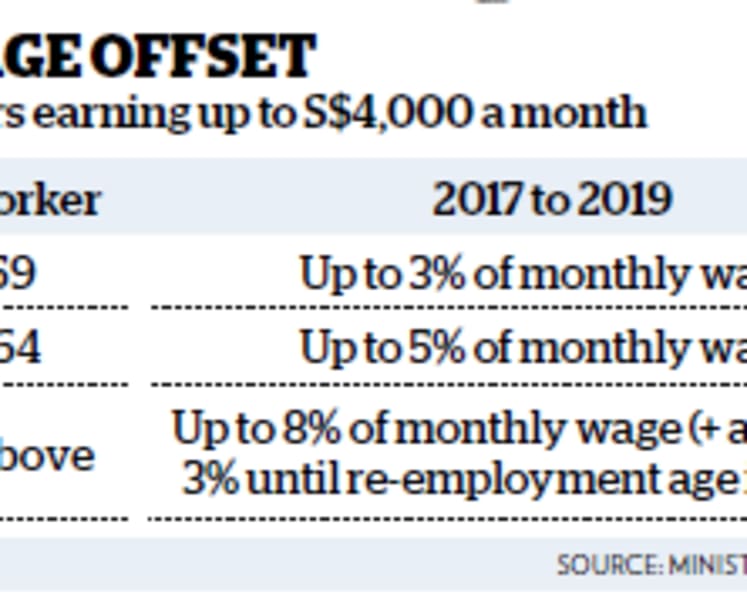
The Special Employment Credit, due to expire this year, will be modified and extended until end-2019. The scheme allows employers to receive wage offsets for Singaporean workers who are aged 55 and above and are earning up to S$4,000 a month.
Those with Singaporean workers aged 65 and above will continue to receive a wage offset of up to 8 per cent. This is on top of the wage offset of 3 per cent for the re-employment of workers aged 65 and above, until the re-employment age is raised in 2017.
For workers aged 60 to 64, employers will get a credit of up to 5 per cent, and up to 3 per cent for workers aged 55 to 59. With these changes, the Special Employment Credit will get a top-up of S$1.1 billion to cover about 340,000 workers, or about three in four older Singaporean workers.
For small business owners in the heartlands, the Government is offering an enhanced package to help revitalise shops, where there will be better support for promotional activities and upgrading projects in public housing town centres and neighbourhood centres. Enterprise development agency SPRING will also work with merchant associations to “strengthen their capabilities”. This initiative will cost the Government about S$15 million yearly.
Even with the tight labour market and competition among businesses, the authorities are not relaxing their position on foreign workers. Levy increases for work permit holders in the services and construction sectors, as well as S-pass holders in all sectors, will continue as planned.
Construction workers under the basic-skills tier will have their levies increased from the current S$550 to S$650 this July, and to S$700 in July next year.
But there are exceptions. Given the challenging business conditions and the lower number of work permit holders in the marine and process sectors, the Government will defer for a year levy increases for such workers hired in both industries. Levies for manufacturing work permit holders will also remain constant for a year, as announced in last year’s Budget.
“Taken together, this calibrated set of measures is appropriate to address the near-term concerns of our firms, especially SMEs, while enabling restructuring,” Mr Heng said.
While some firms have requested a repeat of the support measures seen in 2009, he pointed out that that was when the economy was already in deep recession. “For now, while the outlook is soft, (the Ministry of Trade and Industry) expects positive growth in 2016. We must not let pessimism take hold, lest it create self-fulfilling expectations,” he added.




