







Lower bus, train fares from Dec 27 due to cheaper oil prices
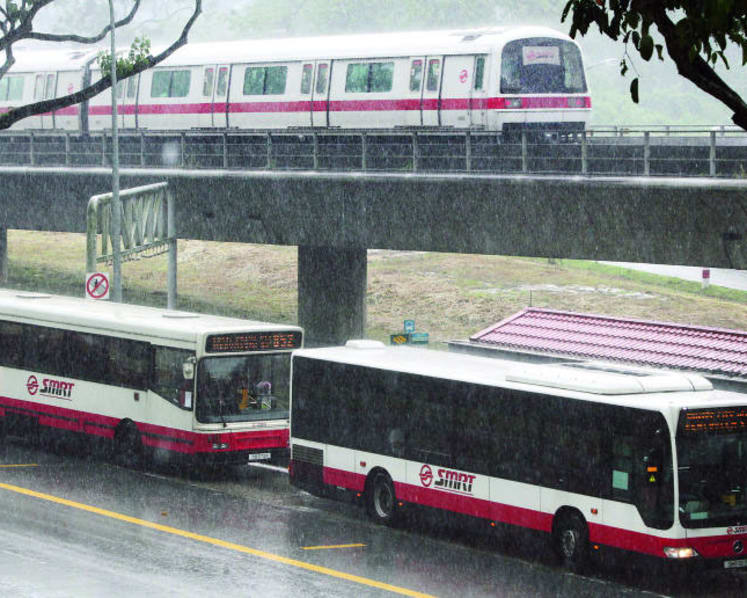
Mr Magnus said the council tried to spread fare reductions across various groups of commuters. TODAY file photo


SINGAPORE — Most commuters will pay less for bus and train rides from Dec 27 due to lower energy prices last year, announced the Public Transport Council (PTC) today (Oct 23) as it completed the 2015 Fare Review Exercise.
Adult card fares will decrease by 1 to 4 cents depending on the distance travelled, and card-carrying students and senior citizens will pay 1 to 2 cents less. Prices of all monthly concession passes and travel passes, as well as cash fares and single-trip ticket fares, will remain unchanged.
This works out to a 1.9 per cent drop in fares, the maximum allowable under the fare adjustment formula, which takes into account core inflation, changes in average wages, and diesel and electricity price movements. A potential 1.9 per cent drop in fares was first mentioned in August by former Transport Minister Lui Tuck Yew, who said he encouraged the PTC to pass it fully on to commuters.
Mr Lui had also said the fare changes would take effect in December instead of April next year — as has usually been the case — to coincide with the opening of the Downtown Line Stage 2.





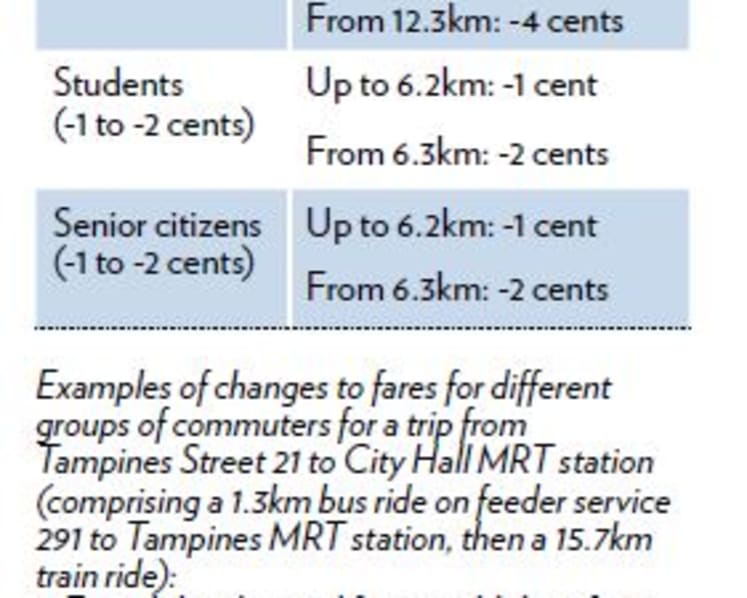
In tandem with the PTC’s announcement, the Ministry of Transport said separately it would reduce fares for low-wage workers on the Workfare scheme, and for people with disabilities. Concession schemes for the two groups were introduced last July, with Workfare commuters receiving a discount of 15 per cent or more off adult fares, and those with disabilities receiving 25 per cent off or more from adult fares.
From Dec 27, the lower-wage commuters will pay 1 to 4 cents less, depending on distance travelled, while those with disabilities will pay 1 to 2 cents less. The monthly concession pass and off-peak pass for persons with disabilities will remain at S$60 and S$40, respectively.
At a press conference today, PTC chairman Richard Magnus said the council tried to spread fare reductions across various groups of commuters, including students and senior citizens. It decided that commuters who experienced higher fare increases in the last exercise should now see a larger reduction in fares, he added.
Commuter Adeline Tan, 34, who takes the train on weekdays to and from work, said the fare changes would not make much of a difference to her. “Whether fares are reduced or not, we still need to travel,” said the marketing manager, who also takes the train occasionally with her family on weekends.
Asked why cash fares remain unchanged while card fares went down, the PTC said cash-paying and single-trip-ticket commuters make up less than 3 per cent of total daily trips on trains and buses, and it wants to get more of them to use fare cards.
Mr Magnus said the council went for the maximum reduction allowable because the operators “previously benefitted from the cap”.
He added that the “substantial drop in energy cost” last year outweighed the pressure from higher wages and other operating costs. Asked why the energy component of the formula dropped only 15.3 per cent when oil prices tumbled by a greater extent last year, Mr Magnus said the PTC looks at objective data that is publicly available — the market price of diesel of the 10ppm type, and the Energy Market Authority’s published wholesale electricity price.
If operators hedge to contain energy costs, it is their commercial decision to make, he added.
CIMB Private Banking economist Song Seng Wun said: “While the public would certainly love for a full downward adjustment on the back of a decline in energy costs, the flip side is it could just as well rise as sharply, should there be a subsequent rebound.”
Core inflation and wage growth — which each take up 40 per cent of the price index of the fare adjustment formula — are likely to be “fairly modest” for the next fare review exercise, said Mr Song. Energy prices, the other component, take up 20 per cent of the index.
Mr Song said that with supply continuing to outstrip demand, putting downward pressure on energy markets, “we shouldn’t rule out another round of fare reduction”.
The formula will be reviewed before 2017, given the bus contracting model — under which the Government owns bus operating assets and collects the fares, while operators run the services — will be implemented from the middle of next year, said Mr Magnus.




