







Singapore monitoring 'relevant standards' amid safety concerns over hidden car door handles
China will ban hidden car door handles from Jan 1, 2027, over safety concerns.

This audio is generated by an AI tool.


SINGAPORE: The Land Transport Authority (LTA) said on Monday (Feb 9) it is monitoring developments on hidden car door handles and "relevant standards" for them.
This comes after China moved to ban such door handles over safety concerns.
In new rules set to take effect from Jan 1, 2027, cars in China will require door handles to have both interior and exterior mechanical releases. Chinese car models already approved for launch will have an additional two years to achieve compliance.
Responding to CNA queries on Monday, an LTA spokesperson said the authority was "aware of global developments relating to hidden electronic door handles" and is "closely monitoring the development of relevant standards for local adoption".





"Meanwhile, LTA is also engaging the industry on emergency mechanical door release features in vehicles with electronic doors and the lead time required for models without such features to comply," the spokesperson added.
Concerns have risen in China over the safety of aerodynamic car doors that may not be able to be opened properly in the event of a crash.
In one high-profile incident last year, rescuers were seen on video failing to open the doors of a Xiaomi electric vehicle (EV) after it crashed and caught fire in the city of Chengdu.
The car's driver died in the crash.
"Drivers of vehicle models with emergency mechanical door release features are advised to familiarise themselves with the location and operation of the features," said the LTA spokesperson.
"This includes going through the owner's manual for instructions and seeking advice from their vehicle retailers or last (owners) of the vehicles."
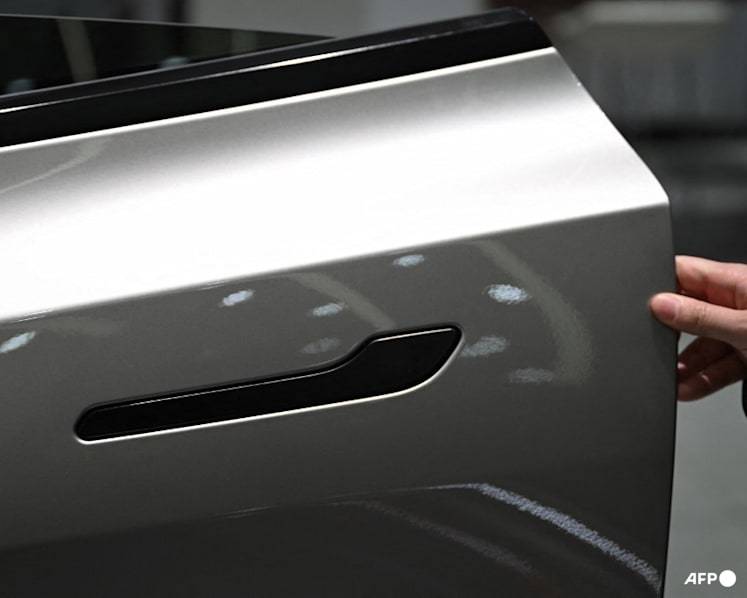
Electronic or hidden car door handles, introduced and popularised in the electric car industry by the 2012 launch of Tesla's Model S, are folded into the body of the car, providing a slight boost to efficiency by reducing drag.
China is the world's largest EV market, and dozens of its brands have growing operations abroad.
Chinese automaker BYD was Singapore's best-selling car brand in 2025, capturing more than one-fifth of all new vehicle registrations.
A total of 11,184 new BYD cars were registered last year, representing 21.2 per cent of the 52,678 cars registered.
Tesla recorded 3,476 new registrations in Singapore last year, making it the second-most popular EV brand in the country.




