







PM Wong pledges 'new and better' jobs as AI disrupts industries, transforms economy
“We may not be able to protect every job. But we will protect every worker,” says Prime Minister Lawrence Wong.
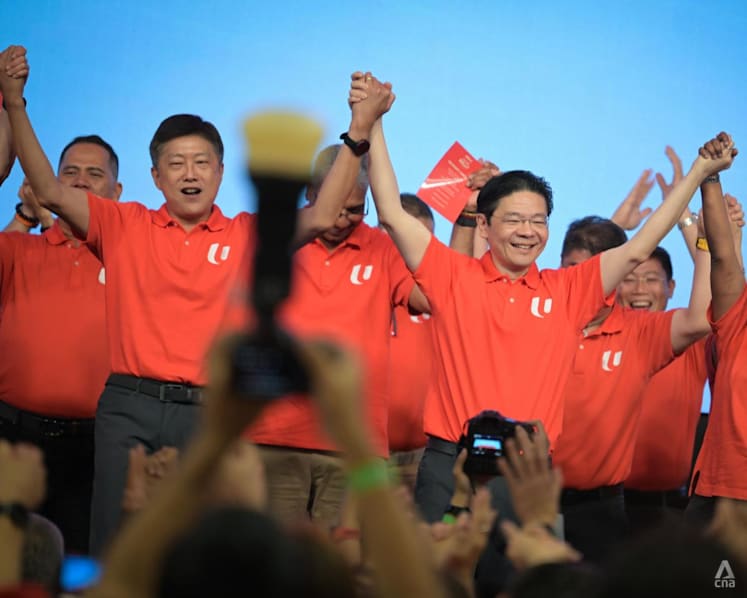
Prime Minister Lawrence Wong with NTUC secretary-general Ng Chee Meng, NTUC president K Thanaletchimi and other union leaders at the end of the May Day Rally. (Photo: CNA/Syamil Sapari)

This audio is generated by an AI tool.




SINGAPORE: As artificial intelligence reshapes industries and Singapore’s economy transforms, “new and better jobs” will be created, Prime Minister Lawrence Wong said on Friday (May 1).
Addressing more than 1,600 union leaders and tripartite partners at the May Day Rally at Downtown East, Mr Wong acknowledged the "massive" impact of AI but pledged that every worker would be protected amid the change.
“I cannot promise that there will be no disruption. Jobs will change. Some will disappear. And the pace of change will be faster than anything we have seen before,” he said.
“But this I can promise you: as our economy transforms, we will create new and better jobs. We may not be able to protect every job. But we will protect every worker. Because in Singapore, every worker matters.”
Mr Wong pointed out that where entire teams were once needed for some workflows, one person can now do it all with AI agents.
“These go far beyond simple chatbots. They don’t just answer your questions. They can plan and execute complex tasks from start to finish, all on their own,” he said. “AI will not just improve productivity. It will disrupt and reshape entire industries.”
FEELING "ANXIOUS" ABOUT AI
Mr Wong acknowledged that not everyone feels ready for the shift.
“Many Singaporeans are anxious about AI. They ask: will it replace jobs? Will it be harder to keep up? Will the next generation still have good opportunities?” he said. “These concerns are real.”
But Singapore has navigated "major technological transitions" before, he added. When he entered the workforce in the mid-1990s, tools like Excel were just taking off – offices needed fewer data entry clerks, but demand grew for accountants and analysts who could use the tools to create more value.
“AI is far more powerful than spreadsheets. So the impact on our workplaces will be much greater.”
Authorities will take "deliberate steps" to ensure the benefits of AI are shared broadly, including bolstering SkillsFuture and merging Workforce Singapore and SkillsFuture Singapore into a new entity.
“The government will provide the tools, the pathways, and the support. But we also need Singaporeans to step forward. Do not let anxiety or uncertainty hold you back from learning and using AI,” said Mr Wong.
“AI is here to stay. So, embrace it, learn it, use it and master it.”





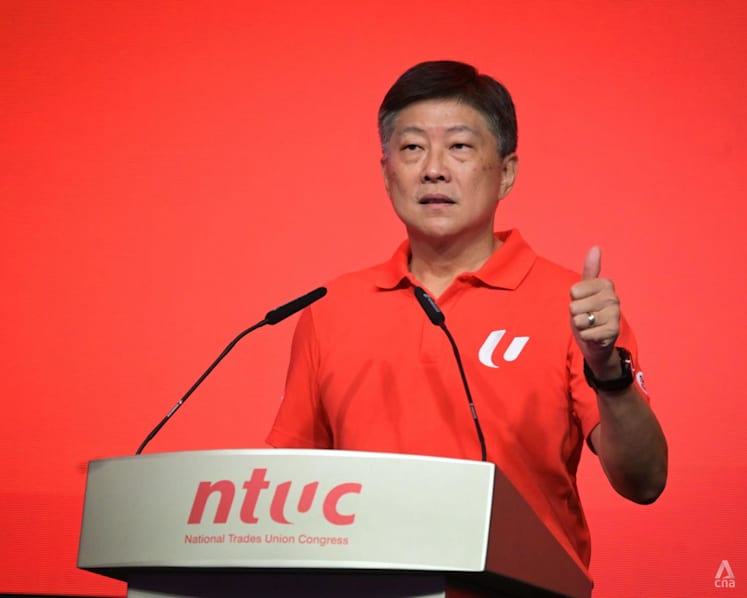
In his Budget speech earlier this year, Mr Wong announced that Singaporeans who take up selected AI training courses will receive six months of free access to premium AI tools.
“You make the effort, and we will be there for you – every step of the way,” he said.
Mr Wong also said authorities plan to scale up the company training committees approach for the AI transition, noting there is "no one-size-fits-all solution" given that every sector is unique and and every company faces different constraints.
He pointed to the new Tripartite Jobs Council, announced on Thursday and initiated by the National Trades Union Congress, which will bring together tripartite partners to support workers and businesses navigating AI's impact.
Mr Wong acknowledged the road ahead would not be easy, and that it is natural to feel overwhelmed.
"We are and will always be a small nation – exposed, vulnerable with little
margin for error. But what defines Singapore is this: we do not give up. We do not abandon one another."
The prime minister became emotional and paused to compose himself as he read out the words of Mr Nisar Keshvani, a Singaporean on an SAF repatriation flight describing the feeling of returning home.
“Whether it is an energy crisis, or the AI revolution, we will look after our own. No Singaporean will be left behind,” Mr Wong said.
“Our solidarity is our greatest strength. It carried us through every storm of the past. It gives us confidence today. And it will carry all of us forward – into the future we are building together.”

MINDSET SHIFT TO FIGHT ANXIETY
Union leaders told CNA that while anxieties about AI's impact on jobs are real, they can be addressed with a broader mindset shift.
NTUC president K Thanaletchimi said unions, employers and the government all need to drive this change in outlook – that workers can acquire new skills regardless of age.
“The only impediment that may make us go slow or stop us from doing certain things is our mindset,” she said.
Nominated MP Sanjeev Kumar Tiwari, general secretary of the Amalgamated Union of Public Employees and a member of NTUC's Central Committee, said anxieties exist even in the public sector.
“I think PM’s very candid point about not protecting the job, but protecting the workers, that's the one that really stood out for me,” he said.
The union leaders identified groups that stand to benefit from the newly announced Tripartite Jobs Council: women returning from career breaks, retrenched workers seeking seamless job transitions, and seniors who may struggle to keep pace with change.
NTUC assistant secretary-general Yeo Wan Ling welcomed the pragmatic support offered, such as access to AI courses and tools, to help ease workers through the transition.
Ms Yeo, who is also executive secretary of the National Transport Workers' Union, said transport workers face similar pressures with the advent of autonomous vehicles.
She also flagged concerns for platform workers, who worry whether a system built around employment would extend adequate support to the self-employed.




