







MHA probing Shincheonji church at centre of S Korea’s Covid-19 outbreak for ‘deceptive recruitment’ in Singapore
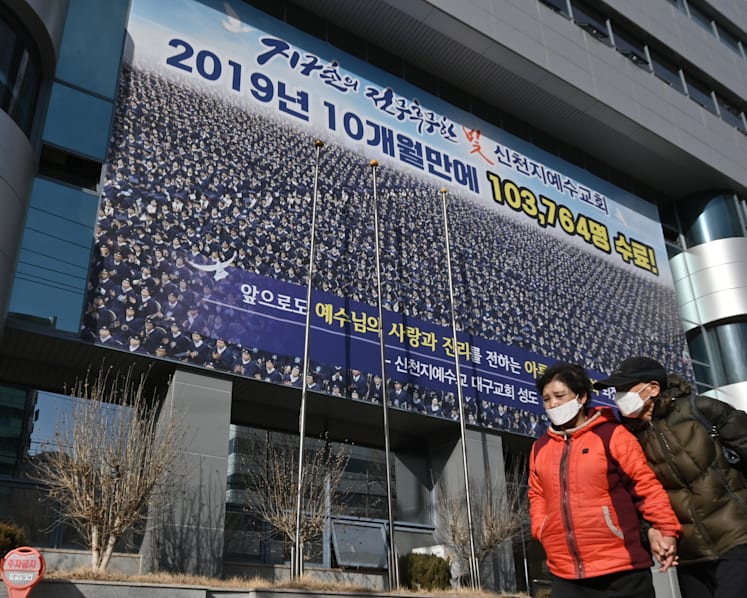
Pedestrians walking past the Shincheonji Church of Jesus in the southeastern city of Daegu, South Korea on February 24, 2020
SINGAPORE — Five South Koreans and two Singaporeans are assisting the authorities with ongoing investigations into the “deceptive recruitment methods” of an unregistered Singapore chapter of the Shincheonji Church of Jesus the Temple of the Tabernacle of the Testimony (SCJ).
The secretive church is reported to have been a major cluster contributing to the surge in infected patients in South Korea’s Covid-19 outbreak.
The Ministry of Home Affairs (MHA) said in a statement on Friday (Feb 28) that it had already been investigating SCJ’s activities in Singapore since last year, but has decided to speed up its probe because of reports linking SCJ’s practices to the spread of Covid-19 in Daegu, South Korea, where the church is based.
More than 60 per cent of South Korea’s confirmed cases, now numbering more than 2,300, are in Daegu, with the church identified as a cluster.
However, MHA said that interviews with members of the SCJ in Singapore have found that none of them have been in recent physical contact with patients in the Daegu cluster.
Four of the South Koreans helping with the investigations had entered Singapore before the outbreak of Covid-19 in Daegu and Cheongdo, another Korean city that has seen a sharp rise in infections.
The fifth South Korean came into Singapore on Feb 21, but checks by the Ministry of Health (MOH) showed that she is well, MHA said.
‘DECEPTIVE RECRUITMENT METHODS’
Speaking to the media on Friday, Home Affairs Minister K Shanmugam said that there are fewer than 100 members in the SCJ’s Singapore chapter.
“I don't want to go into too much detail, but our view is that there have been some actions which have crossed the line of possible criminality, but those are being investigated,” he said, adding that "young people" were brought into the church through front companies that masked the true identity of the organisation.
These people were misled and “defrauded into certain actions”, he added.
MHA said in its statement that the SCJ chapter here targeted Christian youth and young adults in their recruitment.
A controlling influence is then exerted over these members, requiring them to comply with strict instructions to conceal the existence of SCJ here and their involvement with it, the ministry said.
Members are not allowed to contact one another, verify teachings with other churches or inform their families of their involvement with the organisation.
SCJ was founded by South Korean Lee Man-Hee in 1984 and it has been accused of being a cult in several countries, MHA noted.
Former members testified that Lee has claimed to be the second coming of Christ, who would bring 144,000 people to heaven with him on the Day of Judgement.
He has also claimed to be the only person who can interpret the Bible, and SCJ allegedly regards all other churches and pastors as belonging to Satan.
SCJ teaches that it is acceptable to use deceit and lies if it serves God’s purposes, MHA said.
It has been accused of infiltrating and disrupting established South Korean churches by using deception and secrecy to trick people into becoming involved with them, the ministry added.
.embed-container { position: relative; padding-bottom: 56.25%; height: 0; overflow: hidden; max-width: 100%; } .embed-container iframe, .embed-container object, .embed-container embed { position: absolute; top: 0; left: 0; width: 100%; height: 100%; }HOW MHA INVESTIGATION BEGAN
MHA said that SCJ members tried to register a company in Singapore under the name of “Heavenly Culture, World Peace & Restoration of Light” (HWPL) in February last year.
MHA raised security objections to the registration, because it believed that HWPL was going to be used as a front for SCJ.
On its website, HWPL was described as an “international peace organisation” with branches in 170 countries.
Investigations later found that SCJ had previously incorporated another front company called Spasie Pte Ltd, which described itself as offering consultancy services and the development of software.
The Accounting and Corporate Regulatory Authority Singapore states that the company was registered in December 2016.
Recently, SCJ set up a sole proprietorship called Kings Ave and described it as providing corporate training services, motivational courses and personal development workshops.
That entity is also a front, MHA said, so that it may lease a property for use as a “temple”.
“While MHA was investigating SCJ’s activities in Singapore, the Covid-19 situation erupted,” the ministry said.
“In the normal course, the investigations into SCJ would have taken another few weeks to conclude. However, MHA decided to accelerate its investigations into SCJ and consider earlier action, because of reports linking SCJ’s practices to the Covid-19 cluster in Daegu in South Korea.”
If the members of SCJ’s Singapore chapter had been in recent contact with those in Daegu, then there could be health risks to Singapore, MHA said.
However, the Singapore-based members who have been interviewed told the authorities that they have not been in physical contact with their Daegu counterparts recently.




