







Migrant workers can be partners against radicalisation: Experts
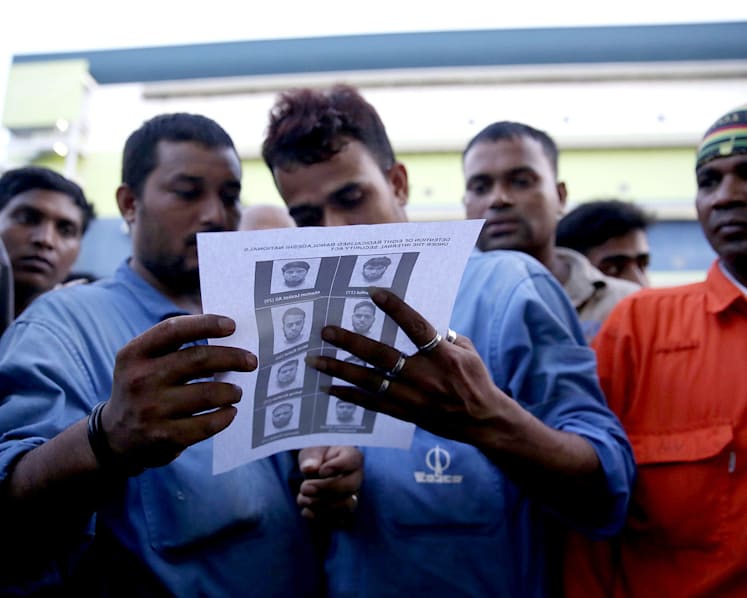
Foreign workers looking at the photographs of the 8 Bangladeshi men detained for planning terror attacks in Bangladesh. Authorities should work with leaders from various migrant communities to design programmes that highlight the dangers of radical teachings, said an analyst. Photo: Wee Teck Hian


SINGAPORE — Terror and security experts said the emergence of a second case of radicalised migrant workers here points to the need for the authorities to engage the community, to harness them as possible prevention partners rather than to ostracise them and see them as “targets” of radicalisation.
This means national efforts to boost Singapore’s resilience against terrorism-related activities must involve both Singaporeans and transient residents at the grassroots level.
In his comments after security forces detained members of the clandestine group Islamic State in Bangladesh — who plotted terrorism on their home country while working here — Singapore Home Affairs Minister K Shanmugam revealed that the community at large did not provide information leading to their arrest.
Mr Rohan Gunaratna, a security studies professor at the S Rajaratnam School of International Studies (RSIS), said that more must be done to engage the migrant workforce and diaspora population, given the expanding footprint of the Bangladeshi terror network.





“Whatever takes place at home (in Bangladesh) has an impact overseas ... In the current political and security climate, periodic arrests and deportation of migrant workers susceptible to extremist and terror ideologies could be a common feature.”
Apart from security agencies, the wider community such as employers, co-workers and neighbours play an important role in detecting terrorist activities and extremist teachings.
Associate Professor Kumar Ramakrishna, head of policy studies at RSIS, said: “These people are in daily contact with individuals susceptible to radicalisation and will serve as additional eyes and ears to supplement security agencies.”
In particular, he called for more public education on what constitutes “signs of radicalisation”. “I feel there is a lack of understanding (right now) ... People may mistake increased religiosity for radicalisation,” he said.
Singaporeans’ response should be calibrated, he added. “We should be alert, but not alarmed ... We should be more vigilant, but not in a way that ostracises the migrants’ community. I think (ostracising them) is not justified.”
Ms Nur Diyanah Anwar, a research analyst at the RSIS Centre of Excellence for National Security, would like to see the authorities working with leaders from various migrant communities to design programmes that highlight the dangers of radical teachings.
“The leaders are the ones who hold more clout and have most ‘access’ to the community,” she said. “There must be a level of trust to involve them in safeguarding national security.”
She cautioned that Singaporeans should not let the recent arrests taint their mindset towards foreign workers. “We should not paint every migrant worker with the same broad stroke. Not all are interested in radical activities ... The larger worry is that we may increasingly view them as ‘targets’ of radicalisation rather than possible partners in preventing it.”
National University of Singapore political scientist Bilveer Singh said “every country (is) a target” in the globalisation of terrorism, and he urged the Government to work more closely with security partners in the Middle East and South Asia, and to penetrate the online recruitment platforms of the terror group Islamic State.




