







Mindef to expand training in Australia and Guam
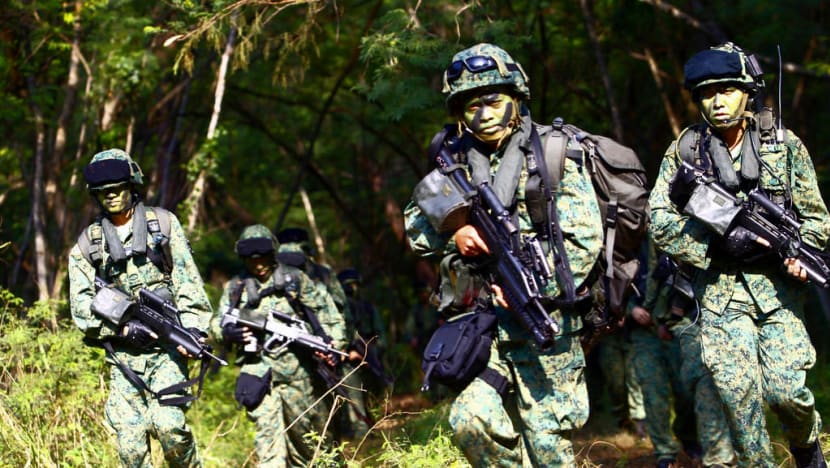
The Singapore Armed Forces will be restructured to better deal with terrorism, cyberthreats and maritime threats, said Defence Minister Ng Eng Hen.
SINGAPORE — The Singapore Armed Forces (SAF) will be expanding its training in Australia and Guam, as it restructures to better respond to contemporary security challenges such as terrorism, cyber threats and maritime threats, said Defence Minister Ng Eng Hen.
Speaking in Parliament on Monday (March 2), Dr Ng, who was presenting the Defence Ministry’s plans for the next few years, said that whatever the threats, for each SAF unit, “effective training makes the decisive difference”.
“In an uncertain landscape, we must raise, train and sustain units within the SAF to deal with both conventional and unconventional threats," he said.
And for conventional operations, the SAF aims to have the best training facilities globally, he added.





The SAF has trained in Australia since 1990 and conducts its largest unilateral exercise in Shoalwater Bay annually.
Under the Comprehensive Strategic Partnership signed between Singapore and Australia in 2015, Singapore troops can have access to a bigger training area in Australia for 25 years.
This will involve expanding existing training facilities at Shoalwater Bay, as well as establishing a new training facility in Greenvale. Taken together, the area for training will be approximately 10 times the size of Singapore.
Dr Ng said that the facilities being built in Shoalwater Bay and Greenvale in the Australian state of Queensland will be a “key node” for the best-of-class training facilities.
Providing an update on the construction of facilities there, Dr Ng said that “significant progress” had been made with the completion of an ammunition storage building last year.
The Combined Arms Air-Land Ranges is now being developed for the Army and Air Force to train together with tanks, infantry fighting vehicles, drones, artillery and other combined arms platforms.
To facilitate integrated combined arms live-firing in an urban environment, the Urban Operations Live Firing facility will also be set up.
“In essence, when completed we can conduct complex training on a much larger scale, that only few militaries are able to elsewhere,” said Dr Ng.
“We expect construction at Shoalwater Bay to be completed by 2024 and Greenvale to be completed by 2028. When these facilities are completed, the SAF will be able to conduct integrated training across all three Services, involving up to 14,000 personnel annually and over a span of up to 18 weeks,” he added.
Currently, only 6,600 personnel can be deployed to Australia for up to six weeks each year.
The Republic of Singapore Air Force (RSAF) will also have a training space that is more than 80 times the size of Singapore, once it completes the building of facilities for a fighter training detachment in Guam by 2029.
The fighter training detachment was established after Singapore and the US signed a Memorandum of Understanding last December.
Dr Ng said that the RSAF plans to deploy its F-15s, F-16s and supporting assets such as the Gulfstream 550 — Airborne Early Warning to Guam for training.
“The airspace around Guam, together with training facilities, will allow the RSAF to conduct larger scale, more complex, and realistic air-to-air and air-to-ground training,” said Dr Ng.
The detachment in Guam alongside the RSAF’s other fighter deployments in Australia, India and Thailand will also allow quick redeployment back to Singapore when required, he added.
RESTRUCTURING THE SAF
Dr Ng also announced that Mindef will restructure the SAF to deal with the challenges of terrorism, cyber and maritime threats, against the backdrop of changing geopolitics.
1. NEW CYBER COMMAND AND FORCE
Dr Ng said that a high-level committee headed by Permanent Secretary (Defence Development) Joseph Leong and Chief of Defence Force (CDF) Lieutenant-General Melvyn Ong will be set up to deal with cyber threats.
What it will do:
The committee will spearhead efforts to build an integrated cyber command and force to defend Singapore’s digital borders, especially against foreign cyber actors that threaten national security.
The cyber command will provide threat assessments and early warning in cyber attacks and respond accordingly.
After the restructure, which will take a few years, CDF will continue to be in charge of its mission outcomes while the Chief C4I (Command, Control, Communications, Computers and Intelligence) will oversee the command and report directly to CDF.
2. NEW PLATFORMS TO PROTECT TERRITORIAL WATERS
The Republic of Singapore Navy’s Maritime Security Task Force (MSTF), which conducts daily patrols in the Singapore Strait to guard Singapore’s waters, will acquire new purpose-built platforms to deal with maritime threats.
Why: There has been a recent spike in sea robbery incidents in the Singapore Strait. Last year, sea robbery incidents in the Singapore Strait hit a four-year high with 31 incidents.
There have also been intrusions into Singapore’s territorial waters, such as when Malaysian government vessels intruded into Singapore territory in 2018 following a maritime dispute between both countries over Malaysia’s extension of its Johor Bahru port limits.
What it will do:
The MSTF will receive new purpose-built ships in the next few years. In the meantime, it will receive four refurbished patrol vessels to protect territorial waters before the review of the restructure is completed in the next few months.
Singapore has also reached out to Malaysia and Indonesia to extend the Malacca Straits Patrol initiative to other areas in Singapore’s surrounding waters. The three countries currently coordinate anti-piracy patrols in the Malacca Strait.
3. TERRORISM
To combat terrorism, the SAF is restructuring its military intelligence outfits.
What it will do:
SAF intelligence units will be expected to do more to detect, forewarn and respond to terrorist plots.
These units will also acquire systems and capabilities that can uncover, investigate and monitor threat concerns.
The SAF has formalised intelligence-sharing through the Association of Southeast Asian Nations’ “Our Eyes” initiative, which was launched in 2018.
The initiative, which involves Brunei, Indonesia, Malaysia, the Philippines and Thailand, allows these countries to exchange strategic information on terrorism, radicalism and violent extremism.
CORRECTION: An earlier version of this article stated that Mindef will start training in Guam. This is incorrect. Singapore has previously trained in Guam, but will be establishing a permanent detachment there for the first time. We are sorry for the error.




