







‘Miscommunication’, says SportSG after cerebral palsy football team loses, then regains, home turf
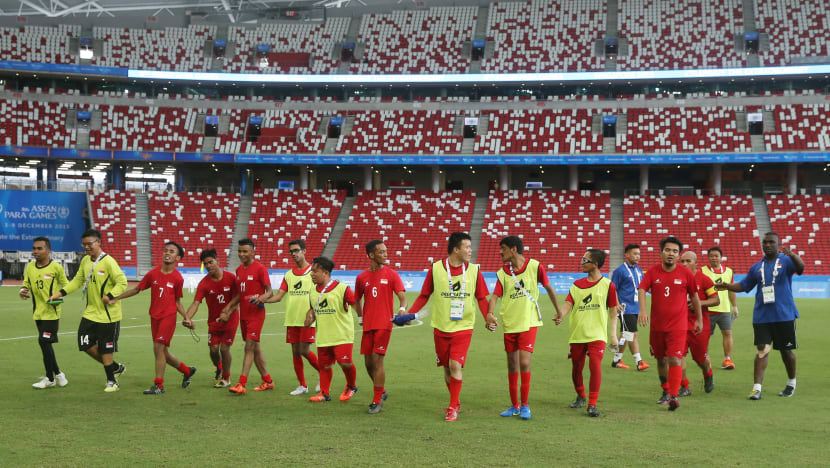
The Singapore Cerebral Palsy (CP) Football team after a match against Indonesia at the 8th ASEAN Para Games Cerebral Palsy football match held at the National Stadium on 3 Dec 2015. Photo: Ooi Boon Keong/TODAY


SINGAPORE – December was the cruellest month for Singapore’s Cerebral Palsy (CP) football team.
Over a week ago, the team received notice that it would no longer be allowed to hold its training sessions at Queenstown Stadium - the team’s home since April 2016 - as the facilities had been reallocated to the Singapore Rugby Union (SRU) instead.
The CP team had gained the use of Queenstown under the 2016 Disability Sports Master Plan aimed at encouraging those with disabilities to participate in sports.
The five-year plan set out five centres of expertise for various sports, including CP football. These centres would have special facilities and programmes for those interested in the sports.
So it came as a shock to the CP team when it was told last month that it would not be able to book Queenstown for its use. It sought out other facilities, and settled for the Rainforest Sports Hub at Turf Club, where it has been holding training sessions for the past two weeks.
Friday (Jan 5), however, brought good news.
A day after TODAY’s queries to Sport Singapore (SportSG) about the reasons for the CP team being booted out of Queenstown, the team was told that it was a miscommunication.
The national sports body told them CP football could share the use of Queenstown with the SRU, and that players could train there on Saturday (Jan 6).
Speaking to TODAY, Mr Toh Boon Yi, chief of SportSG’s Singapore Sports Institute, said SportSG has “always been supporting our CP Football team including fully subsidised use of training facilities through our annual grants to the Singapore Disability Sports Council”.
He added: “We will continue to work closely with them on their training needs while optimising the use of the Queenstown stadium alongside other sports and users. They know that they can also raise with us additional training needs that we will do our best to meet.”
When interviewed before SportSG’s turnaround, CP football players and officials said they were upset by the treatment dished out to them.
“I’m very upset that we’re not given a proper stadium to train in…and that the national team is treated in such a manner. It feels like we’re homeless,” said a player who declined to be named.
He added that the Rainforest Sports Hub was not a good alternative. “Turf City is not that practical for training as it’s a cage concept and the pitch is artificial turf, so we have had to readjust to this new environment.”
The Disability Sports Master Plan was announced in Parliament by the Ministry of Culture, Community and Youth (MCCY) in April 2016. The first centre of expertise, in Sengkang, was launched in June that year, for swimmers with disabilities.
Queenstown was earmarked for those with CP, and Toa Payoh, Jurong West, and Delta will complete the set by 2021. Apart from swimming, CP football and boccia, there are plans to include other sports such as athletics, badminton, basketball, football, goalball, sitting volleyball, and tennis.
While their training ground woes appear to be resolved for now, the worries for the CP football team linger.
Said a member on the team: “For us, it’s important that we are all there or all out. If it’s our home, it must be home, and we cannot be running around between different places.”




