







MSF apologises for missing line in 87,000 digital LPAs, tables Bill to ensure affected documents remain valid
SINGAPORE — Around 87,000 electronic Lasting Power of Attorney (LPA) documents that were certified online between Nov 14, 2022 and Jan 4, 2024 had left out an important line required under the law.
The Ministry of Social and Family Development (MSF) said on Wednesday (March 6) that the decisions made in the creation of these documents are still legally valid, but it tabled a Bill in Parliament to clarify the validity of these 87,000 documents.
It has also taken steps to ensure that electronic LPA documents certified on or after Jan 5, 2024 will now include the required statement.
"MSF would like to apologise for this omission by the Office of the Public Guardian. The omission was discovered in October 2023, and the assessment of the implications and required rectification was completed in December 2023," it said in a statement.





It added that the Bill when passed as law will retroactively validate the affected LPA documents. Affected donors do not need to re-make an LPA that was already done and no action is required by members of the public.
While MSF is working to "commence the Amendment Bill as soon as possible", the omission might subject the affected documents to legal challenge, it said.
However, it assured affected parties that the law affords legal protections to them if they rely on the registered LPA when they are unaware of the defects that may render the form invalid.
All affected LPA documents will be validated when the Bill passes into law and comes into force.
An LPA is a legal document and deed that allows a person or donor, who is at least 21 years old, to voluntarily appoint one or more persons to make decisions and act on their behalf should they lose their mental capacity.
A deed is a signed legal document that is most commonly used to transfer a title or legal ownership of a property or asset between two parties.
The appointed person or donee can be tasked to act in matters pertaining to personal welfare as well as property and affairs, and sign deeds on the donor's behalf.
Since the LPA also acts as a deed, it can be used to appoint another person to act on the donor's behalf or be used to transfer immovable property.
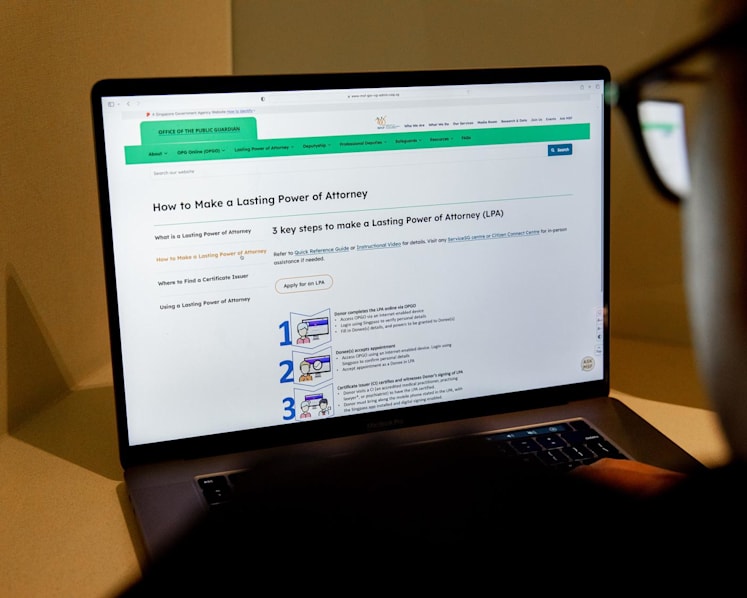
To make an LPA, it was initially done offline with hard copies, but after changes to the Mental Capacity Act that was passed in Parliament in July 2021, people were allowed to make an LPA online through a government portal.
This cut down the processing time from an average of three weeks to 15 minutes.
WHAT IS THE OMISSION ABOUT?
MSF said that the Office of the Public Guardian had omitted a required line — "I intend this instrument to be a deed" — which was discovered by MSF in October last year.
This was after feedback was received by a member of the public that month.
"We discovered that the error took place during the drafting and vetting process for creating a new electronic LPA process and template when the online system for the Office of Public Guardian was being developed," MSF said.
Time was then needed to assess the legal implications for the affected electronic documents and to determine the most appropriate way to rectify it and to draft the Bill to give effect to the solution.
The Office of the Public Guardian is a division of MSF that supports the Public Guardian, who carries out various functions to enable and protect people who lack mental capacity.
These functions include setting up and maintaining an LPA register.
Under Section 12A(1)(a) of the Mental Capacity Act, it is required for an electronic LPA to clearly state within its document that it is intended to be a deed by the donor.
"Even though the significance and effect of an LPA are clearly explained on the electronic LPA document, it did not expressly state that it is a deed, which is not in compliance with the provision in the Mental Capacity Act," MSF said.
The ministry added that it then took immediate corrective action after an assessment of the implications and the required rectification was completed in December last year.
Electronic LPA documents that were certified on or after Jan 5 this year now include the required line.
All hard copies remain unaffected.
In response to TODAY's queries about why the omission of the line could lead to legal challenges for the affected e-documents, Mr Gregory Vijayendran, a partner and Senior Counsel at Rajah & Tann, said: "Without the stated line, an electronic LPA cannot be validly executed in law as an LPA."
He added that such a formal legal requirement cannot be waived or dispensed with, and must be complied with to ensure the validity of an online LPA.
Mr Vijayendran explained that an important practical use for deeds, although relatively rare, is the record of deeds filed against land under an old common law system of land registration.
This is why Singapore has a Registry of Deeds that administers the Registration of Deeds Act and its rules, and such deeds are also lodged with the Singapore Land Authority.
"So, considering that the powers of buying and selling real estate as well as transferring property from one owner to another could be spelt out in an LPA, it has been designed to be a legal document and a deed," the lawyer said.




