







Medical certification needed for mobility scooter users from Jun 1; those 70 and older exempt
Those caught riding a mobility scooter on public paths without a valid certificate of medical need may be fined up to S$2,000, jailed for up to six months, or both.
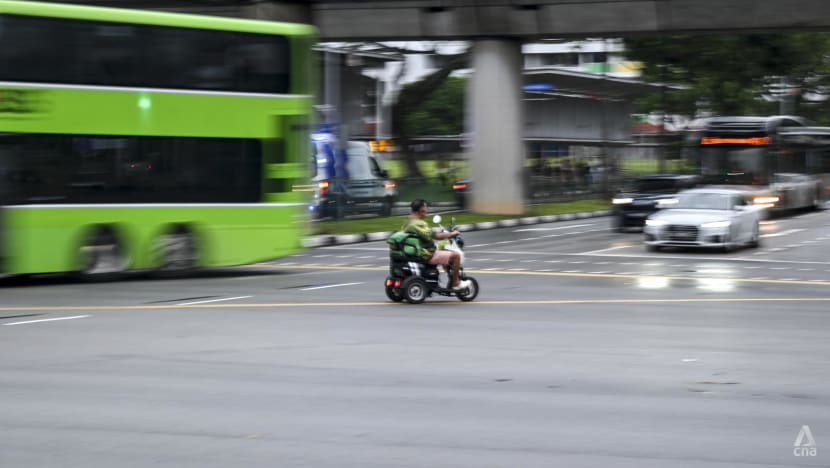
A bus turns past a PMA rider crossing a traffic junction in Yishun on Dec 16, 2024. (Photo: CNA/Wallace Woon)

This audio is generated by an AI tool.


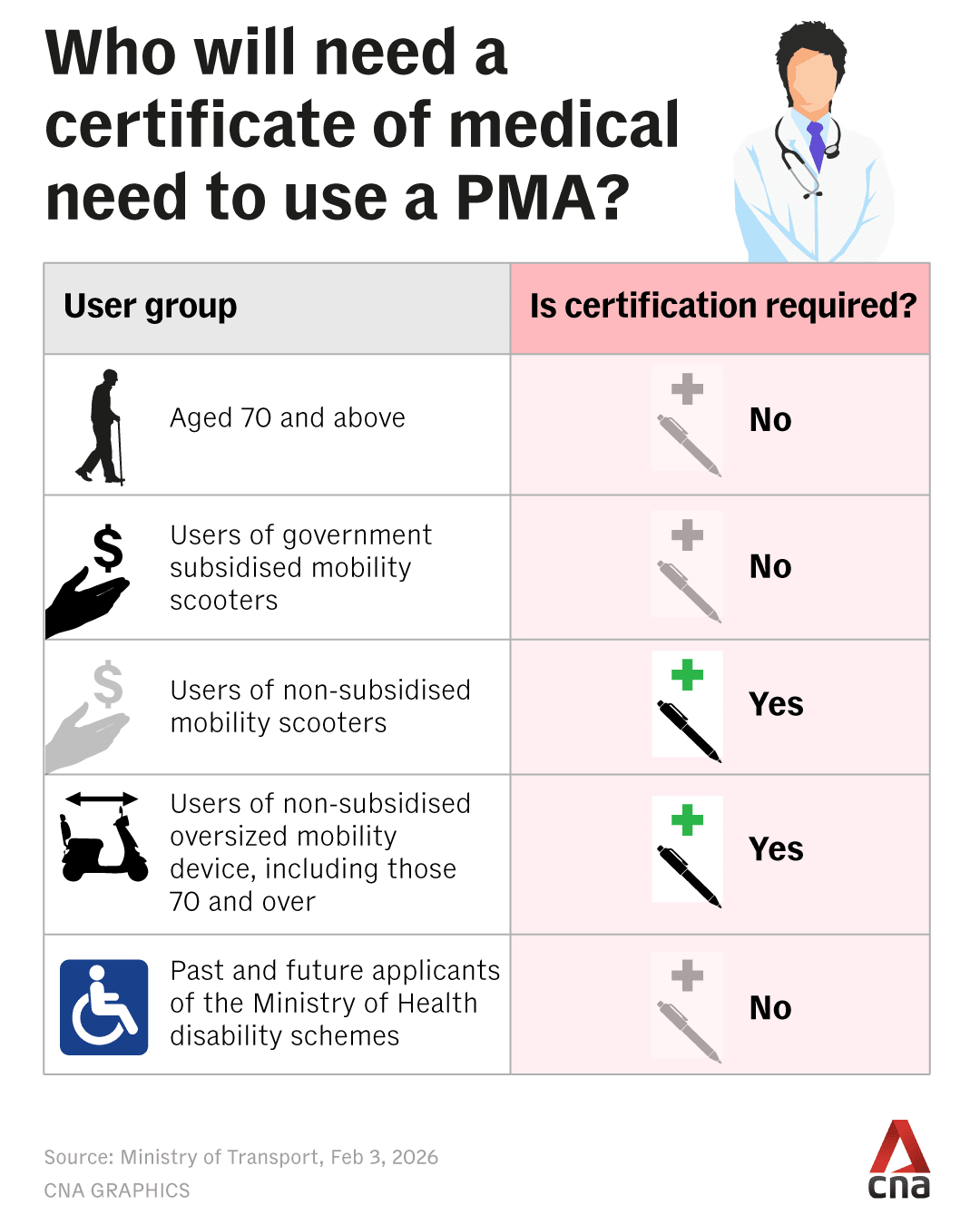
SINGAPORE: A certificate of medical need will be required for users of mobility scooters from Jun 1, with seniors aged 70 and above exempt, after a law was passed in parliament on Wednesday (Feb 4).
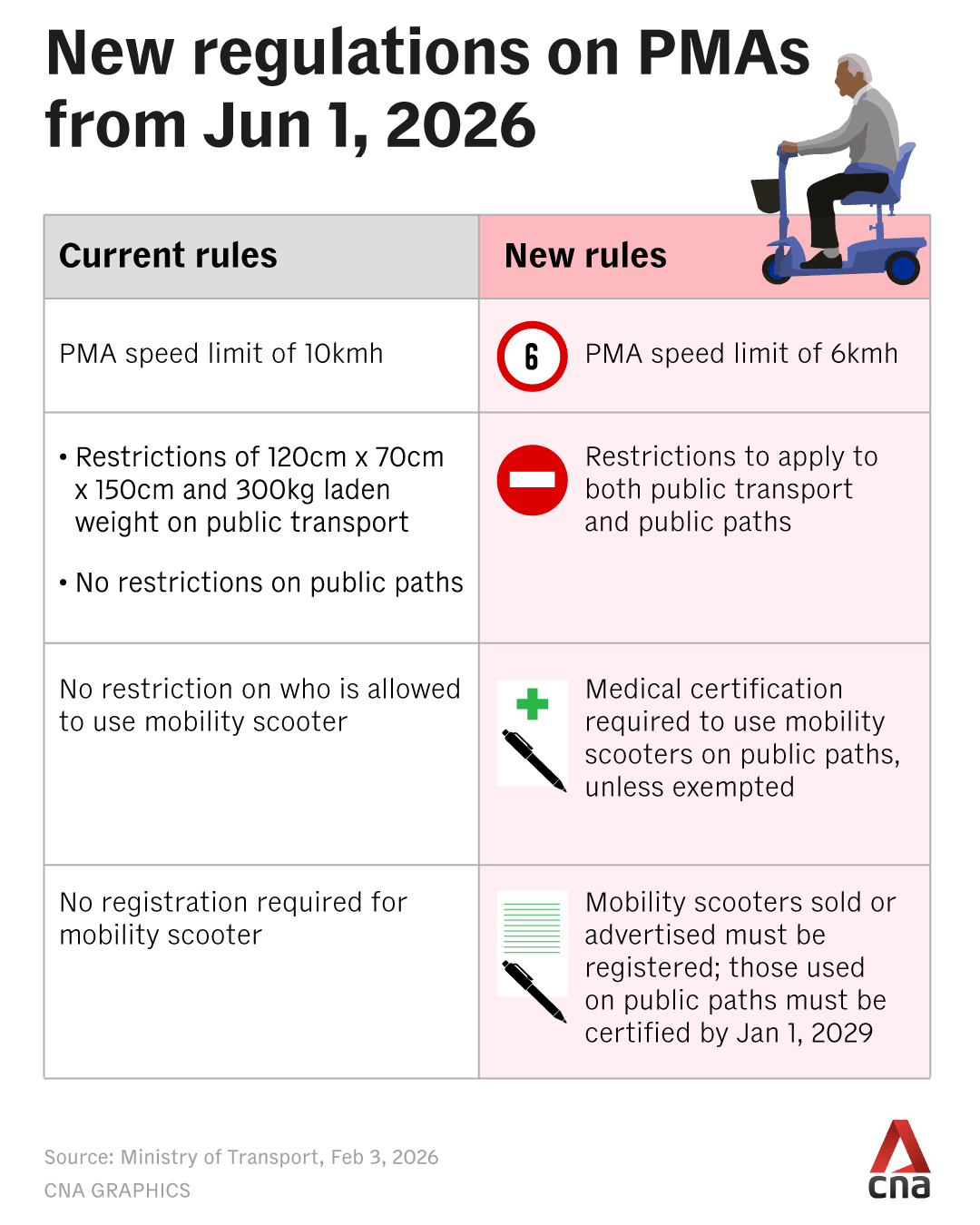
From Jun 1, the speed limit for personal mobility aids (PMAs) will also be reduced from 10kmh to 6kmh.
Members of Parliament raised questions about the new regulations, asking if the reduced speed limit could result in a loss of earnings for food delivery riders who depend on PMAs for their job, and whether enforcement of errant riders will be sufficient, among other concerns.
“We face a concerning trend of able-bodied individuals who are misusing mobility scooters,” Minister of State for Transport Baey Yam Keng said during the debate on the Land Transport and Related Matters Bill.
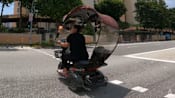
“Although the device is a replacement for walking, some ride at top speed on paths, or operate large devices that endanger other path users, especially seniors and young children.”
Requiring a certificate of medical need targets the “core problem of able-bodied users misusing devices meant for those with mobility needs”.
The certificate will be available from Feb 27, following an assessment for mobility scooter use developed in consultation with the Ministry of Health (MOH).
A list of clinics offering the assessment will be published on the Land Transport Authority’s (LTA) website from Wednesday.
Based on LTA’s survey of clinics, assessment fees are expected to range from S$20 (US$15.70) to S$150, with a median fee of S$50.
“Given that a budget mobility scooter costs around S$1,000 and mid-range models can reach up to S$2,000, the cost of the assessment is relatively modest compared to the price of the device itself,” said Mr Baey.
“We hope users can understand that this would help to ensure that mobility scooters on public paths are only for those with genuine medical need.”
Enforcement officers will focus on visibly able-bodied individuals misusing mobility scooters.
Those caught riding a mobility scooter on public paths without a valid certificate of medical need face penalties of up to S$2,000 in fines, up to six months’ jail, or both.
Mr Baey said the risk of able-bodied seniors misusing mobility scooters is expected to be low, particularly given the reduced speed limit.
“We will monitor the situation and calibrate accordingly if necessary,” he said.
Users who have already had their mobility needs or disabilities assessed and submitted relevant information to the government will also be exempt.
This includes existing beneficiaries of subsidised mobility scooters under the Seniors’ Mobility and Enabling Fund and the Assistive Technology Fund.
It also includes individuals certified with activities of daily living needs in “mobility” or “transferring” who have applied for MOH disability schemes such as the Home Caregiving Grant.
These exemptions will apply automatically, and users need not take any action.
OTHER REGULATIONS
Mr Baey said that with the PMA speed limit reduced from 10kmh to 6kmh, mobility vehicles "match the pace of a brisk walker, which meets the needs of genuine users who have difficulty walking".
Anyone who drives a mobility vehicle at speeds exceeding 6kmh on public paths faces fines of up to S$2,000, up to six months’ imprisonment, or both, with stiffer penalties for repeat offenders.
From Jun 1, PMAs used on public paths must not exceed:
- 70cm in width
- 120cm in length
- 150cm in height
- 300kg in laden weight
These limits align with existing dimension restrictions on public transport.
Users caught riding oversized devices on public paths face penalties of up to S$10,000 in fines, up to six months’ imprisonment, or both. Sellers of oversized mobility vehicles could face fines of up to S$20,000, up to 24 months’ imprisonment, or both.
Mobility scooters will also need to be registered with LTA.
What is the difference between a mobility scooter and a PMA?
A PMA is an umbrella term that includes mobility scooters and wheelchairs, both manual and motorised.
Mobility scooters are three- or four-wheeled motorised devices with a single seat steered using handlebars.
Unlike manual or motorised wheelchairs, mobility scooters are subject to new regulations requiring users to hold a valid certificate of medical need, unless exempted.
All PMAs, including motorised wheelchairs, are now regulated under a maximum speed limit of 6kmh.
PMAs are also subject to dimension and weight limits that now apply on public paths, and not only on public transport.
FIRE SAFETY
Fire risks linked to active mobility devices remain a concern, with 49 such fires recorded in 2025.
Personal mobility devices accounted for most cases - 31 incidents - with the majority involving devices that were not UL2272-certified, a fire safety standard for PMDs.
While it was an offence to ride a non-UL2272-certified e-scooter on public paths or roads, it was not illegal to keep such devices.
Under the amendments to the Small Motorised Vehicles (Safety) Act, the keeping of unsafe devices is now prohibited.
Penalties include fines of up to S$2,000, up to three months’ imprisonment, or both, with higher penalties for non-individuals and repeat offenders.
MPS RAISE QUESTIONS
Twenty-four MPs on both sides of the aisle raised questions during the debate that stretched across Tuesday and Wednesday.
MP Yeo Wan Ling (PAP-Punggol) and MP Joan Pereira (PAP-Tanjong Pagar) asked if there would be transition support for food delivery riders who use mobility scooters and could be affected by the new regulations.
“The reduction in PMA speed limits will lengthen delivery times for riders who are already pushing themselves daily, those extra minutes compound quickly,” said Ms Yeo.
“Fewer completed jobs means lower earnings, and for riders living close to the age, even a modest drop in income can translate into real trade-offs between food, utilities or even medical needs.”
Ms Pereira noted that when e-scooters were banned from footpaths in 2019, there was a S$7 million grant to support their transition to new transport modes. She asked if similar support would be granted for those who may not be able to use PMAs come Jun 1.
In his round-up speech, Mr Baey said that only workers with mobility needs should use PMAs for their work.
“Such workers have to abide by the reduced speed limit and dimension limits for everyone's safety,” he said.
“This protects not just other path users but the PMA riders themselves - by going at a slower speed and using devices that are not oversized, they can navigate crowded paths and complete their deliveries safely.”
He added that by riding safely, they also reduce the risk of serious accidents that can affect earning stability.
For riders without mobility challenges, PMAs are not the right mode of transport, he said.
"They should not misuse PMAs. They can continue their trade by switching to other devices or vehicles."

MP David Hoe (PAP-Jurong East-Bukit Batok), MP Ng Shi Xuan (PAP-Sembawang) and MP Hamid Razak (PAP-West Coast-Jurong West) also raised questions on the process of obtaining the certificate of medical need.
Hurdles such as making a doctor’s appointment, paying for the consultation and registering their PMA may stand in the way of genuine users, said Mr Hoe.
“If this process is not implemented well, it may deter people who genuinely need a mobility scooter,” he said.
Doctors or occupational therapists may fill in a standard online form and submit it to LTA, or issue a hard copy of the standard form. Once the assessor completes the form, the certificate is granted.
“For the hard copy, the user is encouraged to take a photo and submit it to LTA so that it is stored in the LTA digital registry,” said Mr Baey.
As part of the certification, the doctor or occupational therapist will assess and indicate if the user's need for a mobility scooter is long-term or temporary.
The government will maintain a registry of those with valid certificates of medical need, and enforcement officers will request the user's particulars to perform a check on the spot.
“If the certificate has not been submitted online, the user just needs to produce a hard copy form for inspection,” he said.
MPs also raised suggestions to strengthen enforcement against errant users.
MP Tin Pei Ling (PAP-Marine Parade-Braddell Heights) asked if more permanent cameras would be installed to catch errant users.
MP Dennis Tan (WP-Hougang) asked if enforcement against non-compliant devices will be done through door-to-door inspections or in a specific zone for a sustained period of time.
“This will send a strategic message, rather than spreading our limited resources too thinly,” he said.
Mr Baey said that LTA has a “comprehensive strategy” to tackle errant users.
Active mobility enforcement officers will patrol public paths and conduct checks on user and device compliance. They will be supported by volunteer active mobility community ambassadors to enhance engagement efforts, he said.
CCTV cameras that are focused on paths have been deployed islandwide, along with roving cameras to react to emerging hotspots.
MP He Ting Ru (WP-Sengkang) also raised concerns that enforcement officers will rely on casual visual perception of able-bodiedness.
“Enforcement officers will be trained to be sensitive in checking for the certificate of medical need,” said Mr Baey.
Ultimately, it is better to rely on education rather than enforcement, he added.
“Enforcement officers cannot be everywhere, neither is it desirable to foster a culture where correct behaviour is dependent only on enforcement and penalties,” he said.
“It is better to also focus on education and awareness.”
To that end, LTA has engaged with the community to promote awareness of active mobility rules, he said.
In parliament on Wednesday (Feb 4), Senior Minister of State for Home Affairs Sim Ann, Minister of State for Transport Baey Yam Keng and Acting Transport Minister Jeffrey Siow responded to clarifications sought by Members on the Land Transport and Related Matters Bill. The bill was passed in the House.




