







Modi warns Asia against return to great power rivalries, cites Asean as ‘inspiration’ for regional cooperation
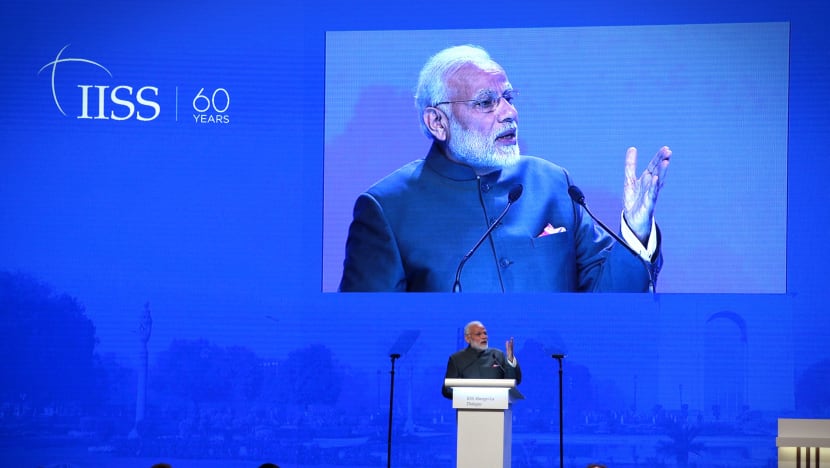
Indian Prime Minister Narendra Modi delivers the keynote address at the IISS Shangri-la Dialogue on Friday, June 1, 2018.


SINGAPORE — Warning of growing insecurities and new fault lines in an “age of uncertainty”, Indian Prime Minister Narendra Modi on Friday (June 1) made an impassioned plea for greater regional cooperation and inclusiveness based on the international rule of law.
To that end, he cited the Association of South-east Asian Nations (Asean) as “an example and inspiration” that diverse countries can indeed rise above their differences to work together.
“Asean unity is essential for a stable future of this region, and each of us must support it,” said Mr Modi, the first Indian leader to deliver the keynote speech at the annual Shangri-La Dialogue, a highly-watched regional security summit.
Mr Modi, who is on a three-day official visit to Singapore, also singled out the Republic as the model example of a country that “stands on the side of principles, not behind one power or the other”.





In his wide-ranging speech to an audience of academics and top defence officials from the region, the Indian leader cautioned Asian nations against sliding back into an age of great power rivalries.
Asia, Mr Modi argued, should attempt to shape this century through mutual respect and cooperation.
“Competition is normal but contests should not turn into conflicts. Differences must not be allowed to turn into disputes,” he noted, without directly mentioning the territorial disputes in the South China Sea or growing trade tension between Washington and Beijing. “This a world of interdependence… and no nation can shape its success on its own.”
Turning to an issue which he had highlighted in Malaysia and Indonesia, the two earlier stops in his South-east Asia trip, Mr Modi stressed that freedom of navigation in the region’s waterways and airspace was critical to peace and prosperity in Asia.
He pointed out that international “rules and norms concern us all, not just the powerful few”.
Mr Modi added: “We believe that our common prosperity and security require us to evolve, through dialogue, a common rules-based order for the region.... These rules and norms should be based on the consent of all, not on the power of the few. This must be based on faith in dialogue, and not dependence on force.
“It also means that when nations make international commitments, they must uphold them. This is the foundation of India's faith in multilateralism and regionalism; and, of our principled commitment to rule of law.”
The Indian leader did not directly mention Beijing, which has been stirring regional unease with its activity in the South China Sea. China asserts sovereignty over almost all of the South China Sea, despite rival claims from Malaysia, the Philippines, and Vietnam.
Amid escalating trade tensions between the US, China and the European Union, Mr Modi made clear India’s support for “an open and stable international trade regime”.
“What we seek is a level playing field for all,” he added, arguing that countries could not find solutions behind “walls of protectionism”.




