







MOM investigating firm that owes 48 workers tens of thousands of dollars
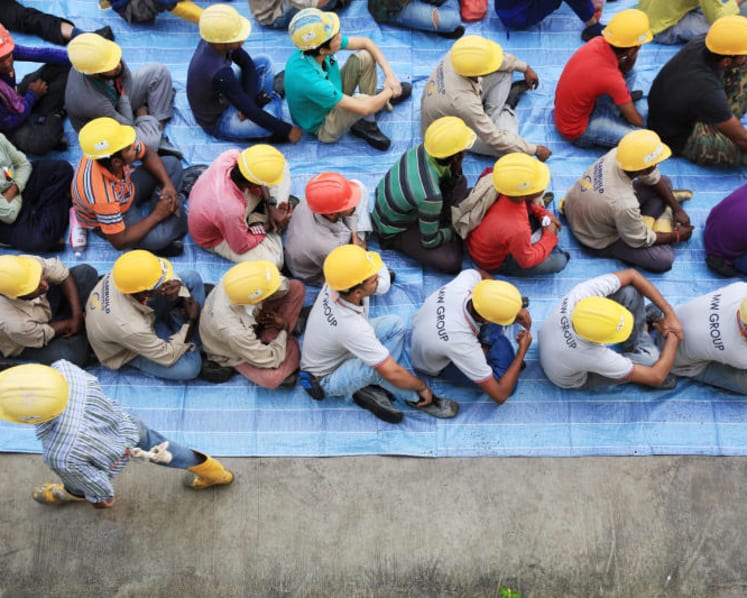
Construction workers at Bukit Batok West Ave 6.


SINGAPORE — Mr Faruk Oman thought he could finally provide for his family of six in Bangladesh after landing a job with Singapore contracting firm Nihal Enterprise in February last year.
As a "higher skilled" worker in the construction sector, he was to be paid S$1,600 monthly.
But the 34-year-old was only ever paid a fraction of the promised salary and, in December 2017 and January this year, he said he was made to sign blank salary vouchers, rendering his work — which involved cleaning, excavation and equipment repairs — unpaid.
Mr Faruk is one of 48 foreign workers who have lodged complaints against Nihal Enterprise and Nihal Construction, both held by parent company Nihal Group, between January and April this year for defaulting on their salaries.





The Manpower Ministry (MOM) has suspended Nihal Group's work pass privileges and investigations are ongoing, said a spokesman in response to TODAY's queries.
To date, only nine of these employees have been paid following "successful mediation" under the Tripartite Alliance for Dispute Management launched last year.
Seven of them have found new employment and one employee has decided to return home after being paid, said the MOM.
While mediation is assessed to be successful, it is likely that most of the workers will have to settle for smaller sums than what they are owed, said Mr Ethan Guo, general manager of non-government organisation Transient Workers Count Too (TWC2), which has been helping with the bulk of the workers' claims.
Mr Faruk, for one, has so far only managed to claw back about S$2,000, less than a-tenth of the S$23,000 (including overtime hours) is owed him, according to the terms of his contract.
The workers TWC2 is helping are owed amounts ranging from S$2,732 to S$24,986.
"TWC2 has observed a number of companies that hire workers at this $1,600 rate, but have no intention of actually paying their workers this amount," said Mr Guo, adding that employers often hire higher skilled workers to benefit from lower levies.
According to the pay slips of several Nihal workers seen by TODAY, they were paid only a quarter of the promised rate each month.
"With the large number of cases pending, however, we are expecting the workers who are only coming to us now to see a reduction in their chances of getting much, if any, of their owed salary back at all," said Mr Guo.
Asked why he did not seek help from the authorities earlier, despite being underpaid for close to a year, Mr Faruk said: "The boss kept telling us this is a big company and has resources, and we should take the (smaller amounts of) money first."
He filed his complaint in January and has been unemployed since.
Mr Faruk is holding out hope that he will receive more compensation after subsequent mediation sessions.
"I paid S$7,000 to come to Singapore, borrowed from relatives and banks. If I go back to Bangladesh now, how do I give them this money? If my company cannot give me what I have earned, what do I do? What can I do," Mr Faruk lamented.
Nihal Construction and Nihal Enterprise are housed at Ubi Techpark along Ubi Crescent.
Nihal Construction was incorporated in August 2015 while Nihal Enterprise was incorporated in May the following year, according to records from the Accounting and Corporate Regulatory Authority.
The records listed Kulvinder Singh Bajaj and Birbal Singh Bajaj as directors of Nihal Group, while Angad Singh Harbans Singh is the director of Nihal Construction and Nihal Enterprise.
Contacted on a mobile number provided by the workers, a member of Nihal's management team, who identified himself only as Mr Singh, claimed his ex-employees had inflated their claims.
While he acknowledged that some of them were indeed underpaid for working overtime due to miscalculations by payroll staff who have since been dismissed, Mr Singh accused the foreign workers of ganging up to "rip him off".
"Some of them are the masterminds and the others are asked to follow... How is it possible that we would owe each one of them more than S$20,000? Are they trying to say that they have been working for me for free," he said.




