Rowell Road residents battle nightly 'onslaught' of mosquitoes as NEA finds 7 breeding sites, takes action against culprits
The complaints at Rowell Road coincide with a surge of Culex mosquitoes islandwide, which tend to bite at night and do not transmit dengue.
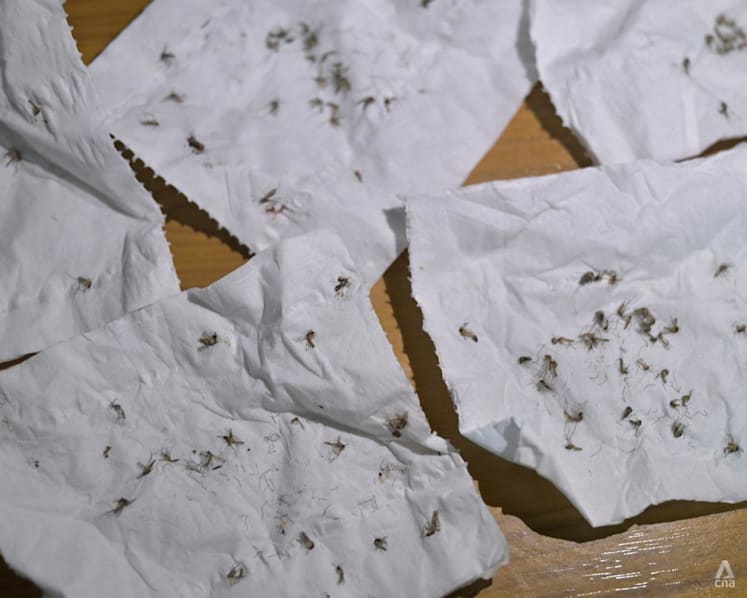
The dead mosquitoes caught by Sabrina Sow's family during the outbreak in April, with a single piece of tissue representing each night's catch. (Photo: CNA/Syamil Sapari)

This audio is generated by an AI tool.


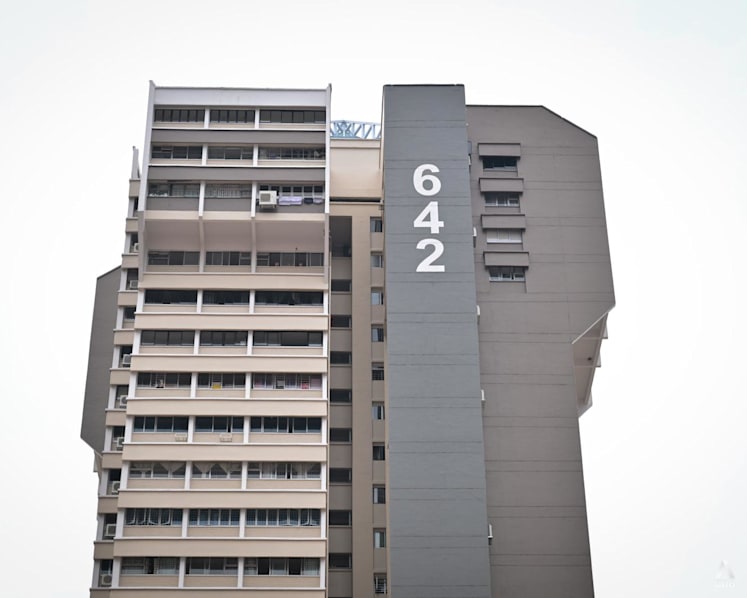
SINGAPORE: Residents in a 25-storey housing block in Jalan Besar said a surge in mosquitoes has left them struggling to sleep despite repeated efforts to keep the pests at bay since February.
Every night at Block 642 Rowell Road, residents staying on various floors have had to fend off swarms of insects entering their homes using mosquito repellents, electronic traps and protective netting, but to no avail.
Despite intervention from the Jalan Besar Town Council and the National Environment Agency (NEA), the mosquitoes keep coming back, they said.
On one of the higher floors at Block 642, Madam Sabrina Sow’s family of four has been battling what she calls an “onslaught of mosquitoes” almost every night for the past two months.





Each night, the family struggles to sleep and gets up periodically to swat mosquitoes with an electric bug zapper bought recently because of the infestation.
They have also installed mosquito nets on door grilles and windows. At night, the family keeps the windows shut, but this has created another problem with heat.

“We do not have an air-conditioner in the house, only standing fans to help circulate the warm, stale air, which is already not conducive to sleep. Worse still, we have to contend with the incessant mosquito attacks.
“It is impossible to have a good night’s sleep, having to wake up now and then just to swat mosquitoes, and then trying to fall back asleep in a hot, humid, enclosed environment,” said Mdm Sow, who works part-time at a restaurant.
On particularly bad nights, she said she can see numerous insects trying to break through the mosquito nets, which she described as a scene from the Walking Dead drama series.
SURGE OF CULEX MOSQUITOES ISLANDWIDE
In response to CNA queries, NEA said that inspectors detected seven mosquito breeding sites at Block 642 Rowell Road between Apr 2 and 9, with the majority in common areas.
"Immediate remedial actions were taken, including flushing drains, and enforcement actions will be taken against the premises owner and manager," NEA added without giving details on the enforcement actions.
There have been no reported dengue cases at the block or surrounding buildings this year as of Apr 24, NEA said.
The spokesperson said that the agency detected two species of mosquitoes breeding at Rowell Road, namely Aedes mosquitoes and Culex quinquefasciatus, with "more profuse breeding" of the latter.
There is also a spike in Culex quinquefasciatus mosquito breeding habitats detected islandwide since the start of this year due to the weather, NEA added.
There were more than 2,000 Culex quinquefasciatus mosquito breeding habitats across the island in the first 15 weeks of 2026, an increase of about 55 per cent from about 1,300 breeding habitats detected in the same period last year.
As a result, the agency has received more feedback on mosquito activity in the first three months of this year as compared to the same period last year, even as the number of Aedes aegypti mosquito breeding habitats continue to drop.
Differences between Aedes and Culex mosquitoes
Aedes mosquitoes are best known for transmitting diseases like dengue, Zika, and chikungunya. The two most common Aedes species in Singapore are Aedes aegypti and Aedes albopictus, which have black and white stripes on their bodies and legs.
Aedes mosquitoes typically breed in artificial or natural water containers such as flower pots, clogged roof gutters, and household water storage containers. They bite primarily during the day and also at night in well-lit areas.
Culex mosquitoes are more commonly associated with illnesses such as West Nile virus and Japanese encephalitis. Unlike Aedes mosquitoes, they do not spread dengue and are also not targeted by Project Wolbachia.
"Culex quinquefasciatus are primarily night biters, and their bites and buzzing near the ear can be a source of discomfort for residents. Their bites do not spread the dengue virus," NEA said.
The most common Culex species in Singapore’s urban setting is Culex quinquefasciatus, which is a golden-brown mosquito with a dark proboscis. Its typical breeding habitats include blocked drains.
NEA attributed the recent increase in Culex mosquito breeding habitats to weather conditions.
"Recent prolonged hot weather interspersed with sudden thundershowers has created conditions conducive for mosquito breeding, as warmer temperatures accelerate mosquito development cycles and there are more pools of stagnant water outdoors.
"These conditions favour the breeding of the Culex quinquefasciatus mosquito, which is most commonly found in outdoor breeding habitats," the spokesperson added.
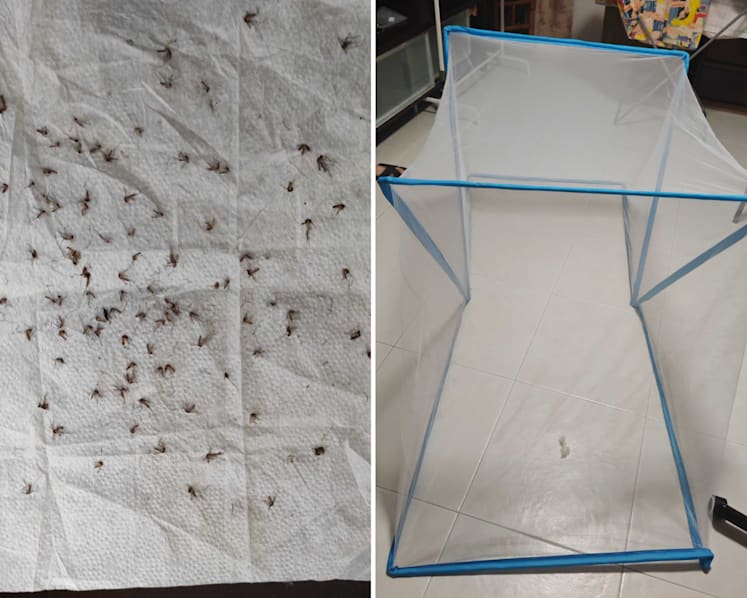
On Apr 20, Mdm Sow showed CNA the dead mosquitoes caught by her family, with a single piece of tissue representing each night's catch. On particularly bad nights, the family can kill up to 80 mosquitoes, some of which had drawn blood.
As the 68-year-old spoke to CNA from her home, her two sons stood nearby swatting the insects, killing at least three within the span of 10 minutes.
She said she was at her wits’ end over how to resolve the issue, having approached the NEA for help since February, and subsequently, her Member of Parliament Denise Phua, who oversees the Kampong Glam ward within Jalan Besar.
While the situation would improve briefly after interventions, the mosquitoes would soon return, said Mdm Sow, adding that this is the worst infestation she has experienced as a resident of nearly three decades.
MOSQUITO PROBLEM SPANS MULTIPLE FLOORS
Residents in other levels of the block described similar experiences.
One resident of a unit on a lower floor pointed out the bites on her three-year-old daughter's limbs, neck and face, sustained over successive nights of mosquito attacks.
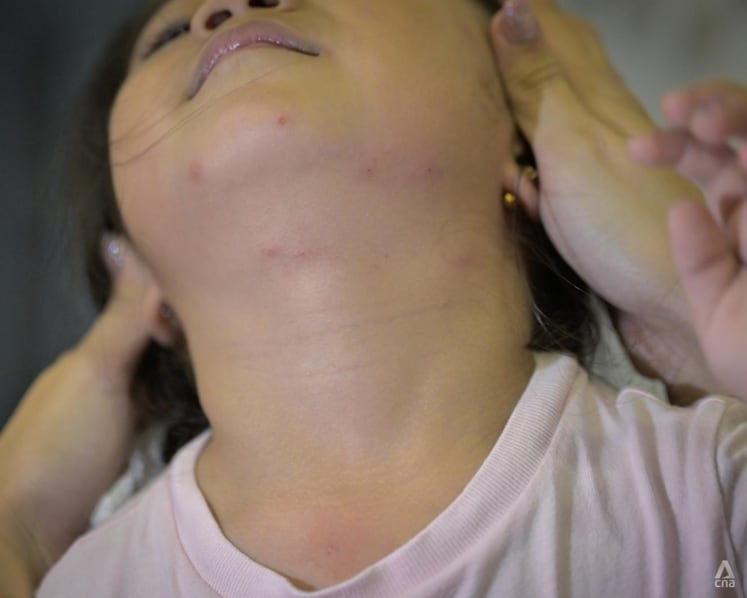
Ms Lim, who did not want to give her full name, said the problem began around the end of March.
"I tried to do something about it but I found out it was getting more and more," the 32-year-old housewife said, adding that the pests fly in from outside and multiply as night falls. Her husband lodged a report with NEA on Apr 3.
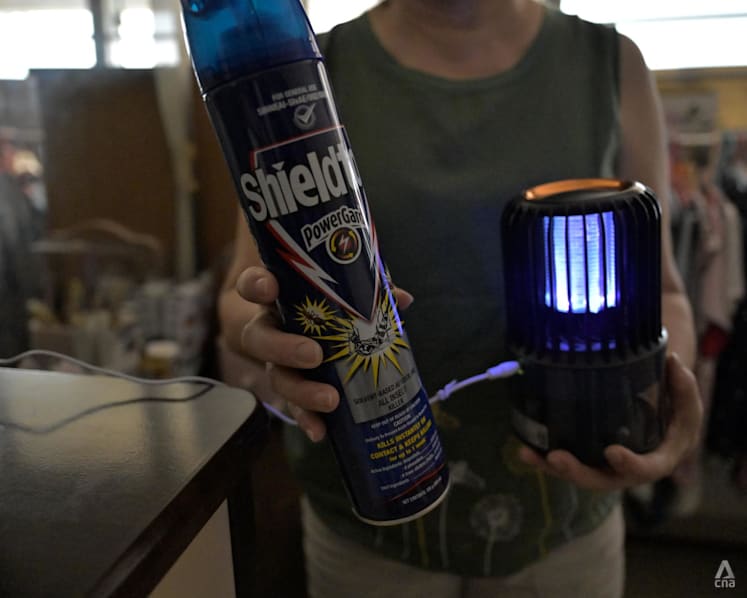
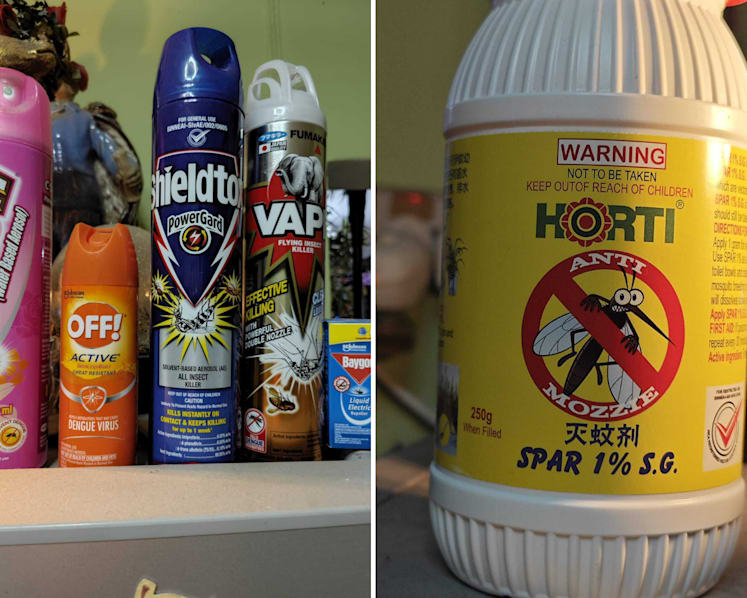
Mosquito sprays and electric traps have done little to resolve the problem.
One resident on a higher floor described buying a mosquito lamp which proved ineffective.
Mr Tan Hai Heng, 64, later bought two smaller lamps for more than S$100 (US$78) but said his son still kept waking up at night after being bitten.
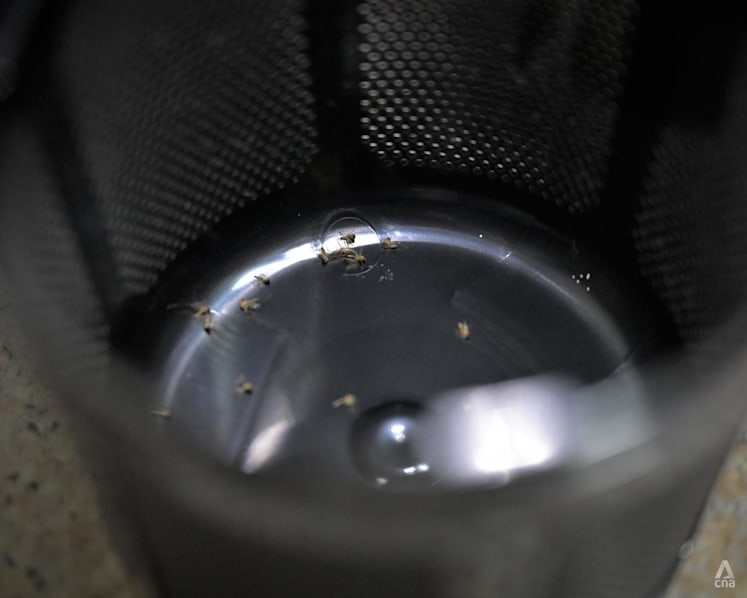
On the ground floor, a long-time tenant told CNA that mosquitoes infest the kitchenette and toilet area.
"Every day I am killing mosquitoes," said the tenant, who declined to be named.
One floor above, a commercial door supplier left out cans of insecticide in the corridor for residents to use.
The pests also swarm other common areas, residents said.
Ms Joanne Park, 37, described a swarm of mosquitoes descending on her when she took the lift earlier this month, and scores more attacking her on the ground floor.
"(We) cannot sleep, nowadays from April my husband and me night time is to catch the mosquito. When we sit on the sofa also, everyday we catch almost five to six," the housewife said.
Elsewhere in Jalan Besar, some residents are also reporting an increase in mosquitoes in recent weeks.
At Block 641, technician Shahul Hameed, 61, said his family has lost count of the number of mosquitoes in their home, adding that they often wake up feeling itchy.
"Even I use the chemical (spray) for the mosquitoes, still we have a problem. There's no difference," Mr Shahul said.
"During sleep time, we don't realise how many times, but we are able to see when we wake up, we are very itchy," he added.
Around Pek Kio, which is also within Jalan Besar, resident Benjamin Chiang, 45, said there would usually be mosquitoes when he goes out to his balcony. His family has stocked up on mosquito coils, repellents and zappers to combat the insects.

AUTHORITIES STEP UP MEASURES
Residents said banners and notices about the release of Project Wolbachia mosquitoes were put up around the estate and in lift lobbies from around Apr 21.
The project involves releasing male Wolbachia-carrying Aedes aegypti mosquitoes, which mate with dengue-carrying females to produce non-viable eggs, thereby reducing the Aedes mosquito population. Culex mosquitoes are not targeted by Project Wolbachia.
NEA said the project was rolled out to Little India — which covers Rowell Road — from Apr 21, with releases scheduled twice a week on Tuesdays and Fridays.
Little India is one of the seven new sites NEA has expanded the project to this year, with the expansion increasing coverage by about 135,000 households.
"Project Wolbachia has demonstrated effectiveness in reducing Aedes aegypti mosquito population by 80 to 90 per cent at release areas, and the risk of acquiring dengue has lowered by more than 70 per cent," the NEA spokesperson said.
"The release of non-biting Wolbachia-Aedes male mosquitoes may have resulted in increased mosquito sightings at Project Wolbachia sites during release days."
Some residents are hopeful that the Wolbachia initiative will help resolve the issue by reducing the Aedes mosquito population.
At Pek Kio, Mr Chiang, a tech founder, estimated that there was a 50 per cent increase in the number of mosquitoes in days following the Apr 21 release.
He said he was able to swat around 25 mosquitoes within minutes on the morning of Apr 25.
"Experiencing the project on the ground has been interesting. There is a noticeable increase in the mosquito population, but understanding the Wolbachia approach tempers the instinct to complain," he said.
Asked about the mosquitoes situation, Jalan Besar Town Council said that it received nine pieces of feedback from residents of Block 642 over the past few weeks reporting an increase in mosquito presence.
"Upon receiving the initial feedback, the town council immediately stepped up source reduction efforts, which remain the most effective method of mosquito control," a spokesperson said.
The town council's pest control team inspected common areas to clear stagnant water and intensified efforts to clear drains and remove debris, on top of increasing the use of larvicides and oil in areas where water cannot be permanently removed.
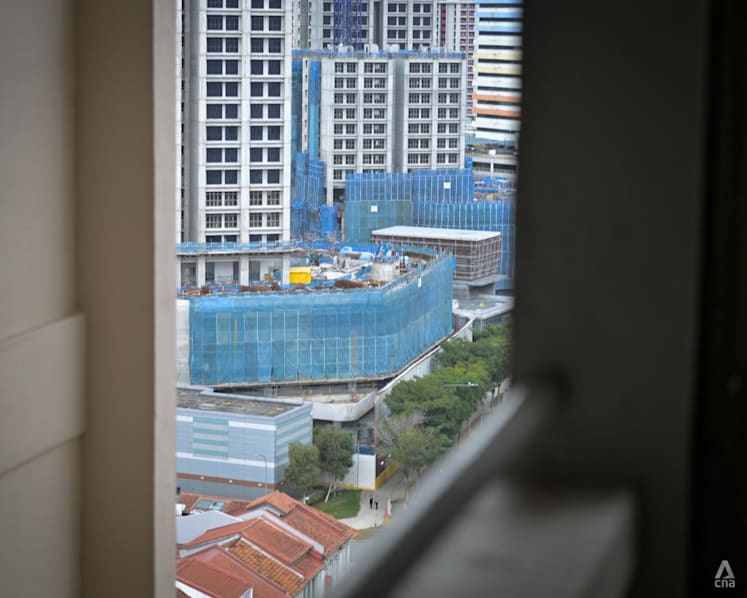
It has also sought NEA's assistance to inspect surrounding areas, including nearby drains and a nearby Build-to-Order construction site, to check for possible breeding sources.
Responding to CNA's queries, Ms Denise Phua said the issue of mosquitoes was of serious concern, especially during the rainy season.
The MP said she is unaware of any dengue cases resulting from the recent infestation, though any single dengue case that may arise is "one too many", she said.
Ms Phua also gave further detail of what NEA has done to combat the scourge, including destroying mosquito-breeding habitats in the Rowell Road vicinity during its inspection on Apr 2.
She said the agency had detected mosquito breeding in roadside drains along Rowell Road on Apr 9.
"The breeding sources have been removed and enforcement action will be taken. The affected drains have been flushed to prevent stagnant water accumulation," Ms Phua said.
Although the agencies took action quickly in early April, the MP still heard appeals from residents saying that the mosquitoes have returned.
Ms Phua said NEA is acting upon feedback she received on Apr 18 and that she will "closely monitor this".
As of Apr 29, residents said the situation has improved.
Mdm Sow told CNA that a blocked drain had been cleared, and while she still got bitten in the past few nights, the problem is now "much better".