







Mum overcomes despair to help other parents of children with cleft lip
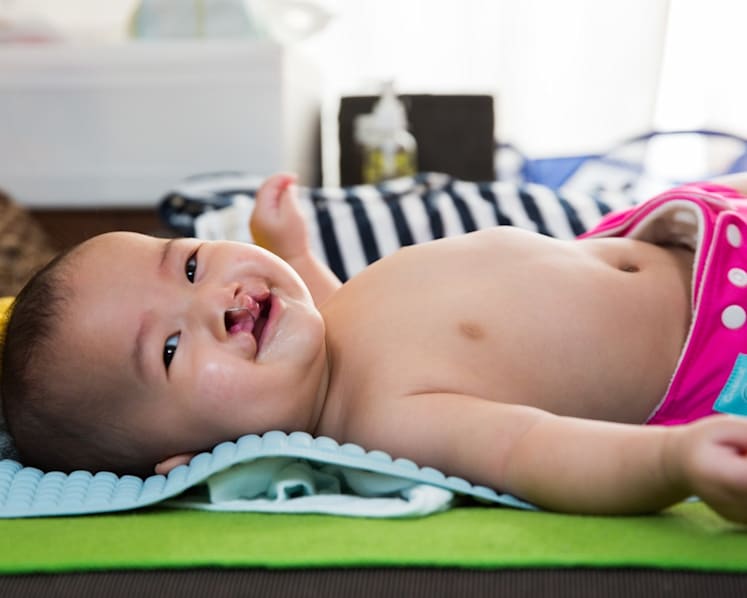
Zoe Chew when she was three months old, before she underwent surgery for a cleft lip.
SINGAPORE – Nearly four years ago, Mdm Rae Wong’s world “crashed” when she learned, during a routine pregnancy scan, that the miracle baby she had conceived after five years of marriage had a severe cleft condition.
Her previous experience with children who had untreated cleft lips or palates during overseas volunteer stints had left her with misconceptions about the birth defect. Online information fuelled her fears as she came across the most severe cases of cleft combined with serious birth defects.
“Irrational” thoughts of abortion crossed her mind. “I confined myself to my bedroom for days, refusing to see anyone. I was so depressed that I could not eat, sleep or go to work, which I love,” said Mdm Wong, 40, a primary school teacher.
“I wasn’t sure if we could financially cater to (the child)’s medical needs. There were other concerns as I had read that cleft babies could have other abnormalities such as cognitive issues. At that time, I had not been aware that with treatment, my child can have a good quality life,” said Mdm Wong.





After seeing a specialist at the Cleft and Craniofacial Centre (CCRC) at KK Women’s and Children’s Hospital (KKH), she calmed down considerably.
She learnt, to her relief, that some of the information she had read online was not scientifically proven and that most of her daughter Zoe’s medical bills could be covered by MediShield and Medisave.
“The medical team gave us a lot of support and advice, which eased our worries. Looking back, I was totally irrational. Maybe it was due to my pregnancy hormones. My husband was definitely a lot more worried about my depression than our baby’s cleft issue,” she said.
AFFECTS TWO IN 1,000 BABIES HERE
Zoe, now three, was born with bilateral cleft lip and palate – there were two gaps in her upper lip and one in the roof of her mouth.
A congenital condition that occurs when tissue in the mouth and/or lip area fails to fuse properly during the first trimester, it affects about two in 1,000 babies born in Singapore.
About one in 10 babies with cleft have a bilateral cleft lip and palate, said Dr Gale Lim, head and consultant at KKH’s department of plastic, reconstructive and aesthetic surgery.
The gap in the lip and/or palate can affect feeding, speech and the child’s self-image if left untreated.
KKH’s CCRC, the national centre for managing cleft and craniofacial conditions, manages about 100 new cases every year.
According to Dr June Tan, a senior consultant at KKH’s department of obstetrics and gynaecology, a specialised ultrasound scan routinely done at around 20 weeks of pregnancy can detect the majority of cleft lip cases.
An isolated cleft palate is more difficult to detect.
Some studies report that 3 to 30 per cent of children with cleft lip and cleft palate may have other anomalies such as cardiac, neurological and limb abnormalities. An isolated cleft deformity detected through an ultrasound does not necessarily mean the foetus has other anomalies, said Dr Lim.
While the cause is largely unknown, several factors such as genetics, environment and the use of certain drugs such as phenytoin (an anti-epileptic drug) and isotretinoin (used to treat severe acne) may be involved, said Dr Lim.
“Most of the evidence points to a multifactorial cause. It is unlikely that the parents did anything that would have directly caused the cleft lip and palate,” said Dr Lim.
This means there is no definitive method to prevent cleft conditions, although it may be helpful for would-be mothers to avoid drugs linked to these conditions, she added.
Both cleft lip and cleft palate are treatable. Treatment options at the CCRC include antenatal counselling and training, naso-alveolar moulding, cleft speech therapy, reconstructive surgery and scar therapy. Naso-alveolar moulding is a non-surgical method of reshaping the gums, lip and nostrils before surgery to minimise the severity of the cleft.
FELT HELPLESS, BUT NOT ANYMORE
The early months were particularly trying for Mdm Wong as her baby had to be fed with a special milk bottle and use a special orthodontic device daily that helped to reshape the gums, lip and nostrils before surgery.
Her heart broke every time she tended to Zoe’s wounds after major surgeries, performed at the age of four and nine months, and three years.
She also had to fight back tears whenever strangers made insensitive remarks in public.
“Some people asked if I had used the scissors during my pregnancy. I remember being very affected by such comments initially, but not anymore,” she said.
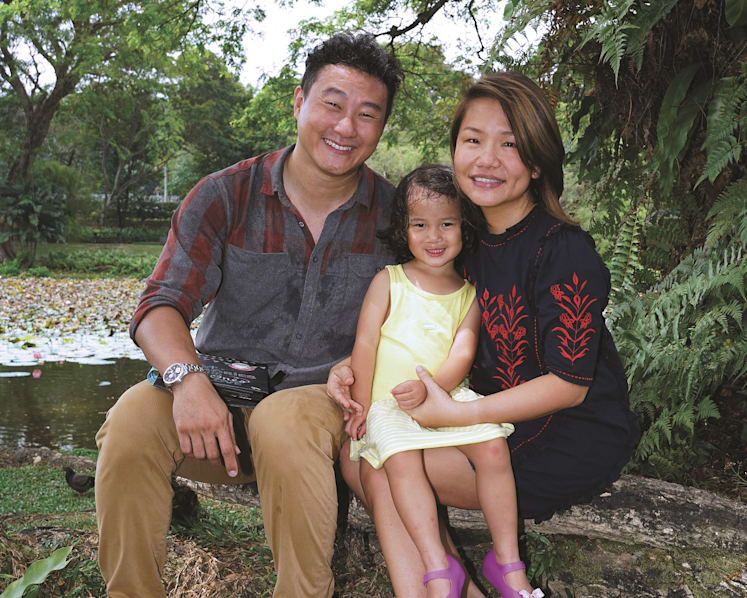
(Above) Mdm Rae Wong and her husband Adrian Chew with their daughter Zoe, who was born with a bilateral cleft lip and palate. Photo: SingHealth
One of her toughest challenges was finding a support group.
“I remember feeling helpless. I didn’t know where and who to seek help from. At the time, I did not know any parents who have cleft children,” said Mdm Wong.
In 2014, she set up a blog called Our Cleft Angels after reconnecting with an ex-schoolmate, who was born with a cleft palate and has a child with the same condition.
They also started the Singapore Cleft Parents Support Facebook group to share experiences and resources in the local context. From a five-person group, it now has about 200 members.
“I remember going ‘cleft-hunting’ at the (CCRC) with a huge pregnant tummy and, later, during Zoe’s check-ups, trying to befriend other mummies there. Now, it warms my heart to see everyone banding together to provide mutual support,” said Mdm Wong.
She is among the 39 people and five patient support groups to receive the Singapore Health Inspirational Patient and Caregiver Award 2018 next week. Started in 2010, the awards pay tribute to patients and caregivers who have shown extraordinary courage, resilience and strength in the face of healthcare challenges.
Zoe is today a fun-loving and chatty girl who loves to sing and dance. She will require more surgeries as she grows but her parents, who have compiled a photo journal, are certain she will be able to bounce back each time.
“Zoe understands she used to have a cleft lip and palate. I think she’s comfortable about it because we don’t hide the facts from her. My hope is for her to grow up with confidence so that she can pursue her dreams,” said Mdm Wong.
She and her husband, Mr Adrian Chew, also want to give hope to other families.
“Some mums initially thought that they would not be able to cope, but decided to keep their babies after they saw Zoe,” said Mdm Wong.




