







National Day Special 2016: Wanted — A national identity for Singapore
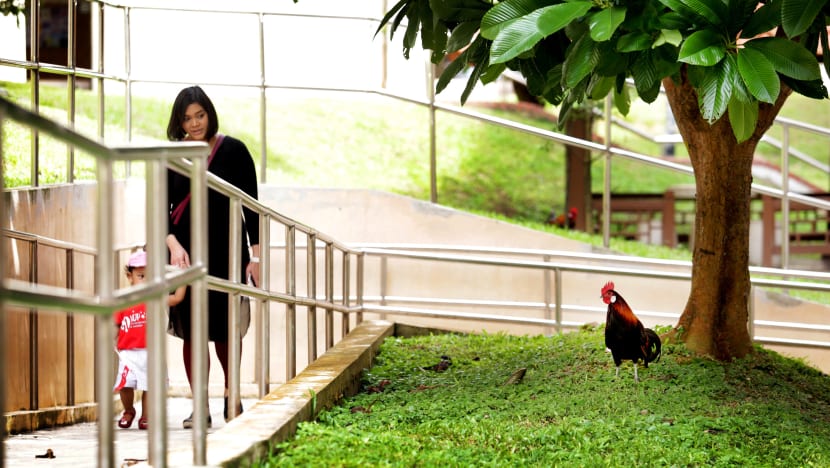
A Red Junglefowl, a wild ancestor of domestic chickens, at Sin Ming Avenue. Photo: Nuria Ling
SINGAPORE — In the Housing and Developing Board estate in which I live, a flock of “chickens” has laid claim to some of the green leafy corners of the neighbourhood, delighting children, alarming other local birds, and provoking a protective instinct among adults, who slow their cars to let the birds cross the road.
Shortly after they moved in, residents were told that they were not, in fact, chickens but Red Junglefowl, the wild ancestor of domestic chickens, and a protected species here. It was a pleasant situation of a community hosting an endangered member of the local eco-system.
Later, I found out that while the Red Junglefowl is native to the region, it had been locally extinct for some years. The birds we see now are likely to have descended from a few plucky creatures that somehow made it from Johor to Pulau Ubin, before moving onto mainland Singapore.
In a small, outward-looking country like Singapore, the line between external influences and what is “native” is often blurred, and origins are not always clear. Yet the push and pull between these two elements is also the undercurrent that runs through many of the things that gives Singapore some of its unique qualities, even if it occasionally gives rise to tensions.





Consider Singlish, a perennial lightning rod for controversy, celebrated and deemed worthy of study by some, deplored as an obstacle to the learning of standard English by others. It is a hybrid language that takes English and blends in words from Malay, Mandarin, Chinese dialects and Tamil. It is a language that, for all its flaws, reflects Singapore’s melting pot culture.
Or take Singapore’s place in the visual arts: In the 1960s, artists from Singapore found inspiration by going elsewhere — Bali, to be exact — and returned home to give birth to the Nanyang movement, Singapore’s enduring contribution to the art world.
This worldview lingers in the contemporary arts landscape. “Singapore artists, regardless of whether they are modern or contemporary, have constantly drawn from external and internal cultural sources in their works that relate back to Singapore as a site where cultural confluences take place, due to Singapore’s geographical position and its multiculturalism,” said Mr Seng Yu Jin, Senior Curator, National Gallery Singapore.
And Singapore’s take on governance and social policy — such as in public housing — has found admirers globally, drawn up as they were by distilling systems seen elsewhere, and adapted to suit Singapore’s circumstances of the day, to unique success.
In its 51st year after independence, Singapore remains in search of its national identity. The Golden Jubilee last year marked Singapore’s “arrival” as a nation. But it has also thrown up questions of where we go from here, who we are as a people, and what are the ties that bind.
The need to foster national identity is one considered important enough for the Ministry of Culture, Community and Youth to make it a priority. The aim is to use sports and arts, among other things, as a means of shaping national identity and pride, said Minister Grace Fu, when she outlined her vision for the ministry in an interview earlier this year.
Underpinning this was the concern that traditional fault lines between racial groups and religions have not gone away, while new ones over the income divide and values have emerged, as well as those between foreigners and locals.
Rallying around what is “native” and celebrating what is unique to Singapore is a logical starting point. The word “native” has its roots in the Latin word “nativus”, which stems from “nasci”, which means “to be born”.
These elements are not always immediately apparent in a country that has been shaped by an immigrant culture in which various ethnic groups have retained their cultural identity even as they embraced nationhood. Nonetheless, in this year’s National Day special, we have attempted to define some of what are unique to Singapore, their surprisingly history, and which way their future lies, as they continue to evolve.
For example, on the topic of food — one thing few Singaporeans do not have an opinion about — cookbook author Tan Su-Lyn, who has worked with noted local chefs like Justin Quek and Jereme Leung, felt that “growing confidence” in the Singapore identity is warming people to the idea of a “modern Singaporean or new Singaporean cuisine”. This, she felt, could contribute to a sense of nation, as Singapore could have a cuisine that can be “subjected to evolution”.
Singapore’s natural heritage has also emerged as a force for capturing the public imagination and sparking a sense of pride.
In an example of how the Republic’s “native children” can help to bring people together, look no further than the “celebrity” otter families, flourishing in our highly-urbanised landscape. When an otter pup called Toby from the Marina Bay pack was separated from its family during their relocation to a new home in May, a member of the public, an otter-watch group on social media, and a few public agencies chipped in to reunite the pup with its family.
This led to the formation of an otter working group that now has 15 members from national water agency PUB, National Parks Board, Wildlife Reserves Singapore, National University of Singapore and the Agri-Food & Veterinary Authority of Singapore.
Singapore businesses have also carved out a niche in the international market place, interestingly by riding on the reputation of competence and reliability built up by the Government, although this has sparked some debate over whether this “Singapore Brand” will be enough to help entrepreneurs ride on a wave of success into the future economy.
In binding a disparate citizenry together through areas of commonality, there is always the risk that it can also give rise to exclusivist thinking. This is being seen all over the world, where protectionist impulses are driving domestic politics — notably demonstrated by Brexit, where the British voted to leave the European Union.
The various “native” facets of Singapore showcased in this issue, in all their melting-pot glory, should be taken as a rejection of insularity. A willingness to look beyond our shores and maintain a spirit of openness has helped shape Singapore culture in indelible ways, and we should not lose sight of this, even while we take pride in what is indisputably ours.
After all, it would be a shame to turn the foreign “chickens” out of my neighbourhood, when they have settled in so nicely here.




