







A nation’s ‘where were you when ...’ moment
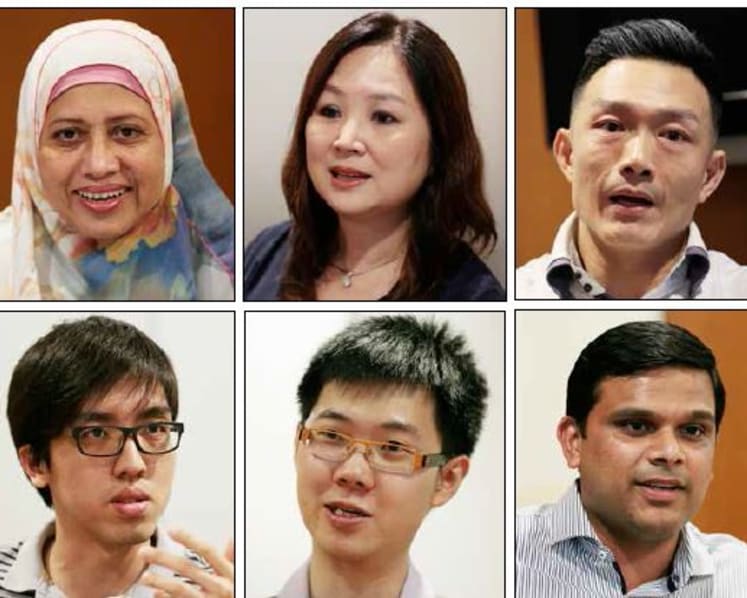
(Clockwise from top left): Sapiah Molla, Candice Chee, Vincent Chio, Vijay Kumar Pillai, Siang Xuan Yu and Kwan Jin Yao.


A year has elapsed since Mr Lee Kuan Yew’s death — so what are the enduring facets of the founding Prime Minister’s legacy? What impact has his death had on the average Singaporean? How have Mr Lee’s values and policies left an imprint on the man in the street — and do they have continuing relevance?
Kenneth Cheng (kennethcjw [at] mediacorp.com.sg) sat down with six Singaporeans from a cross-section of society to get their take on Mr Lee’s legacy and the mark he has left on their lives.
Participants
• Sapiah Molla, 64, retired property management professional





• Candice Chee, 50, management consultant
• Vincent Chio, 48, property agent
• Vijay Kumar Pillai, 30, business owner
• Siang Xuan Yu, 24, mechanical engineering undergraduate
• Kwan Jin Yao, 24, business undergraduate and socio-political blogger
Where were you when you heard the news of Mr Lee’s death and how did you feel? Did you expect Singaporeans to react to his passing in the way that they did?
Vijay: I remember I was in the office. At first, there was disbelief and I had asked myself: “Has it really happened?” (There was also) a feeling of sadness that someone so important in the development of Singapore had left us.
Sapiah: I was at home. I felt very sad because Mr Lee was someone who dedicated his whole life to Singapore and, to lose such a founding father, although it was not that unexpected ... as he had been sick for a while ... But we all hoped that he would recover, especially to celebrate SG50 with us.
I was sad that he couldn’t be around for that very important moment ... It was like losing someone dear, like a father figure. I didn’t expect such an overwhelming response (from fellow Singaporeans to Mr Lee’s death) because I thought maybe some young people may not be able to identify with him. Maybe people of my generation, who actually grew up under his leadership, could. It was (surprising) to see so many young people feel the same way.
Jin Yao: I was at home, and during that time, I was on an internship, so every morning when I woke up, I would scroll through my Twitter and Facebook feeds ... (and I got the news) mainly through social media ... For me, there was a sense of loss, but also a sense of closure — he was ill for some time already.
Xuan Yu: I received the news of Mr Lee’s passing through Facebook where netizens were (overcome) with emotion ... Instead of feeling sad, I was feeling a (sense of) loss. However, I believe that rather than mourning, we should celebrate his life and achievements ... That would be more meaningful.
Candice: Although his passing is inevitable, when I read the news it was very sad; there’s a sense of loss — loss of a great man, loss of a nation’s father.
I didn’t really expect an outpouring of the show of love for him because I would think that some of his policies may not be very popular with some Singaporeans, but nonetheless, I think when he passed away ... everybody gave him the credit where credit is due.
Vincent: I was at home in the morning. When I woke up, I got an SMS so I thought that ... people were just speculating ... until (I saw on) the news that it was true ... I am relieved to have closure, because he has done so much for Singapore and I think he deserved to rest in peace.
How has Mr Lee — and the changes and policies he had put in place — touched your life?
Vijay: A corruption-free government, safe business environment, strong rule of law, a system of meritocracy — these were all key aspects which helped bring Singapore to where it is today.
As a businessperson as well, we enjoy the benefits of having such a system because looking at the countries around us we know how gifted we are to have the system we have in place ... Also the environment ... (creates) a homely feel. I’ve lived overseas in many different countries, but there’s really no place like home. I always want to come back.
Sapiah: Mr Lee knew that we are made of different people and he really pursued multiracialism which I think, until today, is a very good policy ...
(He also pursued) meritocracy, education for all — boys and girls. Education is a social leveller. I came from a very humble family ... and we moved on from a low-income group to now, I am proud to say, that I can be considered middle-income.
I got my university education, I had a good job, and I can provide for my children to become professionals. It’s really fantastic that, within a generation, we can see the transformation of Singapore.
Xuan Yu: One of his most successful policies was the bilingual policy ... This proved to be beneficial in the long term, especially since he predicted that one day China would become an economic power ... Apart from mastering English, it enabled Singaporeans to master Mandarin. This allowed them to enter the China market, which has proved to be a very profitable sector.
Candice: Making English a first language in Singapore has contributed very much to exposing the people to the global market and global opportunities ...
Meritocracy is also a very good policy ... I came from a humble family — we used to live in a one-room flat and ... education was compulsory for everyone ... and an important factor for social mobility, and I am a case in point — through education, I was able to help my family to move on and financially to be in better shape.
Jin Yao: My parents both are non-graduates; they came from a Chinese-speaking background and schools, didn’t have a degree, had to work in the same company over 20, 30 years, and had to go for night classes.
But through it all, having the opportunities and then making sacrifices, we’ve been able to become a middle-income family, which I’ve benefited from (and which was made possible) through the different policies economically and in terms of the education system (which Mr Lee introduced).
What impact has Mr Lee’s passing had on you?
Candice: The immediate thoughts that came to my mind were a lot of anxieties because with his passing come uncertainties. What will become of Singapore? Where will we be heading? Is Singapore going to become vulnerable because a great man that is so protective of Singapore is gone?
It’s also about leadership, and what that is going to be like after him — will (the current leaders) continue what he has started or (will) the change of guard ... decide to implement their own ideas?
Sapiah: Mr Lee is great because he did not stay in power forever. He planned for (life after) his passing actually. We saw him nurture the future leadership and ensure that his legacy goes on ... He had a capable team to carry on ... For me, the impact is emotional ... but in terms of the impact to our country, I think he has put in place the right people, the right system, the right institutions, so these will go on. I am not unduly anxious.
Jin Yao: (Mr Lee’s passing) actually enriched the SG50 discussion that we had last year ... What we also saw was that there was a lot more discourse and challenges to the status quo ... We had questions about the past — there was this contest of different ideas and different perspectives.
People were saying, “Should we have a more balanced narrative of the Singapore Story?” There was also discussion about the future, where we go from here ... The impact that (his passing) left us was that it kind of compelled us to start thinking about the future ... (This has encouraged me) to continue to be active (and) engaged online ... and to translate the rhetoric into action.
What are some of Mr Lee’s values that continue to hold significance today?
Candice: His core values shouldn’t change — like integrity and ... a preserving spirit. He’s also a strong believer in Confucian values, which he cultivated and encouraged all of Singapore to embrace, such as filial piety; that’s why he built houses and gave (Singaporeans) priority to stay near their parents ...
Also, his strong sense of justice; nobody is above the law. That’s why sometimes when some magazines or journalists report things that are inaccurate, he will not hesitate to confront, to correct and make sure that the truth and the facts are out there.
Sapiah: His integrity, incorruptibility and not holding on to power, and (making) sure that his legacy lives on ... he’s very (admirable), I really feel that he’s really a great leader in a very small state. But he made us feel big.
Vijay: It’s also his attitude towards work. He was a very hard worker. Because I remember (sometime) in 2007, when they were building the whole Marina Bay, along with the casino and all ... I was back on my summer holidays, just hanging out with a few friends at OneFullerton and it was about 12.30am and I remember seeing Mr Lee coming and he was inspecting all the work that had been going on ... For someone in his 80s (at that time), he didn’t have to.
What are some of Mr Lee’s governing principles, values or policies that may have worked in the past but might not work today — and hence need to be re-examined?
Jin Yao: One thing that has always defined Singaporeans is confidence. We are very confident ... (and) very dogged in terms of how we approach issues. We are very confident in terms of where we are in the world, but I think sometimes this confidence has kind of morphed into a form of complacency as well, so in many instances we think that we are on a very stable footing, we are very good ... but we don’t quite realise that the rest of the world is catching up quite quickly ...
We need to realise that we are not always ahead of everyone ... Coincidentally, I think these are the lessons that Mr Lee had in the beginning when he was taking best practices from all around the world. And if we’re going to lose that hunger and if we rest on our laurels, that’s going to be a problem for the future.
Candice: Meritocracy is a double-edged sword. While it is good to (make) the good ... better, there will be a great divide ... Other than the meritocracy part of it, we also need to be people-centric ... We can have the hardware, but it is time to look at the heartware, the soft aspect of things. So we may be very developed (and) advanced, but are we gracious towards fellow Singaporeans, are we compassionate?
We cannot always be looking at strategy and at 30,000 feet what is good for the nation; the nation is made up of people. So, it’s about time we look at the people and then from there work outwards ...
Singapore need not always have to be No 1 in everything, because to reach that kind of status, there is always a trade-off, like the quality of life.
Singapore is always building, always striving, always working, but we never really take time to enjoy the fruits of our labour ... Perhaps we should take stock (as) to what extent we want to trade off things that are dear to us.
What are the enduring aspects of Mr Lee’s legacy — what will you remember him most for?
Vincent: His love for his wife. When (Mrs Lee) passed away, he really showed his love ... You could see the softer side of him, that he’s actually a very loving man. I thought ... he would just hold back and he would not show it, but he actually really expressed it.
Jin Yao: Some of the more pragmatic elements of his legacy would be the strong economic and political institutions. I think that’s the result of the intolerance for corruption ... that has allowed for prosperity economically (and) for geopolitical stability. When we are considering his legacy, there are always the not-so-pleasant parts of his legacy, (such as) have we developed economically at the expense of things like culture, heritage? Have we developed and promoted national stability and harmony at the expense of freedom of expression, for instance?
Candice: The first is perseverance. If you look at his life history, he’s very persevering. Whenever we had big obstacles ... how he overcame them and never gave up. This was something that saw me through as well during my younger days, and looking forward, I think Singapore’s going to face a lot more new challenges that we may not know of in this millennium, so the persevering spirit will be something that will remind me for a long time to take on those challenges as they come ... The other one that I felt (has been) very enduring is his integrity, even when it concerned survival, he didn’t trade off his integrity for that. So, as Singapore becomes more globalised, these are the values that I hope my children will continue to carry, because when we become more globalised, there are a lot of temptations out there. So, to what extent do you trade off your integrity for success?
Vijay: It’s his selflessness — his commitment to Singapore and Singaporeans. When he stepped down in 1990, he could have easily ruled for another 10, 15 years, but instead he did what’s right for the country in terms of grooming the next batch of leaders to carry the country forward. A lot of people at that height of power wouldn’t give it up.
Sapiah: Mr Lee has blessed Singapore globally as a Singapore brand. When we travel (and) we say we’re from Singapore, I can see the difference. The Singapore brand is such that it makes you really feel better. Mr Lee has done very well in terms of his statesmanship when he meets all the great leaders ... Because of his ability, it has brought Singapore up.
How would you like to see Singapore building on Mr Lee’s legacy?
Sapiah: It’s about how do we become, really, First World people, in the sense that we not only take care of just those groups of Singaporeans who can grow the economy. We must also think of those who also need help ... Through the years, some are more successful than the others. As we move along, the more successful become even more successful, and the children become even more successful. So this is where we have to look after the not-so-successful, in order to share the fruits of our labour ... In the past, because of the need, the necessity, we needed to grow the cake, but now we should also look into how we should distribute the cake so that we live by the values of a first-class economy.
Candice: On the governance side, I would like to see that they (the Government) engage the community and the people more ... Singaporeans need to have a sense of ownership towards Singapore. Around my circle of friends, a lot of them have migrated or are planning to migrate ... But instead of leaving the country and starting somewhere else, perhaps as a Singaporean I hope we could just stay on ... and maybe step forward in one way or another. It could be in vocalising our opinions at the right places or volunteering ourselves to help fellow Singaporeans.
Jin Yao: The present is very much about maximising opportunities. I think there are a lot of opportunities not just in Singapore, but in the region and around the world that a lot of us are not taking. We’re too comfortable, and it’s too convenient to stay in Singapore. I think sometimes some risk has to be taken ... For the future, the answer would be to embrace ambiguity. I think a lot of us are very afraid of the uncertain ... But to be able to embrace ambiguity, uncertainty and then taking these different opportunities are important in building on that legacy.




