







Nature of aspirations, borders to evolve as S’pore progresses to SG100
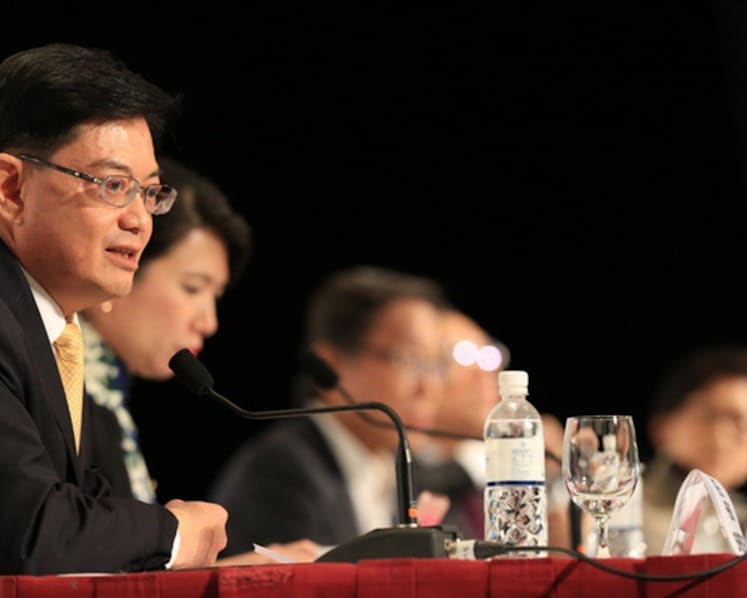
Mr Heng noted that successive leaders after Mr Lee Kuan Yew have had very different styles of leadership and that the trend has been towards increasing openness and participation. Photo: Koh Mui Fong


SINGAPORE — As Singapore enters its next phase of nationhood, the “facts of (its) existence” — a little red dot embedded in a volatile region, as Finance Minister Heng Swee Keat put it — will remain unchanged. However, the rising aspirations of Singaporeans and the nature of the country’s borders, among other things, will continue to evolve, Mr Heng said.
Speaking at the Institute of Policy Studies’ annual Singapore Perspectives conference yesterday, Mr Heng offered his take on the things that will change, and the challenges that will remain, for the Republic over the next five decades.
Speaking at a panel discussion on “The Future of ‘We’”, Mr Heng noted that for the Pioneer Generation, it was simply a matter of survival. Younger Singaporeans today have “a completely different set of hopes and dreams”. “They want to live a life of purpose … (and) make a difference. Their job is not just about earning an income; it’s more than that — it’s really about how do (they) make a difference ... and lead a meaningful life, and I think it is a good change,” he said.
Mr Heng also pointed out the changing nature of borders. He cited the example of terrorism, and how infocomm technology had redefined the notion of what it means to do business. As borders evolve, the effects would be keenly felt at home, he said.





Meanwhile, the sense of kinship among Singaporeans, while already “quite well-embedded”, is a constant work-in-progress. While Singaporeans’ sense of identity would shift as they adopt multiple affiliations, the sense that Singaporeans are bound by common ideals irrespective of “race, language or religion” must not be forgotten, Mr Heng stressed. Dialogue, he noted, would be vital so Singaporeans can build trust and understanding that would help bring about a “collective will to do things together”.
Mr Heng also responded to a question by panellist and Banyan Tree Holdings executive chairman Ho Kwon Ping on whether more could be done to give the public greater access to information. Mr Heng noted that, even as Finance Minister, he does not always get all the information he wants. “Either the information is not collected or some people say this (information) is not relevant to the Ministry of Finance,” he said.
Nonetheless, he said the Republic ought to explore ways in which it can be more data-driven, be it in policymaking or in how businesses operate. While the Government will be doing more in this regard, Mr Heng said it was “not just about Government but … also about what the private sector can do”.
Mr Heng was also asked by Ambassador-at-Large Bilahari Kausikan what he felt constitutes “good politics”, which President Tony Tan brought up last Friday — in his opening address for the 13th Parliament — as a vital element for effective policymaking.
Mr Heng said “good politics” meant a government that seeks to advance the long-term interests of Singapore. It also has to grasp the changes happening around the world and look for better ways to harness the energy and creativity of its people, he added.
Another panellist, Ambassador-at-Large Chan Heng Chee, asked Mr Heng whether there would be a re-examination of the Government’s political style such that “things will be less top-down”. In response, Mr Heng noted that successive leaders after founding Prime Minister Lee Kuan Yew have had very different styles of leadership.
“I would say that the trend has been towards increasing openness and participation,” he said. KENNETH CHENG




