







Man fell and injured brain after being shocked by neighbour's dog exiting lift, daughter sues but fails
The estate of the deceased, Mr Tan Kut Fai, claimed that the dog was aggressive and had lunged at Mr Tan and barked at him.
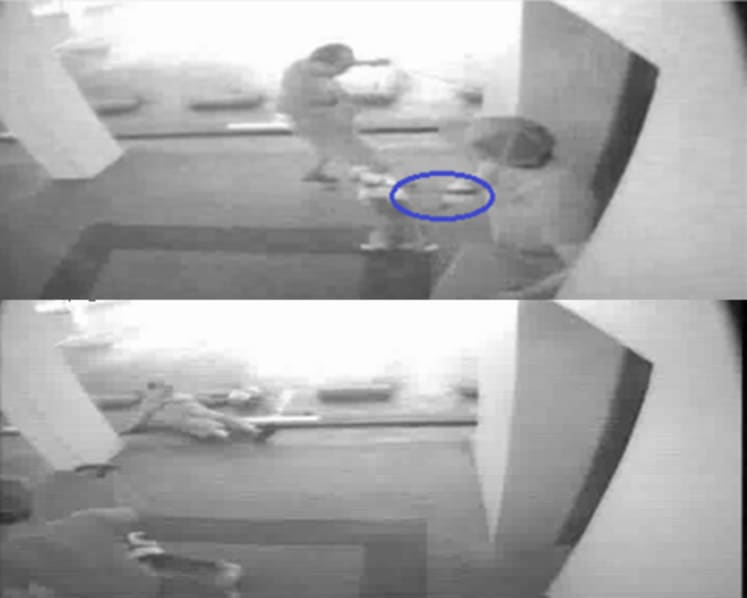
Footage from the condominium's closed-circuit television system depicts the incident. The blue circle, inherent in the photos, indicate that the leash was "short and taut". (Photos: Court documents)

This audio is generated by an AI tool.


SINGAPORE: A man fell and hit his head, suffering a traumatic brain injury, after seeing his neighbour's dog exit a lift at their condominium.
His daughter later sued the neighbour for negligence in how he had handled the dog, and for breach of the condo by-laws.
A court dismissed the suit, finding that the estate of the man, who died after the trial commenced, had failed to prove negligence or breaching of the condo's by-laws.
THE CASE
According to a judgment on Thursday (Dec 11), Mr Tan Kut Fai was waiting on Mar 21, 2019, at the car park lobby of a condominium, which was not named in court papers.
At the same time, the defendant, Mr Loong Kai Jun Matthew, took the lift with his corgi. The dog was secured on a leash measuring 4ft (1.22m), which was shortened by Mr Loong to 3ft, according to court documents.
When the lift door opened at the basement car park lobby, the corgi exited slightly ahead of Mr Loong.
Mr Tan was shocked by the corgi. He fell backwards and hit his head, as captured on footage recorded by the condo's closed-circuit television system.
District Judge Samuel Wee noted, however, that the quality of the footage was poor and was a "one frame per second" recording that did not capture the detailed sequence of motion.
Mr Tan's estate, of which his daughter was the administrator, alleged that the corgi had exited the lift suddenly, barking and lunging towards Mr Tan.
Mr Loong denied this, saying his dog had merely veered right when it walked out of the lift.
After Mr Tan fell, Mr Loong let go of his dog's leash and went to his aid, accompanying Mr Tan to the hospital.
He claimed that he did this as Mr Tan's wife was "annoyed" with her husband, as she had told him not to leave the house and he did not listen. Mr Loong also alleged that Mr Tan's wife did not wish to accompany Mr Tan to the hospital.
Mr Tan was subsequently diagnosed with a traumatic brain injury, which left him unable to function independently and reliant on assistance for mobility and self-care.
As he lacked the capacity to conduct legal proceedings relating to this incident, his daughter, Ms Tan Shuh Lin, was appointed as his deputy and proceedings commenced.
Mr Tan's estate asserted that Mr Loong was negligent as he did not take reasonable care in handling or controlling his corgi when exiting the lift.
The estate alleged that the corgi was an aggressive dog, that it was not kept on a short leash and that it lunged at Mr Tan and barked at him when the lift door opened.
The judge found that the evidence from a purported expert in dog behaviour called by Mr Tan's estate was "unhelpful" as he did not meet or observe the corgi and could not opine on its aggressiveness.
In contrast, Mr Loong gave evidence that his corgi was typically calm and well-behaved, with a vet testifying in support of this.
The corgi had also passed a temperament test, qualifying it to be a canine volunteer with Therapy Dogs Singapore, although it obtained this qualification after the incident.
Judge Wee found that the dog had not lunged at Mr Tan, noting evidence from Mr Loong which was "coherent and remained unshaken during cross-examination".
The video footage also did not show the corgi lunging at Mr Tan, the judge said.
The judge also found insufficient evidence demonstrating that the dog had barked at Mr Tan. There was no audio in the video footage.
Although a Singapore Civil Defence Force ambulance incident report recorded a passer-by's account that the lift door opened and a dog barked, the passer-by is unidentified.
The judge accepted Mr Loong's evidence that the dog did not bark.
In any event, Judge Wee said that it was natural for dogs to bark and that a bark is "generally harmless in the absence of any accompanying physical threat".
"I therefore have difficulty seeing how the defendant could have breached his duty to Mr Tan merely because the corgi barked (without lunging towards Mr Tan)," said the judge.
He found that Mr Loong had kept the dog on a short leash, based on video footage that showed the leash was short and taut. The judge added that had it been any shorter, it would have been "impracticable" for Mr Loong to move about, and the dog may have been strangled by the leash.
He found that the claim in negligence failed.
NO BREACH OF BY-LAWS
Mr Tan's estate also alleged that Mr Loong breached condo by-laws, including the small breed by-law, claiming that a corgi is not a small breed.
The condo's small breed by-law states that "only dogs of small breed as defined by the relevant authorities are allowed".
However, Judge Wee noted that there was no mention of what the relevant authorities are.
There is no universal guideline or classification in Singapore for "small dogs", said the judge.
An email from the National Parks Board (NParks) sent to Mr Tan's daughter in November 2020 stated that there was no classification of dog breed sizes in Singapore aside from the guidelines adopted by the Housing and Development Board (HDB).
NParks said in its email that HDB allows 62 small-sized dog breeds, typically up to shoulder height of 40cm and weight of 10kg, and Singapore Specials registered under Project ADORE to be kept in HDB premises.
Breeds not listed, regardless of size, are not allowed to be kept in HDB premises. Corgis tend to be classified as medium-sized dogs due to their weight and are not one of the 62 approved HDB breeds, said NParks.
Despite this, the judge said there was "simply no basis" for HDB's guidelines to be read into the small breed condo by-law.

The condo does not fall within the purview of HDB, the judge said. The HDB dog list also does not refer to the term "small breed" and cannot be considered a definition of small breeds under the condo by-law.
The judge dismissed the estate's claim as it had failed to prove Mr Loong was negligent in how he handled or controlled the corgi when exiting the lift, or that he was in breach of the condo's by-laws.
"I extend my sympathy to Mr Tan’s family, who have endured the daily consequences of the unfortunate Incident and the anguish of witnessing Mr Tan’s declining health and faculties," said the judge.
He asked parties to file submissions on costs within 14 days.




