







New blueprint for lawyers to embrace technology at work
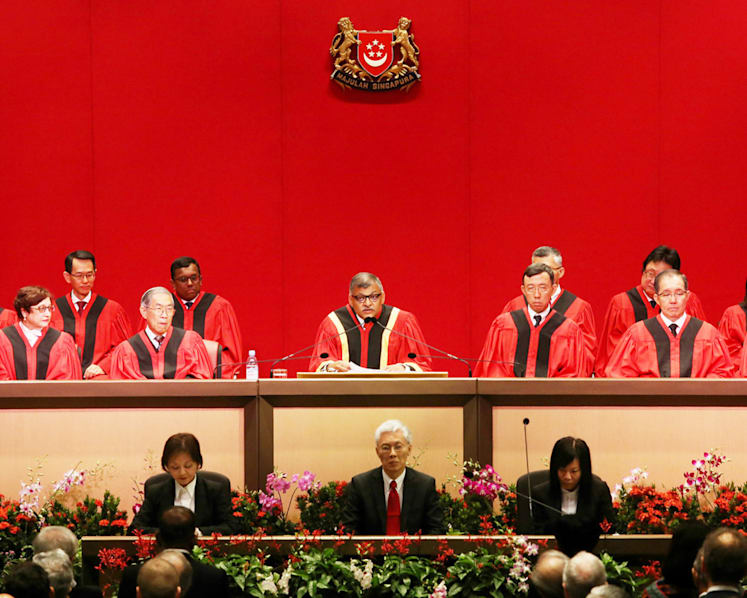
Encouraging law firms to adopt the latest tools to improve operations, Chief Justice Sundaresh Menon (centre) said at the opening of the legal year yesterday that technology will translate to better productivity, higher quality of legal services and cost savings for the firms and for society. Photo: Koh Mui Fong


SINGAPORE — In response to technological advances changing the way lawyers work, a new five-year blueprint will be rolled out to encourage law firms to adopt the latest tools and software to improve operations.
Chief Justice (CJ) Sundaresh Menon announced this at the opening of the legal year in the Supreme Court yesterday, pointing out that spaces traditionally occupied by lawyers would “diminish”. He talked about the appearance of online dispute resolution platforms that allow users to find settlement without going to the courts, saying that such platforms blend negotiation, mediation and arbitration with the use of artificial intelligence.
The Netherlands recently implemented such a platform for matrimonial matters, and he added that it is a matter of time before similar methods are applied in fields such as motor accident and workplace injury claims.
The new blueprint will recommend various infocomm technology initiatives that will be reviewed, revised and updated by a One Judiciary IT Steering Committee.





Addressing some 550 members of the legal fraternity, including lawyers and judges, CJ Menon said that it would be wrong to approach technology as though it is something to be “vanquished” even if it poses challenges. “Technology holds the promise of greater productivity and effectiveness. This should translate to higher quality legal services and cost savings for law firms and, ultimately, for society,” he said.
He also unveiled the Legal Technology Vision: A five-year road map by the Singapore Academy of Law (SAL) to start incubating a legal tech scene.
Under this initiative, small- and medium-sized law firms, in particular, will be encouraged to adopt technologies that cover billing systems and communication tools. There is also the possibility of law firms sharing virtual platforms and workspaces, and collaborating with professionals from other disciplines to create fresh technologies.
Criminal lawyer Amolat Singh, managing partner of Amolat & Partners, said that it may be tough for some small- and medium-sized law firms to change their mindsets and embrace technology. For example, there are firms which still prefer the physical storage of paperwork, instead of creating a database of such materials in soft copy.
In his speech yesterday, CJ Menon also announced a new accreditation scheme for building and construction law practitioners, to recognise lawyers who are experts in their field of specialisation.
The scheme will be extended to other areas such as shipping and arbitration at a later stage. The accreditation — one for younger lawyers (accredited specialist) and one for senior practitioners (senior accredited specialist) — will be for a fixed period and has to be renewed. Applicants must have at least five years of experience and would be assessed by a panel comprising judges and industry professionals, the SAL said. The first batch of accredited specialists will be announced next January.
The scheme is voluntary and those not accredited would continue to practise in their field, but the accreditation would “function as a mark of recognition” of the lawyer’s particular skills and expertise, CJ Menon said.
Mr Christopher Chuah, a partner and head of the infrastructure, construction and engineering practice at WongPartnership, said that there are similar accreditation schemes in the United States, Canada and Europe. Having one here would “incentivise” senior and younger legal practitioners to achieve excellence, he added.
Mr Mohan Pillay, partner and joint head of office at Pinsent Masons MPillay, said that given the significant infrastructure investment opportunities in the region, construction and building lawyers would stand to benefit from the scheme, when there are dispute cases arising from construction projects, for instance.




