







New GE campaign guidelines include constituency political broadcasts in lieu of physical rallies
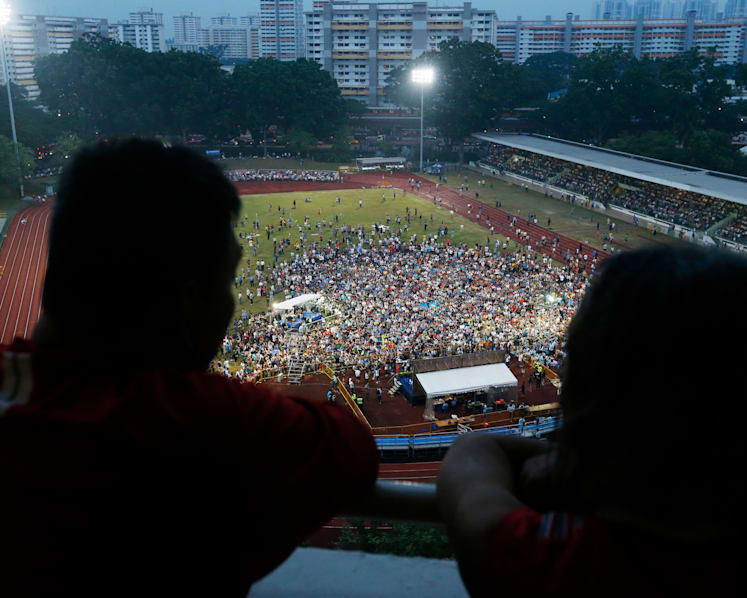
Political parties will be able to make “constituency political broadcasts” on national television, as physical rallies will not be allowed during the Covid-19 pandemic.


SINGAPORE — In the upcoming General Election (GE), political parties will be able to make “constituency political broadcasts” on national television, as physical rallies will not be allowed during the Covid-19 pandemic, the Elections Department (ELD) said on Thursday (June 18).
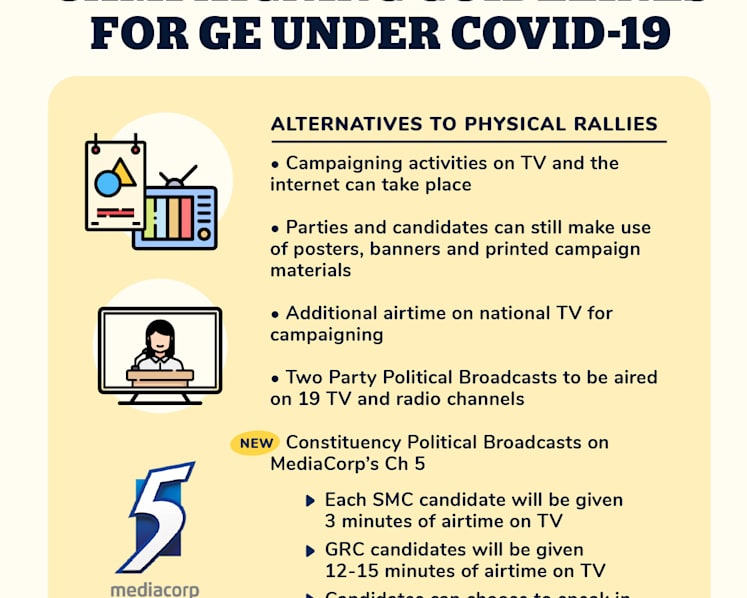
The new category of political broadcast, which will give political parties and candidates more airtime on national TV for their campaigning, will be aired on Mediacorp Channel 5.
This is in addition to the two Party Political Broadcasts each party can make, as per the 2015 GE.
Addressing the media in an online briefing on Thursday, ELD also unveiled other rules pertaining to how rallies, walkabouts and house visits should be conducted in the next GE, which must be held by April 2021.





These rules were designed according to the safe-distancing measures announced by the Government for Phase Two of Singapore’s exit from the circuit breaker, which begins on Friday.
In Phase Two, social and group activities can resume, but are limited to a maximum of five people per group.
The ELD, a department under the Prime Minister’s Office, said that these preliminary campaigning guidelines are subject to change.
“When new guidelines are issued for Phase 3, ELD will update the campaigning guidelines in accordance with the prevailing Ministry of Health guidelines as necessary,” it said.
It added: “The announcement of these guidelines has no relation to the timing of the General Election, which will be decided by the Prime Minister.”
NEW RULES ON CAMPAIGNING
Constituency political broadcasts:
Each contesting candidate will be given an average of three minutes of airtime on national TV and they can choose to speak in any of the four official languages: English, Malay, Mandarin and Tamil.
This means that a candidate running in a Single-Member Constituency (SMC) will be able to speak for three minutes during his or her allotted time slot.
Candidates contesting in a four-member Group Representation Constituency (GRC) will be given 12 minutes of national airtime, while candidates in a five-member GRC will be given 15 minutes.
But the parties can decide among themselves how to divide the allotted time given for that particular constituency among the candidates contesting there.
For example, instead of having four candidates contesting in a four-member GRC each speaking for three minutes, they can decide to have one candidate speak for all 12 minutes.
ELD said in a press statement that these broadcasts are a special, one-off arrangement for the next GE in view of the Covid-19 pandemic.
More details, such as the dates of these broadcasts as well as the schedule, will be made available after the Writ of Election is issued, said ELD.
Party political broadcasts:
Similar to the last GE, each party will be allowed to make two party political broadcasts, but they will be aired across 19 TV and radio channels, up from the 13 in 2015.
Online campaigning:
Besides the national broadcasts, candidates may carry out their campaigning online, such as holding live-streaming sessions through their social media platforms.
The Government will provide venues equipped with internet connectivity that candidates can apply and use for live-streaming at specific time slots throughout the day during the campaigning period.
These venues will be provided at a subsidised rate and should be used only for live-streaming sessions, and not for any other recordings.
Beyond the basic technical set-up, political parties and candidates are expected to make their own arrangements for filming and live-streaming at the venue.
The use of these venues are optional. Political parties may organise their live-stream sessions from their own preferred location.
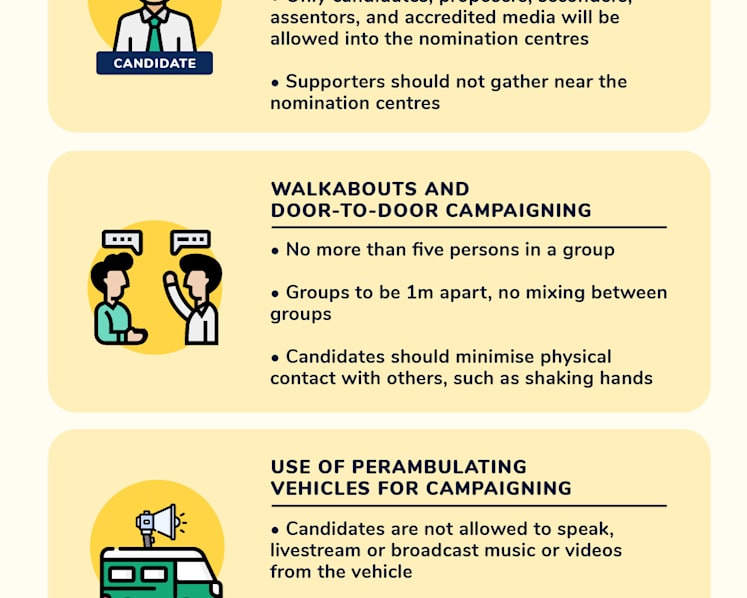
Political parties can use moving vehicles to broadcast recorded speeches, but they will not be allowed to speak, display a live-stream session, or broadcast music or videos from the vehicle.
In response to queries on why candidates would not be able to speak from the back of these vehicles, ELD said that it would amount to a de facto rally and crowds would gather around the vehicles.
“It would pose significant risk to public order, public health and road safety, if crowds congregate or follow the perambulating vehicle on the road,” said the spokesperson.
ELD has advised the public to watch the political broadcasts and live-streaming sessions from their own homes and not gather at the premises where these activities are taking place.
The use of films in campaigning:
Political parties looking to exhibit or distribute their films must submit them to the Infocomm Media Development Authority for classification, with the exception of those that are only going to be posted online. Still, these films need to comply with the Internet Code of Practice.
Party political films, which are considered films that may affect voting in Singapore, are not allowed.
Factual and objective films that do not dramatise or are inaccurate, such as the live recordings of lawful events, manifestos of the political party and candidates announcing their policy proposals, are not considered party political films.
But a recording of a live-stream session that has been edited to dramatise, sensationalise or mislead viewers on political matters would likely be considered a party political film, the ELD said.
Walkabouts and door-to-door outreach:
Political parties on their walkabouts and house visits cannot be in groups of more than five. There should also be no mixing between the groups, and each group needs to remain at least 1m apart from other groups.
Political parties need to take the necessary precautions when doing outreach, such as wearing masks, keeping all interactions transient and minimising physical contact.
Safe distancing ambassadors will continue to ensure that members of the public adhere to safe distancing measures, said ELD.
“If safe distancing ambassadors and enforcement officers come across instances of non-compliance with safe distancing measures by political parties or candidates, appropriate actions in accordance with the prevailing safe distancing and safe management guidelines will be taken.
“This is no different than for any member of the general public,” said a spokesperson.
Nomination Day proceedings:
Only candidates and their proposers, seconders, assentors and accredited journalists will be allowed into nomination centres on Nomination Day, the day when prospective candidates finalise their running in the election by filing their nomination papers.
They must adhere to the prevailing safe distancing measures at all times while in the nomination centres.
Unlike in previous GEs, supporters will not be allowed entry and ELD has advised that they should not gather or loiter around the nomination centres. They will be asked to leave by security officers deployed to the area.
Nomination Day proceedings will be broadcast live on national TV and on online channels for voters to watch.
After polls are closed:
Supporters will not be allowed to gather at assembly centres and wait for the election results after the polls are closed, as has been the case in previous GEs.
Thank-you vehicular processions, often held after Polling Day, will not be permitted as these activities tend to attract crowds.
“Unlike campaigning activities, such processions are not critical to the campaigning process,” said ELD.
What remains the same:
Candidates can continue to display campaign posters and banners as long as they abide by the Parliamentary Elections (Election Advertising) Regulations.
A cooling-off period, during which all campaigning must stop, will still have to be observed.
Political parties have to keep within the limit on election expenses set out in the Parliamentary Elections Act.




