







New SAF counter-terror command centre by end-2019 to tackle looming regional threat
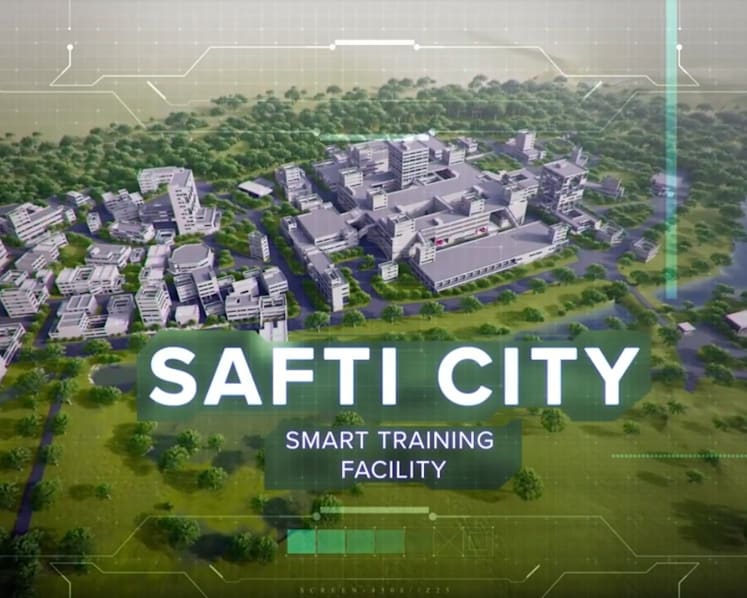
Safti City will have buildings such as a hotel, a hospital and office spaces, and boast technologies such as smart interactive targets and a data analytics system.


SINGAPORE — As the centre of gravity for terror attacks is set to shift from the Middle East to South-east Asia, the Singapore Armed Forces (SAF) is ratcheting up efforts to tackle the threat with a new nerve centre for counter-terrorism operations, Defence Minister Ng Eng Hen has said.
The SAF’s Special Operations Command Centre will be set up by year’s end to plan, monitor and manage counter-terrorism and contingency operations, Dr Ng announced last Friday (June 28) afternoon at an interview in Murai Camp.
Earlier that day, the minister broke ground on Safti City, a sprawling military-training facility to be built south-west of Lim Chu Kang, and construction on the project is expected to start soon.
The first stage of the 88ha training grounds — about the size of 120 football fields — will open gradually from 2023, allowing soldiers to train in mock-ups of a train station, bus interchange and other urban features.





COUNTER-TERROR COMMAND CENTRE
Speaking in a wide-ranging interview to mark SAF Day, which falls on Monday, Dr Ng said the centre of gravity for terror attacks would shift from Iraq and Syria to other places.
“We are one of the hotspots. Let me make this very clear: Returning fighters will be one, but also foreign fighters, because of the networks that are formed in Iraq and Syria, (which) will carry over to our theatre of operations,” added Dr Ng.
To meet the evolving threat, the new Special Operations Command Centre will be set up in Hendon Camp in Changi by the end of 2019. It will be responsible for planning, tracking and managing counter-terrorism and contingency operations.
It will have enhanced C4I (command, control, communications, computers and intelligence) systems to “support operational planning, co-ordination, and to provide situational awareness for back-end sense-making”, the Ministry of Defence (Mindef) said in a statement.
“The SAF’s next-generation counter-terrorism operations will leverage technology such as robotics, unmanned systems, artificial intelligence and data analytics.
“This will enable the counter-terrorism operations to be faster, leaner and more lethal,” the ministry added.
The new centre will work with other agencies to manage incidents, Mindef said.
SAFTI CITY
Meanwhile, the S$400 million Safti City, announced in 2017, will take shape in two stages.
Its first phase — spanning 17ha — will mirror highly urbanised spaces, comprising more than 70 buildings and multiple road networks.
Here are some of its noteworthy features:
A transport hub comprising a bus interchange and an MRT station. The SAF is working with the Land Transport Authority to station a decommissioned MRT train there.
Road networks and buildings can be configured to training needs via built-in “swing panels”, allowing soldiers to move through different building layouts and streetscapes.
Technologies include smart interactive targets that pop up after proximity sensors detect troop movement. These targets can shoot back at soldiers using lasers and retreat. Battlefield effects, such as smoke and blast simulators, will also raise training realism.
Battlefield instruments and video cameras will track troops’ actions in real time. A data-analytics system will process training performance, and feed information on individual and team performance to soldiers.
Other buildings include three 12-storey blocks, a hotel, a museum, a hospital, shophouses and office spaces.
Safti City will eventually house more than 200 buildings and extensive road networks, and will be constructed over a decade, Dr Ng had said in 2017.
The SAF could not give details of when the first stage of Safti City would be fully opened, nor could it provide a schedule for the construction of the second stage, which is still being planned.
The second stage will be devoted to training servicemen in island-defence competencies, such as coastal-defence operations. This phase will comprise elements such as a petrochemical complex, warehouses and container parks.
On Friday, Dr Ng said Safti City, along with a military training base several times Singapore’s size that is being built in Queensland, Australia, would provide the SAF with the “best-in-class training facilities in the world”.
“It will prepare (soldiers) to conduct a wide range of operations that include homeland security, counter-terrorism and disaster-relief operations, as well as conventional operations in all types of terrain,” he added.
Asked how Singapore balances land allocation for defence use and national development, Dr Ng said the armed forces did not need more allocation.
“The SAF thinks for the entire nation. We know that defence is important, but we also lean forward when our national resources are talked about.”
US-CHINA RIVALRY
Turning to external challenges, Dr Ng repeated Prime Minister Lee Hsien Loong’s comments that Singapore does “not want to choose or be asked to choose” between the US and China.
The two powers are entangled in a trade and technological dispute that could have wide-ranging effects on economies around the world.
The US and Singapore, Dr Ng said, are looking to renew a 1990 memorandum of understanding that has allowed American aircraft and ships to use Singapore's air and naval bases.
Singapore also has strong defence ties with China and wants to strengthen military engagements with the Chinese People’s Liberation Army. The two sides are looking to enhance a bilateral defence agreement later this year, Dr Ng said.
He had said in May that both sides still had to iron out some details relating to the Agreement on Defence Exchanges and Security Co-operation signed in 2008. These included a proposal to increase military exercises and step up exchanges between think-tanks of both countries, especially those related to security matters.
CLARIFICATION: An earlier version of this story, as well as previous reports on Safti City, said that the training facility will be as big as Bishan town. Mindef has clarified that this is incorrect; Safti City is smaller than Bishan. A previous version of this report also said two decommissioned MRT trains would be stationed at Safti City. Mindef has clarified that only one such train will be parked there.




