







New Triage System offers ‘targeted intervention for at-risk youths’
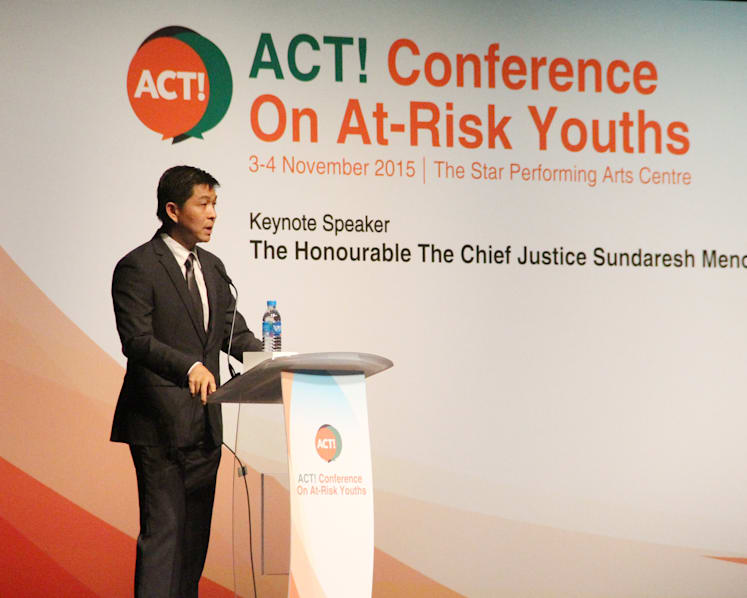
Minister for Social and Family Development Tan Chuan Jin speaking at the ACT! Conference On At-Risk Youths. Photo: TODAY
SINGAPORE — From next year, a more thorough assessment will be conducted on youths arrested by the police for minor offences, to bolster efforts aimed at keeping them out of court while referring the offenders to agencies that can help them.
Under the new Triage System, 12 officers will be spread out across the six police land division headquarters to assess youths up to 19 years of age who are arrested and investigated for minor offences, such as shoplifting and brawling in public places.
With the information gathered from the young offender and his parents, the Triage Officer will provide advice and introduce the youth to relevant programmes or agencies.
The Triage System was among three initiatives announced at the ACT! Conference on At-Risk Youths — which is supported by the National Committee on Youth Guidance and Rehabilitation (NYGR) — today (Nov 4). The other two were a longitudinal study on at-risk youths, and a preventive drug education toolkit.





Social worker Gina Chan, from Youth Services, Care Corner Singapore, welcomed the Triage System as it offers “a targeted intervention for at-risk youths”.
“A lot of times, they are exploring different things to do, and some could just be misguided ... youths just need that extra guidance and be steered away from the court system so they don’t live with a mark (if charged),” she said.
Ms Irene Cheng, assistant director of Probation Services, said the new system will also shorten the investigation process.
“Police investigations can sometimes stretch depending on the severity of the offence. It could be three months to six months. If the triage is done immediately at the police station, it could be immediate. So, the following day, you can actually refer them to supportive services,” she said.
A six-month pilot of the Triage System carried out from September 2012 to March 2013 at the Ang Mo Kio and Bedok police divisions showed positive results, with 95.7 per cent of 452 cases being diverted from the criminal justice system.
One successful case involved Ben (not his real name), who was caught stealing when he was 11. A Triage officer who interviewed Ben and his mother found that the boy was often left alone at home.
The officer was able to provide Ben’s mother with advice on the importance of proper after-school care, and also linked them with a family service centre.
Referring to the Triage System in his opening remarks at the conference, Senior Minister of State (Home Affairs and National Development) Desmond Lee said: “Having that texture, having that detail on the socio-economic situation of young people who run afoul of the law is extremely valuable in allowing us to decide whether (they should) go to court, juvenile court, or diversionary programmes such as GP (Guidance Programme).”
Another initiative to help at-risk youths is a study involving about 3,300 youth offenders and their primary caregivers over a period of 10 years.
Launched by the NYGR, the longitudinal study, which will start early next year, will look at why, and how, youths start to commit offences, and abuse drugs in Singapore.
The study hopes to identify danger signs and high-risk circumstances so that these could be addressed quickly and prevent at-risk youths from offending.
During the conference, which was held at the Star Performing Arts Centre, the Central Narcotics Bureau also launched a Preventive Drug Education toolkit for educators, to help them support and keep youths away from drugs.
The toolkit includes information on commonly used drugs and suggested lesson plans.
Mr Amrin Amin, Parliamentary Secretary for Home Affairs, said as “major touchpoints with our youths”, educators and youth counsellors “play a significant role” in advancing the anti-drug cause.




