







No easy way out, but HK protesters’ demands serve only to humiliate the government: PM Lee
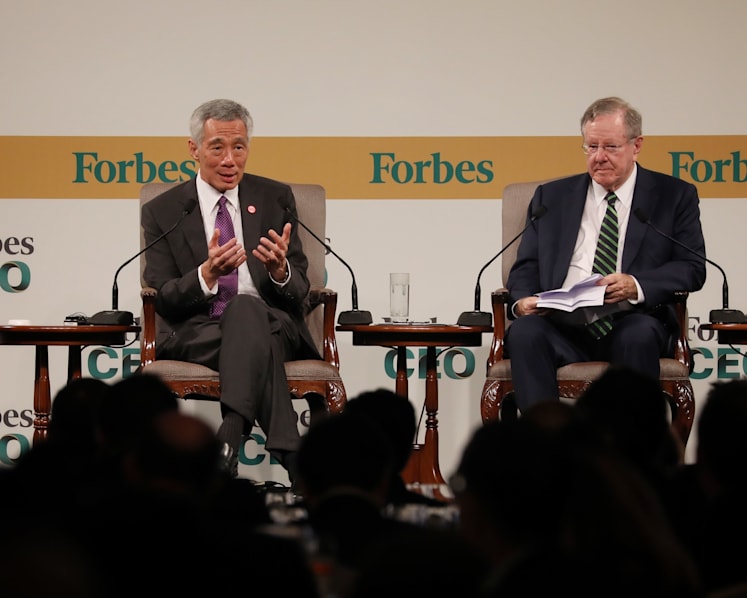
Prime Minister Lee Hsien Loong (left) and Mr Steve Forbes at the Forbes Global CEO Conference held at the Shangri-La Hotel in Singapore on Oct 16, 2019.


SINGAPORE — Hong Kong needs to move beyond the “very unfortunate state” it is in and start taking steps to resolve its problems in areas such as the implementation of the “One Country, Two Systems” principle as well as its social and economic issues, Prime Minister Lee Hsien Loong said.
Speaking at this year’s Forbes Global CEO Conference on Wednesday (Oct 16), Mr Lee said that the five demands made by the Hong Kong protesters serve to “humiliate and bring down” Chief Executive’s Carrie Lam’s government and not solve Hong Kong’s problems.
Hong Kong has been besieged by unrest for the past four months, which started with protests against a now-shelved extradition bill, but has evolved to louder calls for freedom and democracy.
TACKLING HONG KONG’S PROBLEMS





In response to a question on the turmoil in Hong Kong asked by Mr Steve Forbes, chairman and editor-in-chief of Forbes Media, Mr Lee said that he does not see an easy way forward because the protesters are locking horns with the government but are not providing any tangible solution.
“The demonstrators, they say there are five major demands, and not one can be compromised. But those are not demands which are meant to be a programme to solve Hong Kong's problems. Those are demands which are intended to humiliate and bring down the government,” he said.
Mr Lee then asked what would happen, say, after their demands are met?
“Well, I think if you press the question, some of (the protesters) would, if they were candid, say, ‘Well, I don't know… but anyway, I am not happy (now, so) I want this to happen,’” he continued.
Instead of languishing in this state, Mr Lee said that the city needs to start tackling the problems which Hongkongers are unhappy about.
He listed three areas: The “One Country, Two Systems” principle, universal suffrage and the social and economic issues facing Hongkongers, especially its youth.
As there are some Hongkongers who are not happy with the way the “One Country, Two Systems” principle is being implemented, people on both sides of the political spectrum need to come to a compromise, he suggested.
“As one Hongkonger put it very neatly, from China's point of view, they must not only think of one country, but remember that this is two systems. And from Hong Kong's point of view, they must not only think of two systems, but remember that this is one country’.”
The “One Country, Two Systems” principle is enshrined in Hong Kong’s Basic Law, which is effectively the city’s constitution since its handover from Britain to China in 1997.
Mr Lee also said that universal suffrage, as envisioned under the Basic Law, is an area that needs to be addressed. The right to elect their own leaders was a demand protesters pushed for back in 2014 during the “umbrella movement”.
“But there's no simple solution. They say, ‘We want universal suffrage’, but Hong Kong is not a country. It's a special administrative region (SAR). And it has to live and work within that special administrative region framework,” he added.
However, Mr Lee believed that universal suffrage can be made to work in Hong Kong even though it is not a country.
“If it's not made to work, then I think it's very difficult to imagine that ‘One Country, Two Systems’ can continue for another 28 years until 2047,” he added, referring to the year the principle expires.
As for the social problems that Hong Kong is facing, especially housing, Mr Lee said that there are solutions available, though he did not elaborate on the specifics, except to add that they are radical and requires “political courage”. This is because the changes made by the government will come with significant social and economic consequences.
“And so far, the SAR government has gone for conservative approaches, and the problem has not really significantly improved,” he said.
However, before all these issues can be tackled head-on, Mr Lee said that it was necessary for “temperatures to come down” so that Hongkongers can work together.
During the conference, Mr Lee also touched on the tensions between the United States and China, the two major economic powers which has been engaged in a protracted trade war for more than a year.
He reiterated his position that the long-term effects of a trade war would not be beneficial to the global economy, but stated that it is a problem that cannot be solved easily given the increasingly hardline stance citizens of both countries are taking against each other.
DOMESTIC CONCERNS
Besides international issues, Mr Lee touched on several domestic issues in Singapore such as housing, immigration and political succession.
Mr Lee, who is now 67 years old, has stated publicly several times that he does not wish to continue his premiership beyond 70 and hopes that he can hand over the reins to his successor “sometime soon” after the next general election.
When Mr Forbes asked whether he was going to mention when the election was going to be held, Mr Lee answered: “Well, it can be anytime within the next 18 months”.
The next election has to be held by April 2021, and Deputy Prime Minister Heng Swee Keat is widely tipped to be Mr Lee’s successor should the ruling People’s Action Party be re-elected to lead the country.
Mr Lee said that an “orderly” political succession is important so that Singapore would have a competent and experienced leadership team.
“Time and tide waits for no man. You may think that you are as good as you are, as you have been, but every year you are one year older, (it’s) one year less in which you have time to prepare somebody to take over from you,” he said.
In response to a question from the audience on how Singapore manages immigration, which is a sensitive topic for many countries, Mr Lee said that Singaporeans need to have enough of their own children to form the next generation.
Ideally, he would like Singaporeans to “produce” enough to form two-thirds of the population, and the rest would be “topped up” by bringing in people from overseas.
“If all of the people in the next generation are not our own, then where do we come from and what’s the point of this?”
Mr Lee also said that Singapore has managed to avoid being in a situation where populism has taken hold, as it has in other countries, because the Government focuses on fulfilling the “basic needs” of the people, such as healthcare, housing and education.
Explaining the public housing system in Singapore to the audience, some of whom are overseas visitors, Mr Lee said that one core component is ownership, because it gives Singaporeans a sense of permanence and something to defend.
“It gives them... also a stake, so that when they grow old, there's value in the house. And they can use that value to help support themselves in their old age. It's a form of social security,” he said.




