







North Korea minister hits out at US actions since historic summit
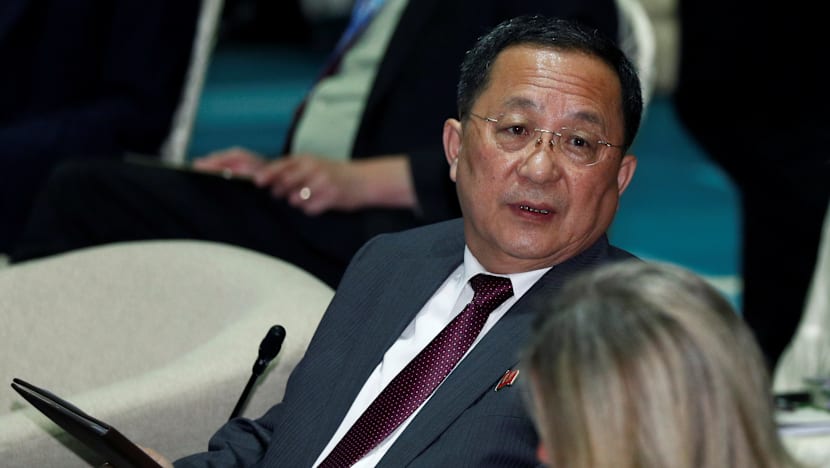
North Korea's Foreign Minister Ri Yong-ho attends the Asean Regional Forum Retreat Session in Singapore on August 4, 2018.


SINGAPORE — North Korean Foreign Affairs Minister Ri Yong-ho on Saturday (Aug 4) hit out at the United States for its continued sanctions and putting pressure on other countries not to send delegates to his country's 70th founding anniversary next month.
In a five-page statement issued at the 25th Association of South-east Asian Nations (Asean) Regional Forum, Mr Ri also said the North Korea-US joint statement – which was signed by US President Donald Trump and North Korean leader Kim Jong-un during the historic summit in Singapore in June – should not “fall prey” to America’s internal politics.
While he did not elaborate, he said that it was "alarming" for the US to return to its old ways, "far from" the intention of its leader — in reference to Mr Trump.
Since the summit, North Korea has initiated “goodwill measures” such as the moratorium on the nuclear and rocket launch tests, and the dismantling of nuclear test ground, among other things, he said.
“However, the United States, instead of responding to these measures, is raising its voice louder for maintaining the sanctions against the Democratic People's Republic of Korea and showing the attitude to retreat even from declaring the end of war, a very basic and primary step for providing peace on the Korean Peninsula,” added Mr Ri.
Mr Ri's remarks came after US Secretary of State Mike Pompeo reiterated at the meetings with regional leaders in Singapore the importance of maintaining diplomatic and economic pressure to achieve the denuclearisation of North Korea, as agreed by Mr Kim.
On Friday, the US also imposed sanctions on a Russian bank which it said had facilitated a transaction with a person blacklisted by Washington for involvement with North Korea's nuclear weapons program.
On the joint statement signed by US President Donald Trump and Mr Kim, Mr Ri said “confidence building” is key to fully implementing the agreement.
The statement had called for both countries to build new relations, and join efforts to build a lasting and stable peace regime on the Korean Peninsula. It also called for North Korea to work towards complete denuclearisation of the Korean Peninsula, and for both countries to recover the remains of prisoners of war or those missing in action.
“(But) impatience is not helpful at all for building confidence… advancing unilateral demands will further deepen mistrust, instead of reviving trust,” said Mr Ri.
He added: “We thought of doing something in response, if the US would come with constructive ideas. However, as long as the US does not show in practice its strong will to remove our concerns, there will be no case whereby we will move forward first unilaterally."
Mr Ri said the “fastest and most reliable shortcut to denuclearisation of the Korean Peninsula is to build confidence in good faith through taking one-by-one and phase-by-phase simultaneous actions”.
Calling on the rest of the world to recognise North Korea's efforts to meet halfway, he added: "The international community should respond to our goodwill measures already taken for denuclearisation with its constructive steps that would encourage and promote peace and economic development of the Korean Peninsula."




